Shi Longxiang, Li Shijian, Yang Xiaoran, Qi Jiaheng, Pan Gang, Zhou Binbin
College of Computer Science and Technology, Zhejiang University, Hangzhou 310027, China.
Biomed Res Int. 2017;2017:2858423. doi: 10.1155/2017/2858423. Epub 2017 Feb 12.
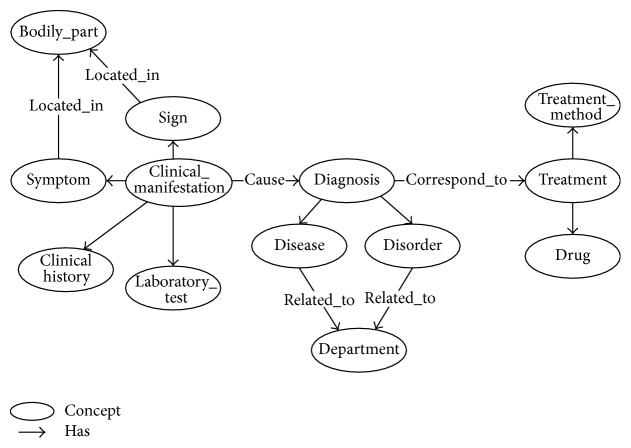
With the explosion of healthcare information, there has been a tremendous amount of heterogeneous textual medical knowledge (TMK), which plays an essential role in healthcare information systems. Existing works for integrating and utilizing the TMK mainly focus on straightforward connections establishment and pay less attention to make computers interpret and retrieve knowledge correctly and quickly. In this paper, we explore a novel model to organize and integrate the TMK into conceptual graphs. We then employ a framework to automatically retrieve knowledge in knowledge graphs with a high precision. In order to perform reasonable inference on knowledge graphs, we propose a contextual inference pruning algorithm to achieve efficient chain inference. Our algorithm achieves a better inference result with precision and recall of 92% and 96%, respectively, which can avoid most of the meaningless inferences. In addition, we implement two prototypes and provide services, and the results show our approach is practical and effective.
随着医疗保健信息的爆炸式增长,出现了大量异构文本医学知识(TMK),其在医疗保健信息系统中发挥着至关重要的作用。现有的整合和利用TMK的工作主要集中在建立直接的联系,而较少关注使计算机正确、快速地解释和检索知识。在本文中,我们探索了一种新颖的模型,将TMK组织并整合到概念图中。然后,我们采用一个框架在知识图谱中自动高精度地检索知识。为了对知识图谱进行合理推理,我们提出了一种上下文推理剪枝算法以实现高效的链式推理。我们的算法分别以92%和96%的精确率和召回率取得了更好的推理结果,能够避免大多数无意义的推理。此外,我们实现了两个原型并提供服务,结果表明我们的方法是实用且有效的。