Ravi Krithika, García-Hidalgo Javier, Gorwa-Grauslund Marie F, Lidén Gunnar
Department of Chemical Engineering, Lund University, P.O. Box 124, SE-221 00, Lund, Sweden.
Department of Chemistry, Applied Microbiology, Lund University, P.O. Box 124, SE-221 00, Lund, Sweden.
Appl Microbiol Biotechnol. 2017 Jun;101(12):5059-5070. doi: 10.1007/s00253-017-8211-y. Epub 2017 Mar 15.
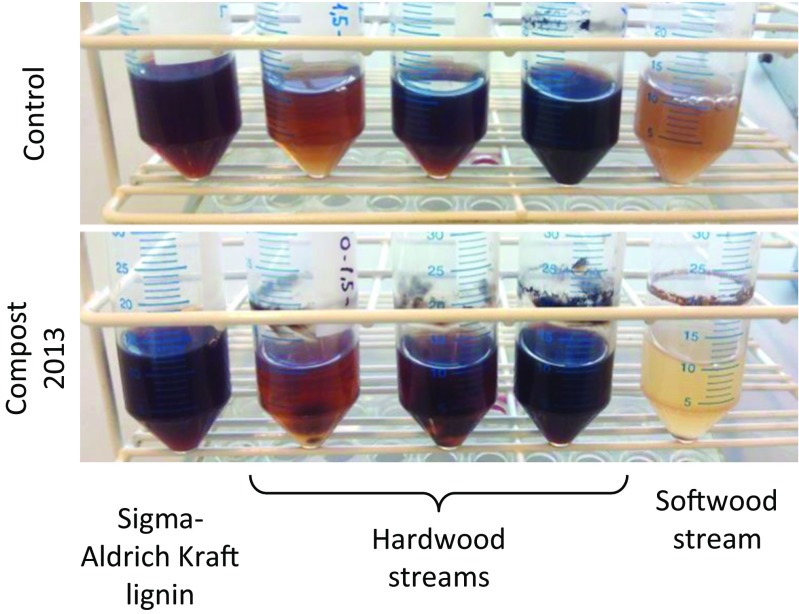
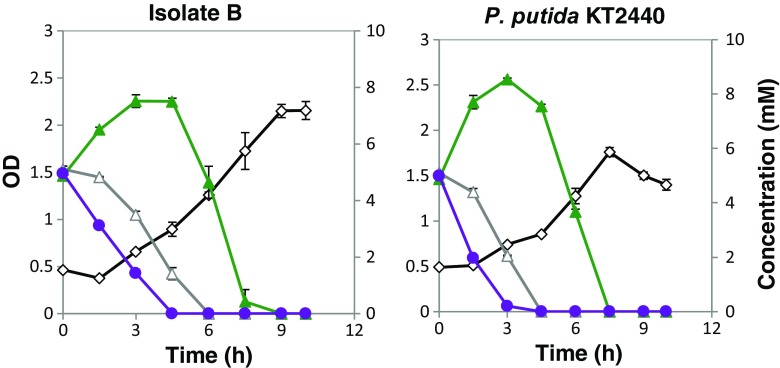
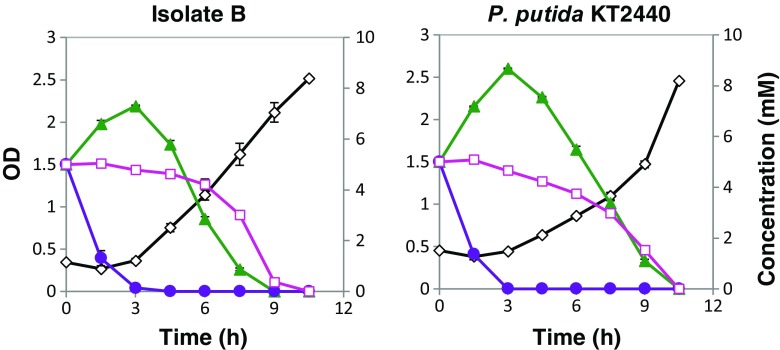
Starting from mature vegetable compost, four bacterial strains were selected using a lignin-rich medium. 16S ribosomal RNA identification of the isolates showed high score similarity with Pseudomonas spp. for three out of four isolates. Further characterization of growth on mixtures of six selected lignin model compounds (vanillin, vanillate, 4-hydroxybenzoate, p-coumarate, benzoate, and ferulate) was carried out with three of the Pseudomonas isolates and in addition with the strain Pseudomonas putida KT2440 from a culture collection. The specific growth rates on benzoate, p-coumarate, and 4-hydroxybenzoate were considerably higher (0.26-0.27 h) than those on ferulate and vanillate (0.21 and 0.22 h), as were the uptake rates. There was no direct growth of P. putida KT2440 on vanillin, but instead, vanillin was rapidly converted into vanillate at a rate of 4.87 mmol (g h) after which the accumulated vanillate was taken up. The growth curve reflected a diauxic growth when mixtures of the model compounds were used as carbon source. Vanillin, 4-hydroxybenzoate, and benzoate were preferentially consumed first, whereas ferulate was always the last substrate to be taken in. These results contribute to a better understanding of the aromatic metabolism of P. putida in terms of growth and uptake rates, which will be helpful for the utilization of these bacteria as cell factories for upgrading lignin-derived mixtures of aromatic molecules.
从成熟的蔬菜堆肥开始,使用富含木质素的培养基筛选出了四株细菌菌株。对分离菌株进行的16S核糖体RNA鉴定显示,四株分离菌株中有三株与假单胞菌属具有高度相似性。使用三株假单胞菌分离菌株以及来自菌种保藏中心的恶臭假单胞菌KT2440菌株,对六种选定的木质素模型化合物(香草醛、香草酸、4-羟基苯甲酸、对香豆酸、苯甲酸和阿魏酸)混合物上的生长情况进行了进一步表征。在苯甲酸、对香豆酸和4-羟基苯甲酸上的比生长速率(0.26 - 0.27 h⁻¹)明显高于在阿魏酸和香草醛上的比生长速率(0.21和0.22 h⁻¹),摄取速率也是如此。恶臭假单胞菌KT2440在香草醛上没有直接生长,而是香草醛以4.87 mmol/(g h)的速率迅速转化为香草酸,之后积累的香草酸被摄取。当使用模型化合物混合物作为碳源时,生长曲线反映出双相生长。香草醛、4-羟基苯甲酸和苯甲酸优先被消耗,而阿魏酸始终是最后被摄取的底物。这些结果有助于从生长和摄取速率方面更好地理解恶臭假单胞菌的芳香族代谢,这将有助于将这些细菌用作细胞工厂来升级木质素衍生的芳香族分子混合物。