
恶臭假单胞菌中木质素碳利用的碳与能量耦合代谢的定量解析
Quantitative decoding of coupled carbon and energy metabolism in Pseudomonas putida for lignin carbon utilization.
作者信息
Zhou Nanqing, Wilkes Rebecca A, Chen Xinyu, Teitel Kelly P, Belgrave James A, Beckham Gregg T, Werner Allison Z, Yu Yanbao, Aristilde Ludmilla
机构信息
Department of Civil and Environmental Engineering, McCormick School of Engineering and Applied Science, Northwestern University, Evanston, IL, USA.
Renewable Resources and Enabling Sciences Center, National Renewable Energy Laboratory, Golden, CO, USA.
出版信息
Commun Biol. 2025 Aug 29;8(1):1310. doi: 10.1038/s42003-025-08723-3.
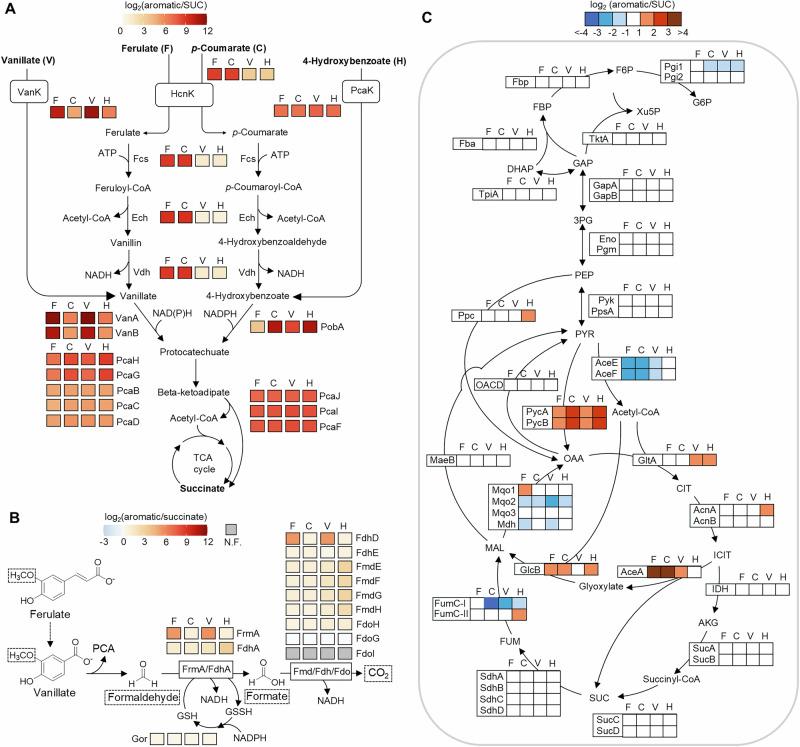
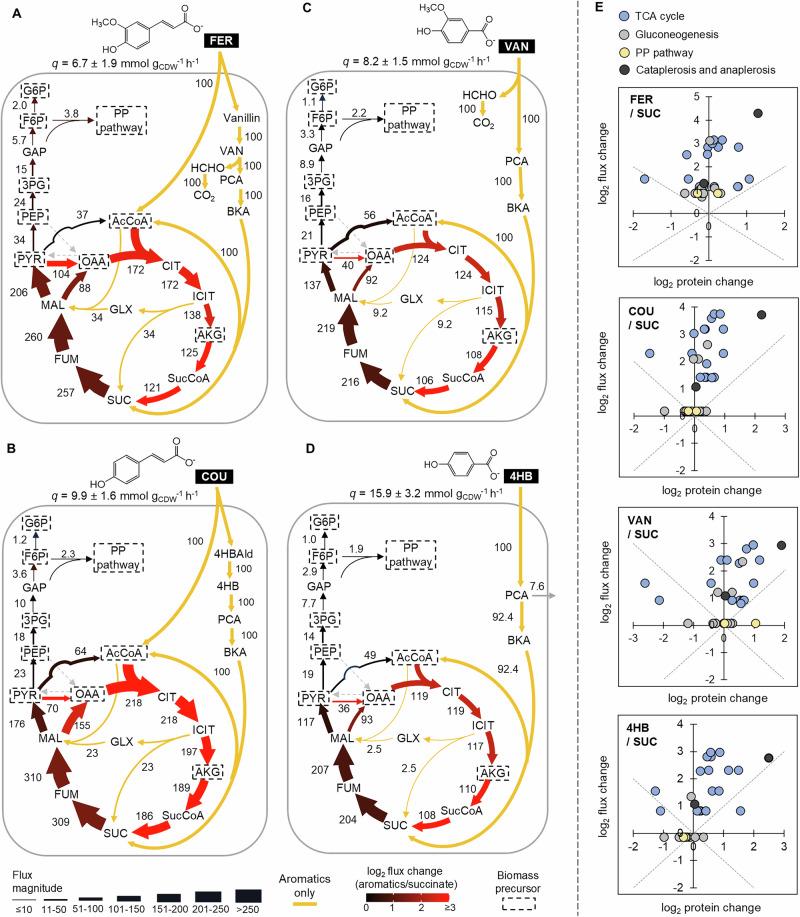
Soil Pseudomonas species, which thrive on lignin derivatives, are widely explored for biotechnology applications in lignin valorization. However, how the native metabolism coordinates phenolic carbon processing with required cofactor generation remains poorly understood. Here, we achieve quantitative understanding of this metabolic balance through a detailed multi-omics investigation of Pseudomonas putida KT2440 grown on four common phenolic acid substrates: ferulate, p-coumarate, vanillate, and 4-hydroxybenzoate. Relative to succinate, proteomics reveals > 140-fold increase in transport and catabolic proteins for aromatics, but metabolomics identifies bottlenecks in initial catabolism to maintain favorable cellular energy charge, which is compromised in mutants with resolved bottlenecks. Up to 30-fold increase in pyruvate carboxylase and glyoxylate shunt proteins implies a metabolic remodeling confirmed by kinetic C-metabolomics. Quantitative analysis by C-fluxomics demonstrates coupling of this remodeling with cofactor production. Specifically, anaplerotic carbon recycling through pyruvate carboxylase promotes tricarboxylic acid cycle fluxes to generate 50-60% NADPH yield and 60-80% NADH yield, resulting in up to 6-fold greater ATP surplus than with succinate metabolism; the glyoxylate shunt sustains cataplerotic flux through malic enzyme for the remaining NADPH yield. This quantitative blueprint affords cofactor imbalance predictions in proposed engineering of key metabolic nodes in lignin valorization pathways.
土壤假单胞菌能在木质素衍生物上茁壮成长,因此在木质素增值的生物技术应用方面得到了广泛探索。然而,其天然代谢如何协调酚类碳的处理与所需辅因子的生成仍知之甚少。在此,我们通过对在四种常见酚酸底物(阿魏酸、对香豆酸、香草酸和4-羟基苯甲酸)上生长的恶臭假单胞菌KT2440进行详细的多组学研究,实现了对这种代谢平衡的定量理解。与琥珀酸相比,蛋白质组学显示芳香族物质的转运和分解代谢蛋白增加了140倍以上,但代谢组学确定了初始分解代谢中的瓶颈,以维持有利的细胞能量电荷,而在解决了瓶颈的突变体中这种电荷受到了损害。丙酮酸羧化酶和乙醛酸循环途径蛋白增加了30倍,这意味着通过动力学C代谢组学证实了代谢重塑。C通量组学的定量分析表明这种重塑与辅因子产生相关联。具体而言,通过丙酮酸羧化酶的回补碳循环促进三羧酸循环通量,以产生50-60%的NADPH产量和60-80%的NADH产量,导致ATP盈余比琥珀酸代谢高出6倍;乙醛酸循环通过苹果酸酶维持分解代谢通量以产生其余的NADPH产量。这种定量蓝图为木质素增值途径中关键代谢节点的拟议工程中的辅因子失衡预测提供了依据。



 Zotero 插件