
1988 - 2012年美国国家健康与营养检查调查中按种族/族裔和性别划分的代谢综合征患病率
Metabolic Syndrome Prevalence by Race/Ethnicity and Sex in the United States, National Health and Nutrition Examination Survey, 1988-2012.
作者信息
Moore Justin Xavier, Chaudhary Ninad, Akinyemiju Tomi
机构信息
Department of Epidemiology, University of Alabama at Birmingham, Birmingham Alabama.
Comprehensive Cancer Center, University of Alabama at Birmingham, Birmingham, Alabama.
出版信息
Prev Chronic Dis. 2017 Mar 16;14:E24. doi: 10.5888/pcd14.160287.
INTRODUCTION
Metabolic syndrome is a cluster of cardiometabolic risk factors associated with increased risk of multiple chronic diseases, including cancer and cardiovascular disease. The objectives of this study were to estimate the prevalence of metabolic syndrome overall, by race and sex, and to assess trends in prevalence from 1988 through 2012.
METHODS
We analyzed data from the National Health and Nutrition Examination Survey (NHANES) for 1988 through 2012. We defined metabolic syndrome as the presence of at least 3 of these components: elevated waist circumference, elevated triglycerides, reduced high-density lipoprotein cholesterol, high blood pressure, and elevated fasting blood glucose. Data were analyzed for 3 periods: 1988-1994, 1999-2006, and 2007-2012.
RESULTS
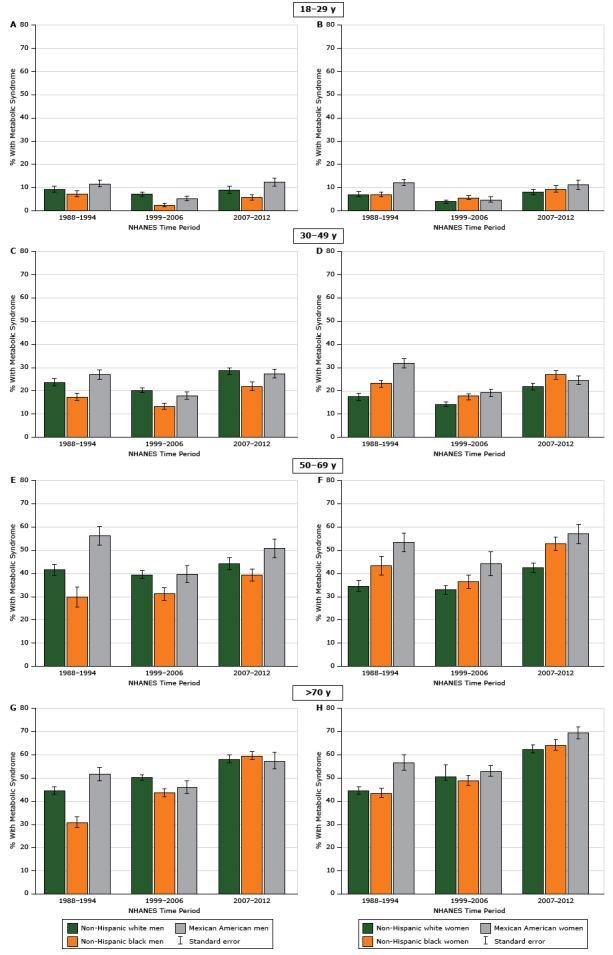
Among US adults aged 18 years or older, the prevalence of metabolic syndrome rose by more than 35% from 1988-1994 to 2007-2012, increasing from 25.3% to 34.2%. During 2007-2012, non-Hispanic black men were less likely than non-Hispanic white men to have metabolic syndrome (odds ratio [OR], 0.77; 95% confidence interval [CI], 0.66-0.89). However, non-Hispanic black women were more likely than non-Hispanic white women to have metabolic syndrome (OR, 1.20; 95% CI, 1.02-1.40). Low education level (OR, 1.56; 95% CI, 1.32-1.84) and advanced age (OR, 1.73; 95% CI, 1.67-1.80) were independently associated with increased likelihood of metabolic syndrome during 2007-2012.
CONCLUSION
Metabolic syndrome prevalence increased from 1988 to 2012 for every sociodemographic group; by 2012, more than a third of all US adults met the definition and criteria for metabolic syndrome agreed to jointly by several international organizations.
引言
代谢综合征是一组心血管代谢危险因素,与包括癌症和心血管疾病在内的多种慢性疾病风险增加相关。本研究的目的是估计总体、按种族和性别划分的代谢综合征患病率,并评估1988年至2012年期间患病率的趋势。
方法
我们分析了1988年至2012年美国国家健康与营养检查调查(NHANES)的数据。我们将代谢综合征定义为存在以下至少3种成分:腰围增加、甘油三酯升高、高密度脂蛋白胆固醇降低、高血压和空腹血糖升高。数据按三个时期进行分析:1988 - 1994年、1999 - 2006年和2007 - 2012年。
结果
在18岁及以上的美国成年人中,代谢综合征患病率从1988 - 1994年到2007 - 2012年上升了超过35%,从25.3%增至34.2%。在2007 - 2012年期间,非西班牙裔黑人男性患代谢综合征的可能性低于非西班牙裔白人男性(优势比[OR],0.77;95%置信区间[CI],0.66 - 0.89)。然而,非西班牙裔黑人女性患代谢综合征的可能性高于非西班牙裔白人女性(OR,1.20;95% CI,1.02 - 1.40)。低教育水平(OR,1.56;95% CI,1.32 - 1.84)和高龄(OR,1.73;95% CI,1.67 - 1.80)在2007 - 2012年期间与代谢综合征患病可能性增加独立相关。
结论
1988年至2012年期间,每个社会人口学群体的代谢综合征患病率均有所上升;到2012年,超过三分之一的美国成年人符合几个国际组织共同认可的代谢综合征定义和标准。

 Zotero 插件