Álvarez-Dávila Esteban, Cayuela Luis, González-Caro Sebastián, Aldana Ana M, Stevenson Pablo R, Phillips Oliver, Cogollo Álvaro, Peñuela Maria C, von Hildebrand Patricio, Jiménez Eliana, Melo Omar, Londoño-Vega Ana Catalina, Mendoza Irina, Velásquez Oswaldo, Fernández Fernando, Serna Marcela, Velázquez-Rua Cesar, Benítez Doris, Rey-Benayas José M
Departamento de Ciencias de la Vida, Universidad de Alcalá, Alcalá, Spain.
Grupo de Servicios Ecosistemicos y Cambio Climático, Fundación Convida, Medellín, Colombia.
PLoS One. 2017 Mar 16;12(3):e0171072. doi: 10.1371/journal.pone.0171072. eCollection 2017.
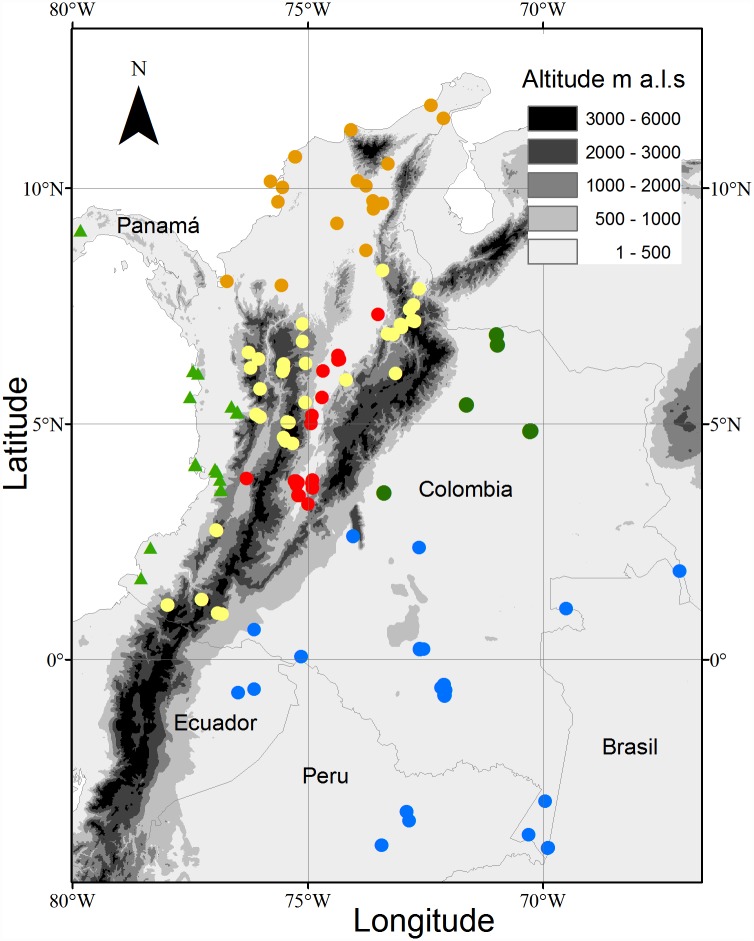
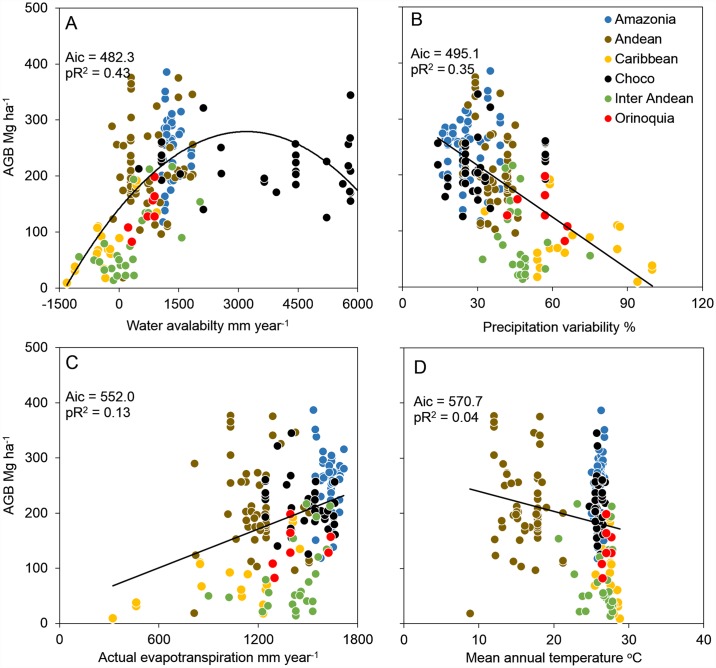
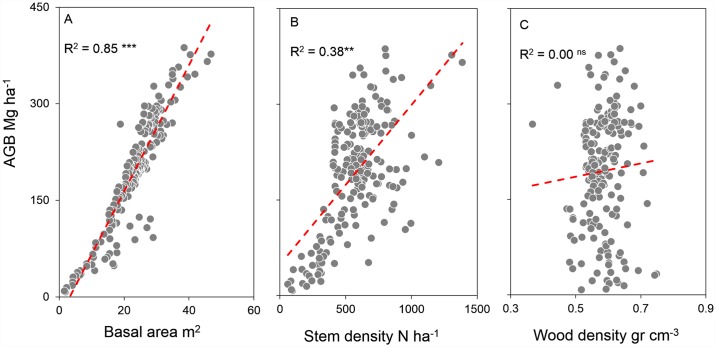
Understanding and predicting the likely response of ecosystems to climate change are crucial challenges for ecology and for conservation biology. Nowhere is this challenge greater than in the tropics as these forests store more than half the total atmospheric carbon stock in their biomass. Biomass is determined by the balance between biomass inputs (i.e., growth) and outputs (mortality). We can expect therefore that conditions that favor high growth rates, such as abundant water supply, warmth, and nutrient-rich soils will tend to correlate with high biomass stocks. Our main objective is to describe the patterns of above ground biomass (AGB) stocks across major tropical forests across climatic gradients in Northwestern South America. We gathered data from 200 plots across the region, at elevations ranging between 0 to 3400 m. We estimated AGB based on allometric equations and values for stem density, basal area, and wood density weighted by basal area at the plot-level. We used two groups of climatic variables, namely mean annual temperature and actual evapotranspiration as surrogates of environmental energy, and annual precipitation, precipitation seasonality, and water availability as surrogates of water availability. We found that AGB is more closely related to water availability variables than to energy variables. In northwest South America, water availability influences carbon stocks principally by determining stand structure, i.e. basal area. When water deficits increase in tropical forests we can expect negative impact on biomass and hence carbon storage.
理解和预测生态系统对气候变化可能产生的响应,是生态学和保护生物学面临的重大挑战。在热带地区,这一挑战尤为严峻,因为这些森林储存了超过全球大气碳总量一半的生物量。生物量由生物量输入(即生长)和输出(死亡)之间的平衡决定。因此,我们可以预期,有利于高生长率的条件,如充足的水源供应、温暖的气候和肥沃的土壤,往往与高生物量储量相关。我们的主要目标是描述南美洲西北部主要热带森林中地上生物量(AGB)储量随气候梯度的变化模式。我们收集了该地区200个样地的数据,海拔范围在0至3400米之间。我们基于异速生长方程以及样地水平上的茎密度、断面积和以断面积加权的木材密度值来估算AGB。我们使用了两组气候变量,即年平均温度和实际蒸散量作为环境能量的替代指标,以及年降水量、降水季节性和水分可利用性作为水分可利用性的替代指标。我们发现,AGB与水分可利用性变量的关系比与能量变量的关系更为密切。在南美洲西北部,水分可利用性主要通过决定林分结构(即断面积)来影响碳储量。当热带森林中的水分亏缺增加时,我们可以预期生物量以及碳储存会受到负面影响。