Ogawa Kazuo, Minai Kosuke, Kawai Makoto, Tanaka Toshikazu, Nagoshi Tomohisa, Ogawa Takayuki, Yoshimura Michihiro
Division of Cardiology, Department of Internal Medicine, the Jikei University School of Medicine, Tokyo, Japan.
PLoS One. 2017 Mar 16;12(3):e0173898. doi: 10.1371/journal.pone.0173898. eCollection 2017.
It is widely accepted that progression of organic stenosis in the coronary arteries and onset of acute coronary syndrome (ACS) are similar in the development of atherosclerosis. However, the extent of the association of each risk factor with the respective pathological conditions has not been fully elucidated.
We investigated the differences in risk factors between these conditions using a statistical procedure.
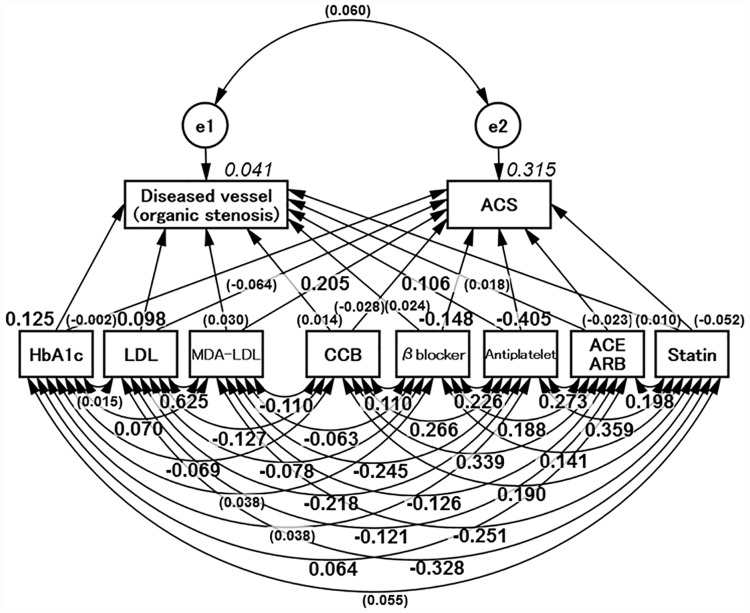
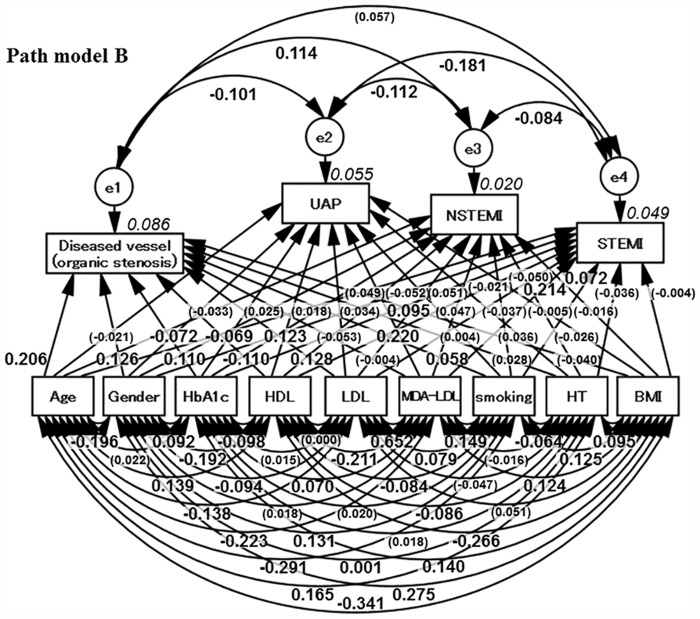
The study population consisted of 1,029 patients with ischemic heart disease (IHD). We divided the study population into two groups (ACS and non-ACS) and by diseased vessels (organic stenosis). Covariance structure analysis was simultaneously performed in one equation model for determination and comparison of the risk factors for organic stenosis and ACS.
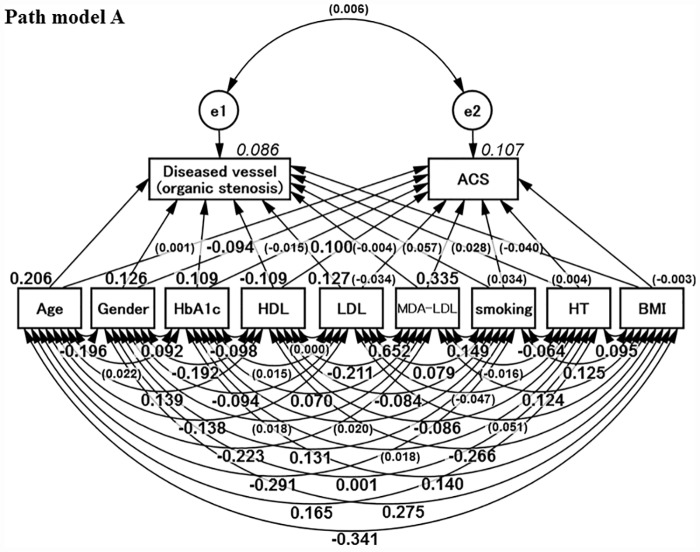
The analysis revealed that age (standardized regression coefficient, β: 0.206, P < 0.001), male gender (β: 0.126, P < 0.001), HbA1c level (β: 0.109, P < 0.001), HDL level (β: -0.109, P < 0.001) and LDL level (β: 0.127, P = 0.002) were significant for the advancement of organic stenosis. HDL level (β: 0100, P = 0.002) and MDA-LDL level (β: 0.335, P < 0.001) were significant for the onset of ACS, but age, HbA1c and LDL (P = NS or β < 0.1, respectively) were not. Among the risk factors, age, HbA1c and LDL were significantly more strongly associated with organic stenosis than ACS, while MDA-LDL was significantly more strongly associated with ACS than organic stenosis.
The current statistical analysis revealed clear differences among the risk factors between the progression of organic stenosis and the onset of ACS. Among them, the MDA-LDL level should be considered to indicate a substantial risk of ACS.
冠状动脉器质性狭窄的进展和急性冠状动脉综合征(ACS)的发作在动脉粥样硬化发展过程中相似,这一观点已被广泛接受。然而,各危险因素与相应病理状况之间的关联程度尚未完全阐明。
我们使用统计方法研究了这些情况之间危险因素的差异。
研究人群包括1029例缺血性心脏病(IHD)患者。我们将研究人群分为两组(ACS组和非ACS组),并按病变血管(器质性狭窄)进行划分。在一个方程模型中同时进行协方差结构分析,以确定和比较器质性狭窄和ACS的危险因素。
分析显示,年龄(标准化回归系数β:0.206,P < 0.001)、男性(β:0.126,P < 0.001)、糖化血红蛋白水平(β:0.109,P < 0.001)、高密度脂蛋白水平(β: -0.109,P < 0.001)和低密度脂蛋白水平(β:0.127,P = 0.002)对器质性狭窄的进展具有显著意义。高密度脂蛋白水平(β:0.100,P = 0.002)和氧化修饰低密度脂蛋白水平(β:0.335,P < 0.001)对ACS的发作具有显著意义,但年龄、糖化血红蛋白和低密度脂蛋白(分别为P = 无显著性差异或β < 0.1)则不然。在这些危险因素中,年龄、糖化血红蛋白和低密度脂蛋白与器质性狭窄的关联显著强于与ACS的关联,而氧化修饰低密度脂蛋白与ACS的关联显著强于与器质性狭窄的关联。
当前的统计分析揭示了器质性狭窄进展和ACS发作之间危险因素的明显差异。其中,氧化修饰低密度脂蛋白水平应被视为ACS的重大风险指标。