Wang Kuo, Gao Man, Yang Mingyue, Meng Fanzheng, Li Deli, Lu Ruihua, Wang Yan, Zhuang Huadong, Li Mengyao, Cheng Genhong, Wang Xiaosong
Institute of Translational Medicine, the First Hospital of Jilin University, Changchun, 130061, China.
Department of Pediatrics, the First Hospital of Jilin University, Changchun, 130021, China.
Hum Genomics. 2017 Mar 16;11(1):4. doi: 10.1186/s40246-017-0101-y.
A growing number of severe Mycoplasma pneumoniae pneumonia (MPP) cases have been reported recently. However, the pathogenesis of severe MPP is not clear. In the current study, transcriptome sequencing was used to identify gene expression and alternative splicing profiles to provide insights into the pathogenesis of severe MPP.
RNAs of bronchoalveolar lavage fluid (BALF) samples from three severe MPP children and three mild MPP children were analyzed respectively by deep sequencing followed by computational annotation and quantification.
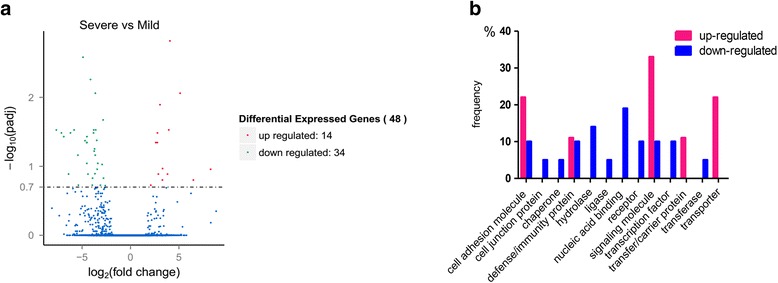
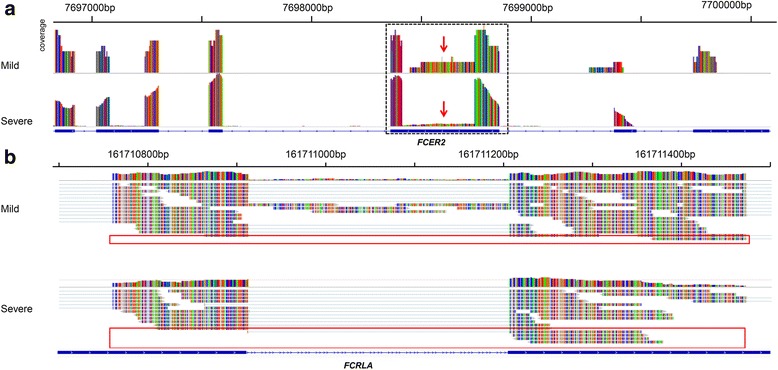
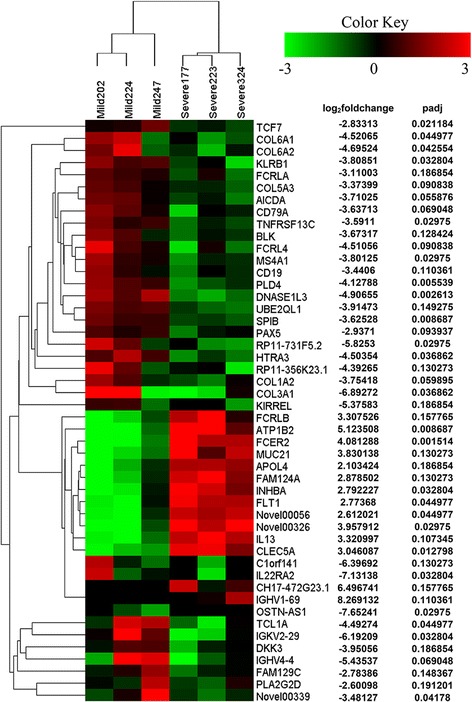
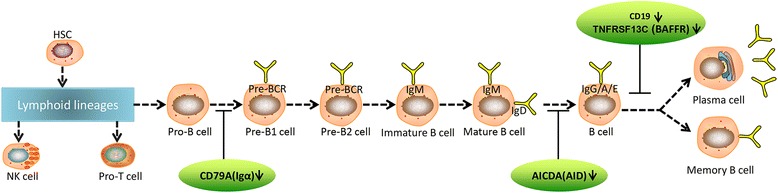
The gene expression analysis revealed 14 up-regulated and 34 down-regulated genes in severe MPP children comparing to mild MPP children. The top 10 most up-regulated genes were IGHV1-69, CH17-472G23.1, ATP1B2, FCER2, MUC21, IL13, FCRLB, CLEC5A, FAM124A, and INHBA. The top 10 most down-regulated genes were OSTN-AS1, IL22RA2, COL3A1, C1orf141, IGKV2-29, RP11-731F5.2, IGHV4-4, KIRREL, DNASE1L3, and COL6A2. Clustering analysis revealed similar expression pattern of CLEC5A, IL13, FCER2, and FLT1. Kyoto Encyclopedia of Genes and Genomes (KEGG) pathway enrichment analyses revealed changes related to primary immunodeficiency in severe MPP children comparing to mild MPP children; the pathway involves CD19, TNFRSF13C, CD79A, and AICDA genes. Among the differentially expressed genes, significant alternative splicing events were found in FCER2 and FCRLA.
The current study on RNA sequencing provides novel insights into the pathogenesis of severe MPP in terms of gene expression and alternative splicing. The up-regulation of IL13, FCER2, FLT1, and CLEC5A and the down-regulation of CD79A, AICDA, CD19, and TNFRSF13C may contribute to the pathogenesis of severe MPP. The differential expressions of FCER2 and FCRLA could be due to their alternative splicing.
近期报告的重症肺炎支原体肺炎(MPP)病例数量不断增加。然而,重症MPP的发病机制尚不清楚。在本研究中,采用转录组测序来鉴定基因表达和可变剪接图谱,以深入了解重症MPP的发病机制。
分别对3例重症MPP患儿和3例轻症MPP患儿的支气管肺泡灌洗液(BALF)样本进行RNA深度测序,随后进行计算注释和定量分析。
基因表达分析显示,与轻症MPP患儿相比,重症MPP患儿中有14个基因上调,34个基因下调。上调最明显的前10个基因是IGHV1-69、CH17-472G23.1、ATP1B2、FCER2、MUC21、IL13、FCRLB、CLEC5A、FAM124A和INHBA。下调最明显的前10个基因是OSTN-AS1、IL22RA2、COL3A1、C1orf141、IGKV2-29、RP11-731F5.2、IGHV4-4、KIRREL、DNASE1L3和COL6A2。聚类分析显示CLEC5A、IL13、FCER2和FLT1具有相似的表达模式。京都基因与基因组百科全书(KEGG)通路富集分析显示,与轻症MPP患儿相比,重症MPP患儿中与原发性免疫缺陷相关的通路发生了变化;该通路涉及CD19、TNFRSF13C、CD79A和AICDA基因。在差异表达基因中,发现FCER2和FCRLA存在明显的可变剪接事件。
目前关于RNA测序的研究在基因表达和可变剪接方面为重症MPP的发病机制提供了新见解。IL13、FCER2、FLT1和CLEC5A的上调以及CD79A、AICDA、CD19和TNFRSF13C的下调可能与重症MPP的发病机制有关。FCER2和FCRLA的差异表达可能归因于它们的可变剪接。