Centre for Neuroscience Studies, Queen's University , Kingston, Ontario, Canada.
Department of Psychology, Queen's University , Kingston, Ontario, Canada.
eNeuro. 2017 Mar 10;4(2). doi: 10.1523/ENEURO.0026-17.2017. eCollection 2017 Mar-Apr.
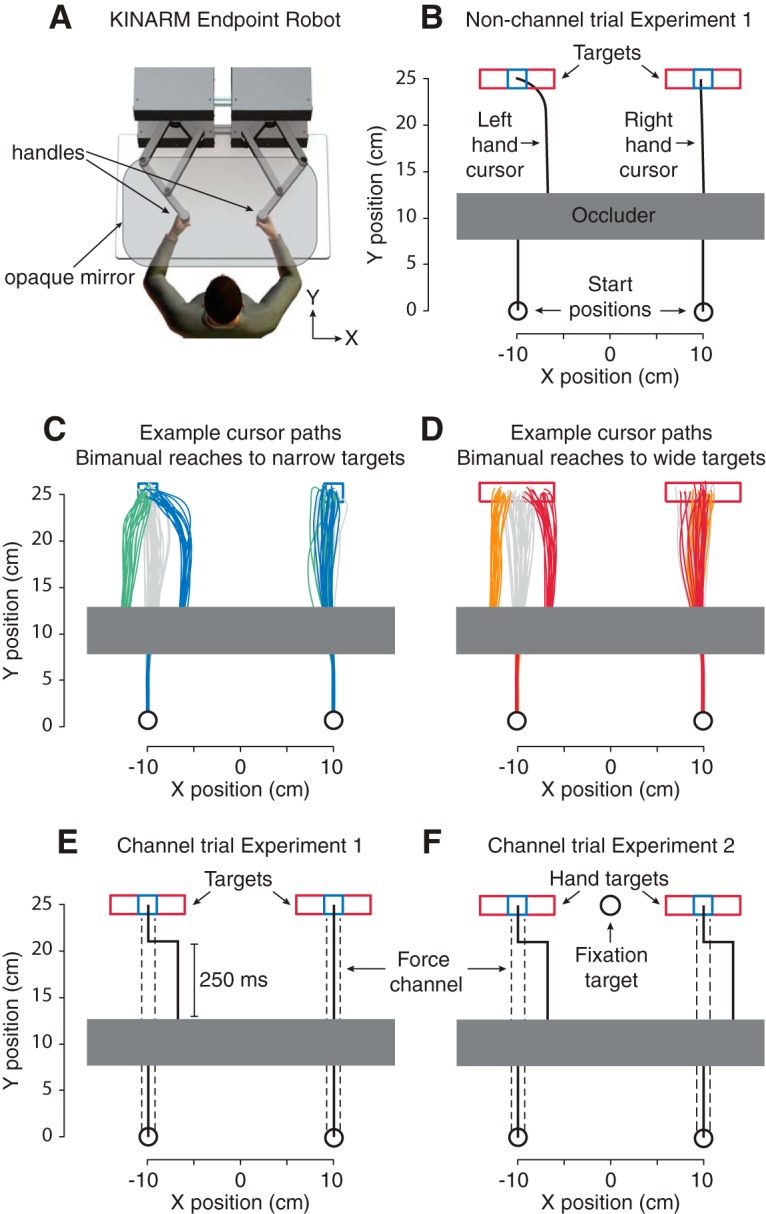
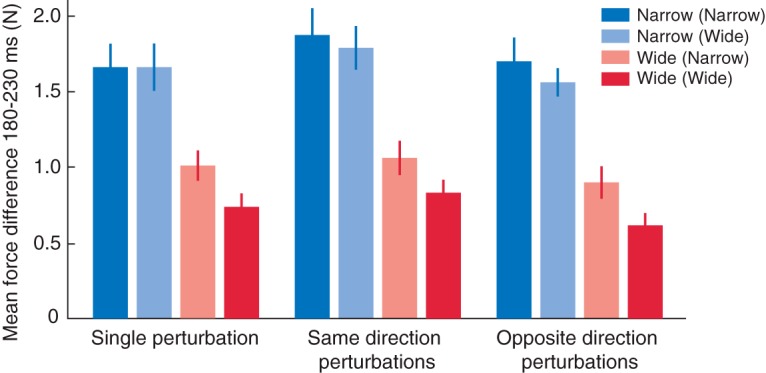
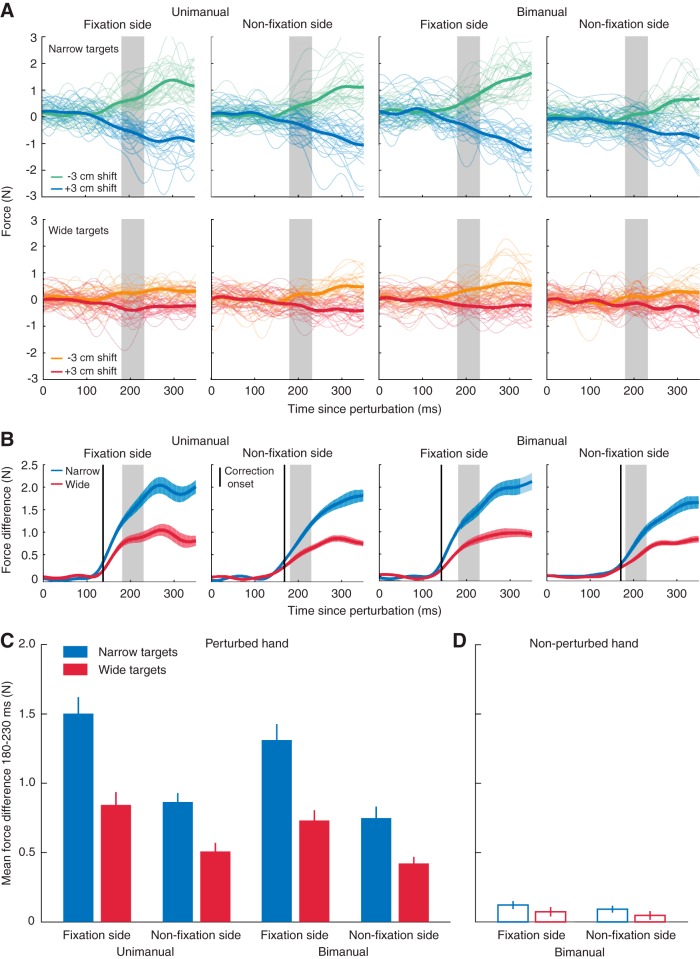
During goal-directed reaching, rapid visuomotor feedback processes enable the human motor system to quickly correct for errors in the trajectory of the hand that arise from motor noise and, in some cases, external perturbations. To date, these visuomotor responses, the gain of which is sensitive to features of the task and environment, have primarily been examined in the context of unimanual reaching movements toward a single target. However, many natural tasks involve moving both hands together, often to separate targets, such that errors can occur in parallel and at different spatial locations. Here, we examined the resource capacity of automatic visuomotor corrective mechanisms by comparing feedback gains during bimanual reaches, toward two targets, to feedback gains during unimanual reaches toward single targets. To investigate the sensitivity of the feedback gains and their relation to visual-spatial processing, we manipulated the widths of the targets and participants' gaze location. We found that the gain of corrective responses to cursor displacements, while strongly modulated by target width and gaze position, were only slightly reduced during bimanual control. Our results show that automatic visuomotor corrective mechanisms can efficiently operate in parallel across multiple spatial locations.
在目标导向的伸手动作中,快速的视觉运动反馈过程使人类运动系统能够快速纠正手部轨迹中的错误,这些错误源于运动噪声,在某些情况下还源于外部干扰。迄今为止,这些视觉运动反应的增益对任务和环境的特征敏感,主要在单臂伸向单一目标的背景下进行研究。然而,许多自然任务涉及双手同时移动,通常是指向不同的目标,因此误差可能会同时并在不同的空间位置出现。在这里,我们通过比较双臂伸向两个目标时的反馈增益与单臂伸向单个目标时的反馈增益,来研究自动视觉运动校正机制的资源容量。为了研究反馈增益的敏感性及其与视觉空间处理的关系,我们改变了目标的宽度和参与者的注视位置。我们发现,尽管目标宽度和注视位置强烈调节了对光标位移的校正反应增益,但在双手控制时,该增益仅略有降低。我们的结果表明,自动视觉运动校正机制可以在多个空间位置上高效地并行运作。