Halling Linder Cecilia, Ek-Rylander Barbro, Krumpel Michael, Norgård Maria, Narisawa Sonoko, Millán José Luis, Andersson Göran, Magnusson Per
Department of Clinical Chemistry and Department of Clinical and Experimental Medicine, Linköping University, 581 85, Linköping, Sweden.
Division of Pathology, Department of Laboratory Medicine, Karolinska Institutet, 141 86, Huddinge, Sweden.
Calcif Tissue Int. 2017 Jul;101(1):92-101. doi: 10.1007/s00223-017-0259-2. Epub 2017 Mar 16.
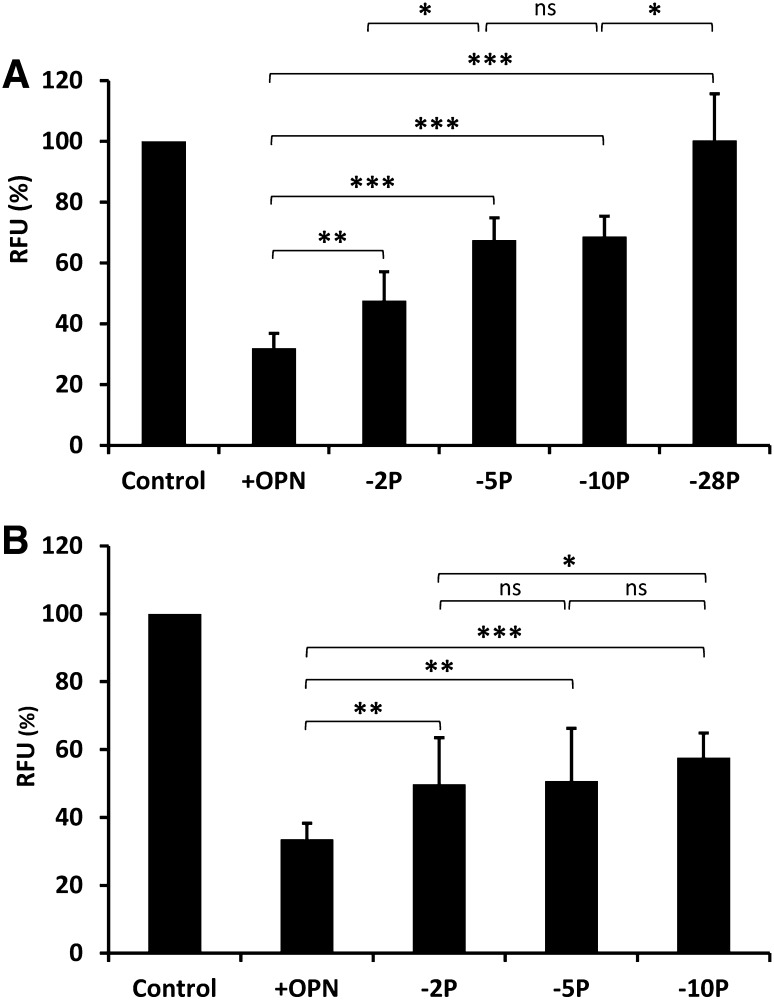
Phosphorylated osteopontin (OPN) inhibits hydroxyapatite crystal formation and growth, and bone alkaline phosphatase (BALP) promotes extracellular mineralization via the release of inorganic phosphate from the mineralization inhibitor inorganic pyrophosphate (PPi). Tartrate-resistant acid phosphatase (TRAP), produced by osteoclasts, osteoblasts, and osteocytes, exhibits potent phosphatase activity towards OPN; however, its potential capacity as a regulator of mineralization has not previously been addressed. We compared the efficiency of BALP and TRAP towards the endogenous substrates for BALP, i.e., PPi and pyridoxal 5'-phosphate (PLP), and their impact on mineralization in vitro via dephosphorylation of bovine milk OPN. TRAP showed higher phosphatase activity towards phosphorylated OPN and PPi compared to BALP, whereas the activity of TRAP and BALP towards PLP was comparable. Bovine milk OPN could be completely dephosphorylated by TRAP, liberating all its 28 phosphates, whereas BALP dephosphorylated at most 10 phosphates. OPN, dephosphorylated by either BALP or TRAP, showed a partially or completely attenuated phosphorylation-dependent inhibitory capacity, respectively, compared to native OPN on the formation of mineralized nodules. Thus, there are phosphorylations in OPN important for inhibition of mineralization that are removed by TRAP but not by BALP. In conclusion, our data indicate that both BALP and TRAP can alleviate the inhibitory effect of OPN on mineralization, suggesting a potential role for TRAP in skeletal mineralization. Further studies are warranted to explore the possible physiological relevance of TRAP in bone mineralization.
磷酸化骨桥蛋白(OPN)抑制羟基磷灰石晶体的形成和生长,而骨碱性磷酸酶(BALP)通过从矿化抑制剂无机焦磷酸(PPi)中释放无机磷酸盐来促进细胞外矿化。破骨细胞、成骨细胞和骨细胞产生的抗酒石酸酸性磷酸酶(TRAP)对OPN具有强大的磷酸酶活性;然而,其作为矿化调节因子的潜在能力此前尚未得到研究。我们比较了BALP和TRAP对内源性底物(即PPi和磷酸吡哆醛(PLP))的作用效率,以及它们通过对牛乳OPN去磷酸化对体外矿化的影响。与BALP相比,TRAP对磷酸化OPN和PPi表现出更高的磷酸酶活性,而TRAP和BALP对PLP的活性相当。牛乳OPN可被TRAP完全去磷酸化,释放其所有28个磷酸基团,而BALP最多去磷酸化10个磷酸基团。与天然OPN相比,经BALP或TRAP去磷酸化的OPN分别对矿化结节形成的磷酸化依赖性抑制能力部分或完全减弱。因此,OPN中存在对矿化抑制很重要的磷酸化,这些磷酸化可被TRAP去除,但不能被BALP去除。总之,我们的数据表明BALP和TRAP都可以减轻OPN对矿化的抑制作用,提示TRAP在骨骼矿化中可能发挥作用。有必要进一步研究以探索TRAP在骨矿化中可能的生理相关性。