Fei Yuxiang, Hou Rong, Spotila James R, Paladino Frank V, Qi Dunwu, Zhang Zhihe
Department of Biodiversity, Earth and Environmental Science, Drexel University, Philadelphia, PA United States of America.
Sichuan Key Laboratory of Conservation Biology for Endangered Wildlife, Chengdu Research Base of Giant Panda Breeding, Northern Suburb, FuTou Shan, Chengdu, Sichuan Province, People's Republic of China.
PLoS One. 2017 Mar 17;12(3):e0173274. doi: 10.1371/journal.pone.0173274. eCollection 2017.
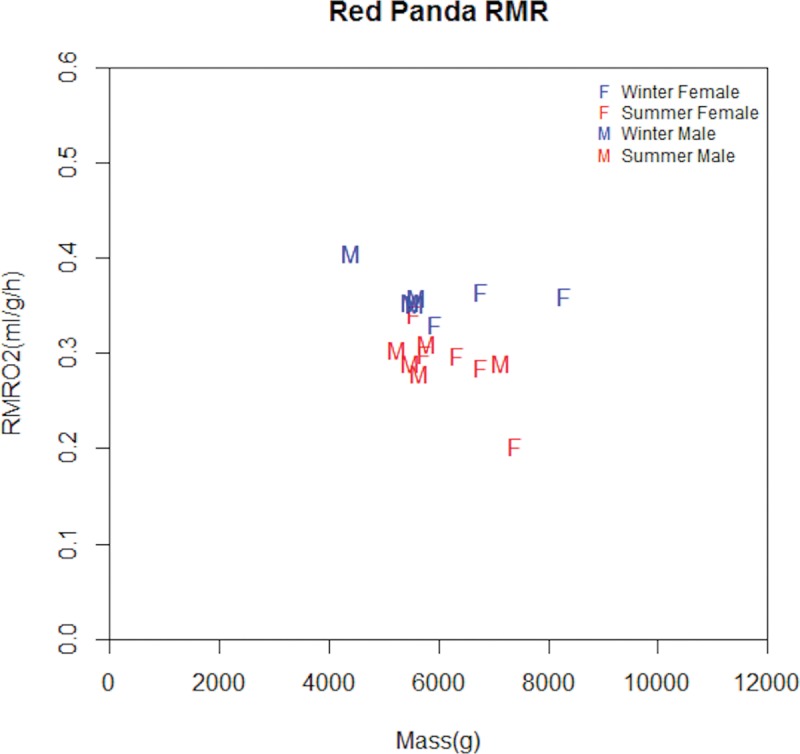
The red panda (Ailurus fulgens) has a similar diet, primarily bamboo, and shares the same habitat as the giant panda, Ailuropoda melanoleuca. There are considerable efforts underway to understand the ecology of the red panda and to increase its populations in natural reserves. Yet it is difficult to design an effective strategy for red panda reintroduction if we do not understand its basic biology. Here we report the resting metabolic rate of the red panda and find that it is higher than previously measured on animals from a zoo. The resting metabolic rate was 0.290 ml/g/h (range 0.204-0.342) in summer and 0.361 ml/g/h in winter (range 0.331-0.406), with a statistically significant difference due to season and test temperature. Temperatures in summer were probably within the thermal neutral zone for metabolism but winter temperatures were below the thermal neutral zone. There was no difference in metabolic rate between male and female red pandas and no difference due to mass. Our values for metabolic rate were much higher than those measured by McNab for 2 red pandas from a zoo. The larger sample size (17), more natural conditions at the Panda Base and improved accuracy of the metabolic instruments provided more accurate metabolism measurements. Contrary to our expectations based on their low quality bamboo diet, the metabolic rates of red pandas were similar to mammals of the same size. Based on their metabolic rates red pandas would not be limited by their food supply in natural reserves.
小熊猫(小熊猫属)的饮食与大熊猫(大熊猫属)相似,主要以竹子为食,且与大熊猫共享相同的栖息地。目前正在做出大量努力来了解小熊猫的生态,并在自然保护区增加其种群数量。然而,如果我们不了解小熊猫的基本生物学特性,就很难设计出有效的小熊猫放归策略。在此,我们报告了小熊猫的静息代谢率,发现其高于此前对动物园动物的测量值。夏季静息代谢率为0.290毫升/克/小时(范围为0.204 - 0.342),冬季为0.361毫升/克/小时(范围为0.331 - 0.406),由于季节和测试温度的原因,存在统计学上的显著差异。夏季温度可能处于代谢的热中性区内,但冬季温度低于热中性区。雄性和雌性小熊猫的代谢率没有差异,体重也没有影响。我们测得的代谢率数值远高于麦克纳布对两只动物园小熊猫的测量值。更大的样本量(17只)、熊猫基地更自然的条件以及代谢仪器更高的精度提供了更准确的代谢测量结果。与基于其低质量竹子饮食的预期相反,小熊猫的代谢率与相同体型的哺乳动物相似。基于它们的代谢率,小熊猫在自然保护区不会受到食物供应的限制。