Javier R T, Izumi K M, Stevens J G
Department of Microbiology and Immunology, University of California, Los Angeles 90024.
J Virol. 1988 Apr;62(4):1381-7. doi: 10.1128/JVI.62.4.1381-1387.1988.
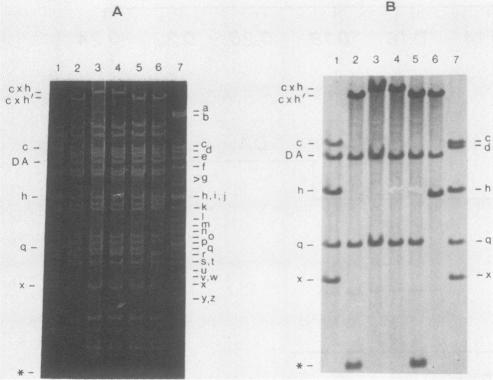
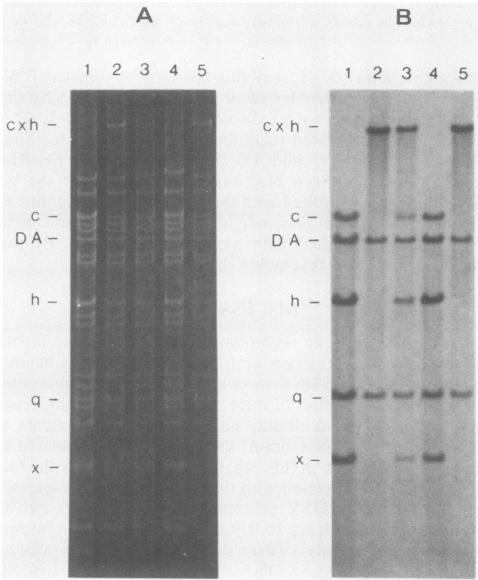
Previous studies with the herpes simplex virus type 1 X type 2 intertypic recombinant RS6 suggested that the genomic region from 0.11 to 0.14 map units is involved in neurovirulence (R. T. Javier, R. L. Thompson, and J. G. Stevens, J. Virol. 61:1978-1984, 1987). To study this further, we isolated an RS6-derived herpes simplex virus intertypic recombinant (R13-1) which has a genetic defect within this area. After inoculation into mouse brains, R13-1 was found to be approximately 10,000-fold less neurovirulent than either the wild-type type 1 or type 2 parental virus. However, R13-1 replicated in the mouse brain to titers resembling those of the wild-type parents. Further comparisons with wild-type counterparts indicated that R13-1 expressed equivalent levels of the enzyme thymidine kinase and replicated to intermediate levels in primary mouse embryo fibroblasts maintained at the normal body temperature for mice. Using marker rescue techniques combined with in vivo selection, we found that recombination between unit-length R13-1 DNA and a cloned type 1 DNA fragment spanning the region from 0.11 to 0.14 map units (EcoRI-d, 0.079 to 0.192 map units) generated viruses with a wild-type neurovirulence phenotype. To further refine the genomic region of interest, we performed marker rescue experiments using two EcoRI-d subclones, EcoRI/BamHI dc (0.079 to 0.143 map units) and BamHI/EcoRI and (0.143 to 0.192 map units), representing the left and right halves of the EcoRI d fragment, respectively. In these experiments the EcoRI/BamHI dc clone, but not the BamHI/EcoRI ad clone, yielded recombinant viruses exhibiting wild-type neurovirulence. These results show that at least one herpes simplex virus gene function associated with neurovirulence is located within a 9.1-kilobase region at 0.079 to 0.143 map units of the viral genome. Perhaps more significantly, the results indicate that this neurovirulence property functions independently of high-titer virus replication in the brain.
先前对单纯疱疹病毒1型与2型间型重组体RS6的研究表明,基因组中从0.11至0.14个图谱单位的区域与神经毒力有关(R.T.哈维尔、R.L.汤普森和J.G.史蒂文斯,《病毒学杂志》61:1978 - 1984,1987年)。为了进一步研究这一点,我们分离出了一种源自RS6的单纯疱疹病毒间型重组体(R13 - 1),它在该区域存在遗传缺陷。将其接种到小鼠脑内后,发现R13 - 1的神经毒力比野生型1型或2型亲代病毒低约10000倍。然而,R13 - 1在小鼠脑中的复制滴度与野生型亲代相似。与野生型对应物的进一步比较表明,R13 - 1表达的胸苷激酶水平相当,并且在维持小鼠正常体温的原代小鼠胚胎成纤维细胞中能复制到中等水平。利用标记拯救技术结合体内筛选,我们发现单位长度的R13 - 1 DNA与一个跨越从0.11至0.14个图谱单位区域(EcoRI - d,0.079至0.192个图谱单位)的克隆1型DNA片段之间的重组产生了具有野生型神经毒力表型的病毒。为了进一步细化感兴趣的基因组区域,我们使用两个EcoRI - d亚克隆EcoRI/BamHI dc(0.079至0.143个图谱单位)和BamHI/EcoRI ad(0.143至0.192个图谱单位)进行标记拯救实验,它们分别代表EcoRI d片段的左半部分和右半部分。在这些实验中,EcoRI/BamHI dc克隆,但不是BamHI/EcoRI ad克隆,产生了表现出野生型神经毒力的重组病毒。这些结果表明,至少一种与神经毒力相关的单纯疱疹病毒基因功能位于病毒基因组0.079至0.143个图谱单位的一个9.1千碱基区域内。也许更重要的是,结果表明这种神经毒力特性的发挥独立于病毒在脑中的高滴度复制。