Wang Jun, Ethridge Lauren E, Mosconi Matthew W, White Stormi P, Binder Devin K, Pedapati Ernest V, Erickson Craig A, Byerly Matthew J, Sweeney John A
Department of Psychology, Zhejiang Normal University, 688 Yingbin Road, Jinhua, Zhejiang China 321004.
Department of Pediatrics, Section of Developmental and Behavioral Pediatrics, University of Oklahoma Health Sciences Center, Oklahoma City, OK USA.
J Neurodev Disord. 2017 Mar 14;9:11. doi: 10.1186/s11689-017-9191-z. eCollection 2017.
Cortical hyperexcitability due to abnormal fast-spiking inhibitory interneuron function has been documented in KO mice, a mouse model of the fragile X syndrome which is the most common single gene cause of autism and intellectual disability.
We collected resting state dense-array electroencephalography data from 21 fragile X syndrome (FXS) patients and 21 age-matched healthy participants.
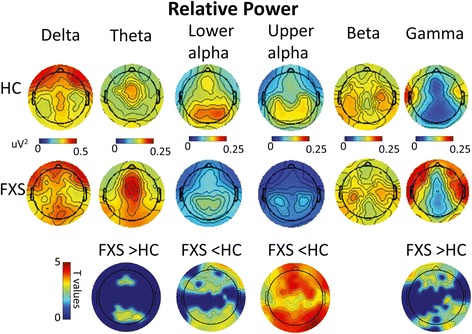
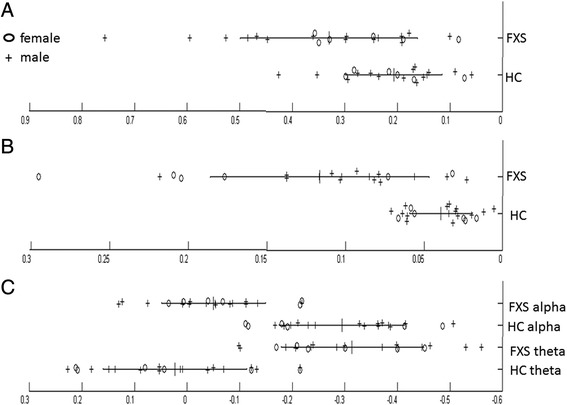
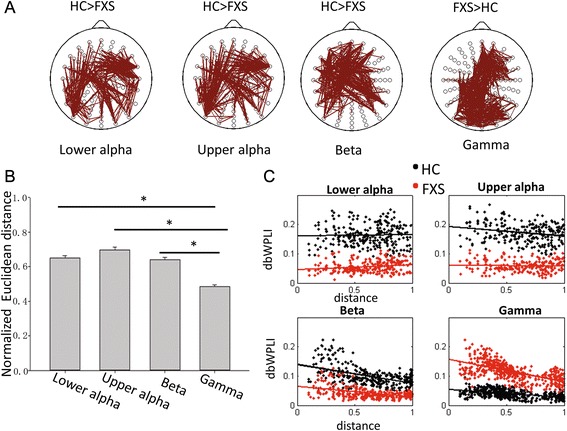
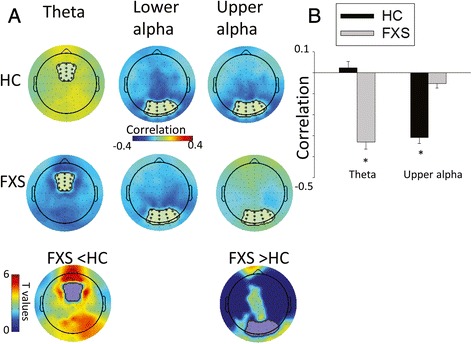
FXS patients exhibited greater gamma frequency band power, which was correlated with social and sensory processing difficulties. Second, FXS patients showed increased spatial spreading of phase-synchronized high frequency neural activity in the gamma band. Third, we observed increased negative theta-to-gamma but decreased alpha-to-gamma band amplitude coupling, and the level of increased theta power was inversely related to the level of resting gamma power in FXS.
Increased theta band power and coupling from frontal sources may represent a mechanism providing compensatory inhibition of high-frequency gamma band activity, potentially contributing to the widely varying level of neurophysiological and behavioral abnormalities and treatment response seen in full-mutation FXS patients. These findings extend preclinical observations and provide new mechanistic insights into brain alterations and their variability across FXS patients. Electrophysiological measures may provide useful translational biomarkers for advancing drug development and individualizing treatments for neurodevelopmental disorders with associated neuronal hyperexcitability.
在脆性X综合征的KO小鼠模型中,已证实由于异常的快突触抑制性中间神经元功能导致皮质兴奋性过高,脆性X综合征是自闭症和智力残疾最常见的单基因病因。
我们收集了21名脆性X综合征(FXS)患者和21名年龄匹配的健康参与者的静息态密集阵列脑电图数据。
FXS患者表现出更高的γ频段功率,这与社交和感觉处理困难相关。其次,FXS患者在γ频段中相位同步高频神经活动的空间传播增加。第三,我们观察到负向θ-γ频段但α-γ频段振幅耦合降低,并且FXS中θ功率增加的水平与静息γ功率水平呈负相关。
额叶来源的θ频段功率和耦合增加可能代表一种机制,为高频γ频段活动提供代偿性抑制,这可能导致在完全突变的FXS患者中观察到的广泛不同水平的神经生理和行为异常以及治疗反应。这些发现扩展了临床前观察结果,并为FXS患者的大脑改变及其变异性提供了新的机制性见解。电生理测量可能为推进药物开发和为伴有神经元兴奋性过高的神经发育障碍个体化治疗提供有用的转化生物标志物。