Division of Developmental Medicine, Boston Children's Hospital, 1 Autumn Street, 6th Floor, Boston, MA, 02115, USA.
Mol Autism. 2021 Feb 25;12(1):17. doi: 10.1186/s13229-021-00425-x.
The lack of robust and reliable clinical biomarkers in Fragile X Syndrome (FXS), the most common inherited form of intellectual disability, has limited the successful translation of bench-to-bedside therapeutics. While numerous drugs have shown promise in reversing synaptic and behavioral phenotypes in mouse models of FXS, none have demonstrated clinical efficacy in humans. Electroencephalographic (EEG) measures have been identified as candidate biomarkers as EEG recordings of both adults with FXS and mouse models of FXS consistently exhibit alterations in resting state and task-related activity. However, the developmental timing of these EEG differences is not known as thus far EEG studies have not focused on young children with FXS. Further, understanding how EEG differences are associated with core symptoms of FXS is crucial to successful use of EEG as a biomarker, and may improve our understanding of the disorder.
Resting-state EEG was collected from FXS boys with full mutation of Fmr1 (2.5-7 years old, n = 11) and compared with both age-matched (n = 12) and cognitive-matched (n = 12) typically developing boys. Power spectra (including aperiodic and periodic components) were compared using non-parametric cluster-based permutation testing. Associations between 30 and 50 Hz gamma power and cognitive, language, and behavioral measures were evaluated using Pearson correlation and linear regression with age as a covariate.
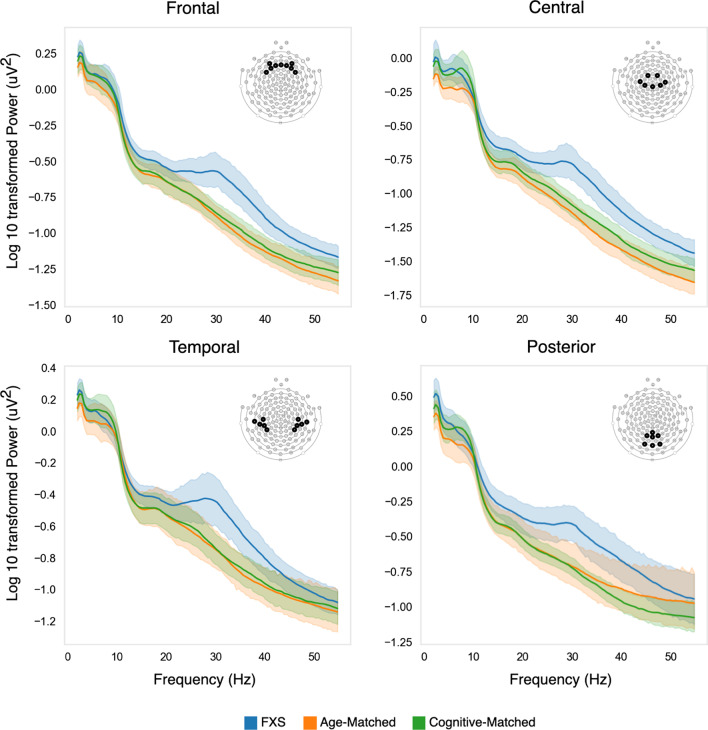
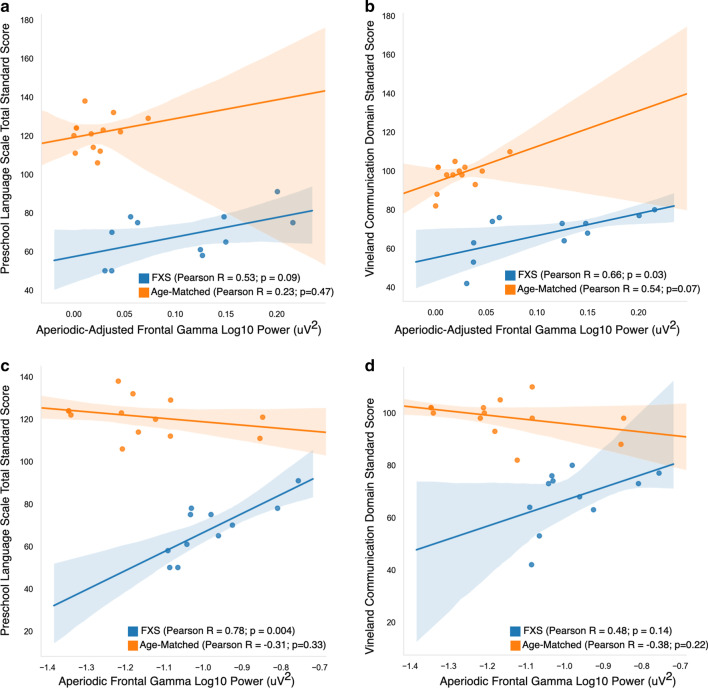
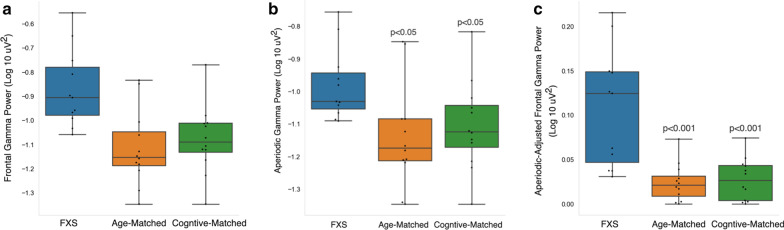
FXS participants showed increased power in the beta/gamma range (~ 25-50 Hz) across multiple brain regions. Both a reduction in the aperiodic (1/f) slope and increase in beta/gamma periodic activity contributed to the significant increase in high-frequency power. Increased gamma power, driven by the aperiodic component, was associated with better language ability in the FXS group. No association was observed between gamma power and parent report measures of behavioral challenges, sensory hypersensitivities, or adaptive behaviors.
The study sample size was small, although comparable to other human studies in rare-genetic disorders. Findings are also limited to males in the age range studied.
Resting-state EEG measures from this study in young boys with FXS identified similar increases in gamma power previously reported in adults and mouse models. The observed positive association between resting state aperiodic gamma power and language development supports hypotheses that alterations in some EEG measures may reflect ongoing compensatory mechanisms.
脆性 X 综合征(FXS)是最常见的遗传性智力障碍形式,目前缺乏稳健可靠的临床生物标志物,这限制了从实验室到临床的治疗方法的成功转化。虽然许多药物在逆转 FXS 小鼠模型的突触和行为表型方面显示出了前景,但没有一种药物在人类中表现出临床疗效。脑电图(EEG)测量已被确定为候选生物标志物,因为 FXS 患者的脑电图和 FXS 小鼠模型的脑电图记录均显示静息状态和任务相关活动的改变。然而,这些 EEG 差异的发育时间尚不清楚,因为迄今为止的 EEG 研究并未关注患有 FXS 的幼儿。此外,了解 EEG 差异与 FXS 的核心症状有何关联对于成功将 EEG 用作生物标志物至关重要,并且可能有助于我们了解该疾病。
从携带 Fmr1 完全突变的 FXS 男孩(2.5-7 岁,n=11)中采集静息状态 EEG,并与年龄匹配的男孩(n=12)和认知匹配的男孩(n=12)进行比较。使用非参数聚类置换检验比较功率谱(包括非周期性和周期性成分)。使用 Pearson 相关和线性回归(以年龄为协变量)评估 30-50 Hz 伽马功率与认知、语言和行为测量之间的关联。
FXS 参与者在多个大脑区域显示出β/γ频段(约 25-50 Hz)的功率增加。非周期性(1/f)斜率的降低和β/γ周期性活动的增加都导致了高频功率的显著增加。由非周期性成分驱动的伽马功率增加与 FXS 组的语言能力更好相关。在 FXS 组中,未观察到伽马功率与父母报告的行为挑战、感觉过敏或适应行为测量值之间存在关联。
尽管与其他罕见遗传疾病的人类研究相比,该研究的样本量较小,但研究结果也仅限于研究年龄范围内的男性。
这项针对患有 FXS 的年轻男孩的研究中的静息状态 EEG 测量结果与先前在成人和小鼠模型中报道的伽马功率增加相似。观察到静息状态非周期性伽马功率与语言发展之间的正相关支持了这样的假设,即某些 EEG 测量值的改变可能反映了正在进行的代偿机制。