Key Laboratory of Functional Protein Research of Guangdong Higher Education Institutes, Institute of Life and Health Engineering, College of Life Science and Technology, Jinan University, Guangzhou 510632, Guangdong, China.
State Key Laboratory of Applied Microbiology Southern China, Guangdong Provincial Key Laboratory of Microbial Culture Collection and Application, Guangdong Institute of Microbiology, Guangzhou 510070, Guangdong, China.
Sci Rep. 2017 Mar 20;7:44706. doi: 10.1038/srep44706.
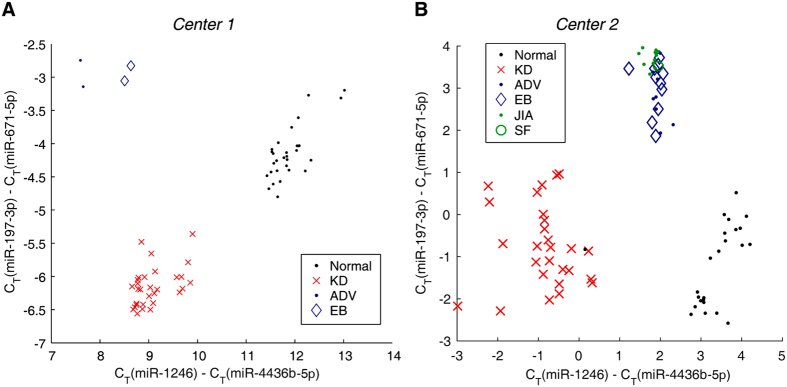
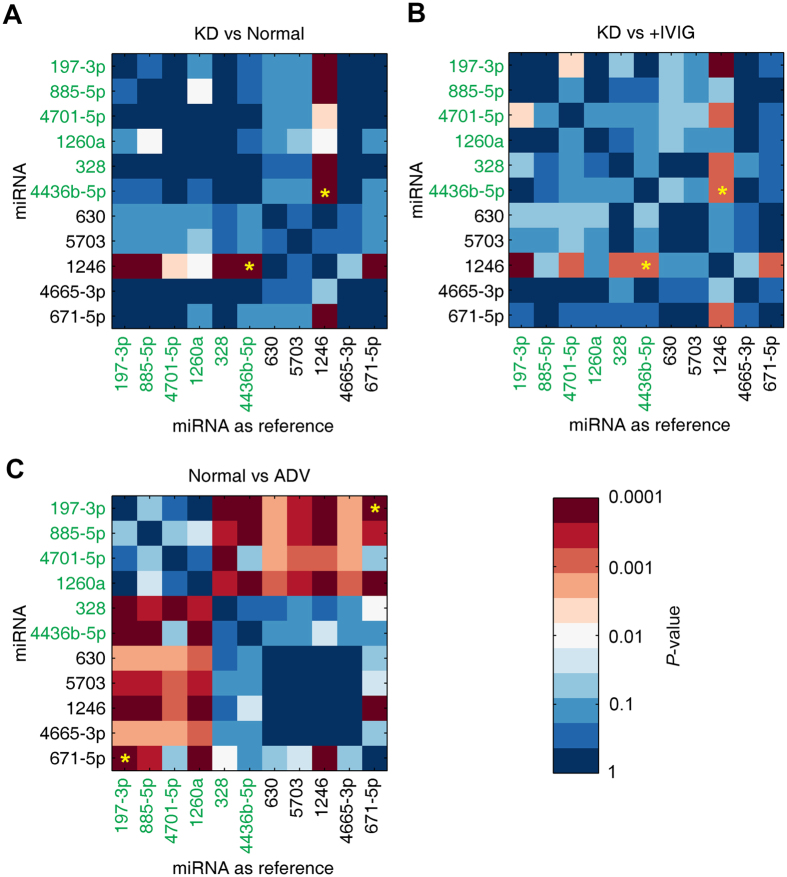
Although Kawasaki disease is the main cause of acquired heart disease in children, no diagnostic biomarkers are available. We aimed to identify candidate biomarkers for diagnosing Kawasaki disease using serum exosomal microRNAs (miRNAs). Using frozen serum samples from a biobank, high-throughput microarray technologies, two-stage real-time quantitative PCR, and a self-referencing strategy for data normalization, we narrowed down the list of biomarker candidates to a set of 4 miRNAs. We further validated the diagnostic capabilities of the identified miRNAs (namely, C(miR-1246)-C(miR-4436b-5p) and C(miR-197-3p)-C(miR-671-5p)) in 79 samples from two hospitals. We found that this 4-miRNA set could distinguish KD patients from other febrile patients as well as from healthy individuals in a single pass, with a minimal rate of false positives and negatives. We thus propose, for the first time, that serum exosomal miRNAs represent candidate diagnostic biomarkers for Kawasaki disease. Additionally, we describe an effective strategy of screening for biomarkers of complex diseases even when little mechanistic knowledge is available.
虽然川崎病是儿童获得性心脏病的主要原因,但目前尚无诊断的生物标志物。我们旨在使用血清外泌体 microRNAs(miRNAs)来鉴定川崎病的诊断候选生物标志物。利用生物库中的冷冻血清样本,通过高通量微阵列技术、两阶段实时定量 PCR 和用于数据归一化的自我参考策略,我们将候选生物标志物的列表缩小到一组 4 个 miRNAs。我们进一步在来自两家医院的 79 个样本中验证了鉴定出的 miRNAs(即 C(miR-1246)-C(miR-4436b-5p)和 C(miR-197-3p)-C(miR-671-5p))的诊断能力。我们发现,该 4-miRNA 组合可以在一次检测中区分 KD 患者与其他发热患者以及健康个体,假阳性和假阴性率最小。因此,我们首次提出血清外泌体 miRNAs 是川崎病的候选诊断生物标志物。此外,我们描述了一种有效的筛选复杂疾病生物标志物的策略,即使在缺乏机制知识的情况下也可以进行。