Nazarko Taras Y
a Section of Molecular Biology , Division of Biological Sciences, UC San Diego , La Jolla , CA , USA.
Autophagy. 2017 May 4;13(5):991-994. doi: 10.1080/15548627.2017.1291480. Epub 2017 Feb 28.
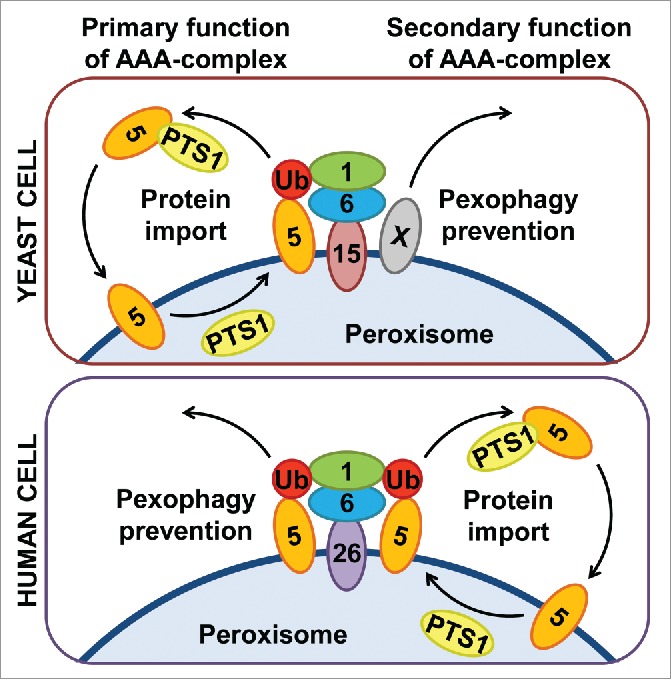
Peroxisome biogenesis disorders (PBDs) is a group of diseases caused by mutations in one of the peroxins, proteins responsible for biogenesis of the peroxisomes. In recent years, it became clear that many peroxins (e.g., PEX3 and PEX14) play additional roles in peroxisome homeostasis (such as promoting autophagic degradation of peroxisomes or pexophagy), which are often opposite to their originally established functions in peroxisome formation and maintenance. Even more interesting, the peroxins that make up the peroxisomal AAA ATPase complex (AAA-complex) in yeast (Pex1, Pex6 and Pex15) or mammals (PEX1, PEX6, PEX26) are responsible for the downregulation of pexophagy. Moreover, this might be even their primary role in human: to prevent pexophagy by removing from the peroxisomal membrane the ubiquitinated peroxisomal matrix protein import receptor, Ub-PEX5, which is also a signal for the Ub-binding pexophagy receptor, NBR1. Remarkably, the peroxisomes rescued from pexophagy by autophagic inhibitors in PEX1 (the most common PBD mutation) cells are able to import matrix proteins and improve their biochemical function suggesting that the AAA-complex per se is not essential for the protein import function in human. This paradigm-shifting discovery published in the current issue of Autophagy has raised hope for up to 65% of all PBD patients with various deficiencies in the AAA-complex. Recognizing PEX1, PEX6 and PEX26 as pexophagy suppressors will allow treating these patients with a new range of tools designed to target mammalian pexophagy.
过氧化物酶体生物发生障碍(PBDs)是一组由过氧化物酶(参与过氧化物酶体生物发生的蛋白质)中的一种发生突变引起的疾病。近年来,人们清楚地认识到,许多过氧化物酶(如PEX3和PEX14)在过氧化物酶体稳态中发挥着额外作用(如促进过氧化物酶体的自噬降解或pexophagy),而这些作用往往与其最初在过氧化物酶体形成和维持中所确立的功能相反。更有趣的是,在酵母(Pex1、Pex6和Pex15)或哺乳动物(PEX1、PEX6、PEX26)中构成过氧化物酶体AAA ATP酶复合物(AAA复合物)的过氧化物酶负责下调pexophagy。此外,这可能甚至是它们在人类中的主要作用:通过从过氧化物酶体膜上移除泛素化的过氧化物酶体基质蛋白导入受体Ub-PEX5来防止pexophagy,Ub-PEX5也是与泛素结合的pexophagy受体NBR1的信号。值得注意的是,在PEX1(最常见的PBD突变)细胞中,通过自噬抑制剂从pexophagy中拯救出来的过氧化物酶体能够导入基质蛋白并改善其生化功能,这表明AAA复合物本身对于人类的蛋白质导入功能并非必不可少。发表在本期《自噬》杂志上的这一具有范式转变意义的发现,为所有AAA复合物存在各种缺陷的PBD患者中的多达65%带来了希望。将PEX1、PEX6和PEX26识别为pexophagy抑制因子,将使我们能够用一系列旨在靶向哺乳动物pexophagy的新工具来治疗这些患者。