a Department of Occupational Therapy , University of Texas Medical Branch , Galveston , TX , USA.
b Division of Rehabilitation Sciences , University of Texas Medical Branch , Galveston , TX , USA.
Disabil Rehabil. 2018 Jun;40(12):1401-1409. doi: 10.1080/09638288.2017.1297855. Epub 2017 Mar 21.
To explore the mobility-related preferences among stroke survivors and caregivers following post-acute rehabilitation at inpatient or skilled nursing facilities.
In this cross-sectional study; semi-structured, qualitative interviews of stroke survivors (n = 24) and informal caregivers (n = 15) were conducted. The participants were recruited from the community.
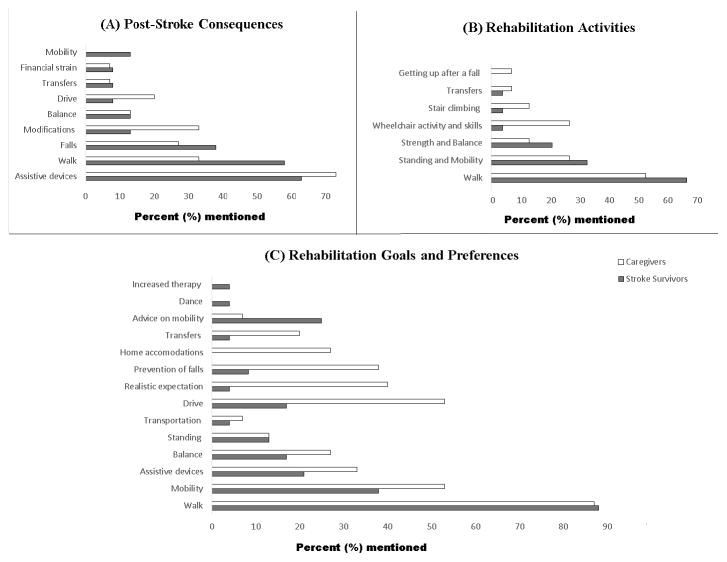
Comparative content analysis was used to identify themes by two independent coders. The survivors (68 years) and caregivers (58 years) mentioned mobility-related consequences including inability to walk, balance, drive, and transfer; and increased falls. The survivors (63%) and caregivers (73%) also mentioned the use of assistive devices. The common rehabilitation activities included: walking (62%); followed by standing and mobility; strength and balance; and wheelchair skills. Some stroke survivors were dissatisfied as their rehabilitation was not patient-centered. Frequently mentioned outcome preferences by survivors were ability to walk (88%), move, and balance. They also wanted to acquire assistive devices to move independently. Caregivers were concerned with the survivor's safety and wanted them to drive (53%), prevent falls, have home accommodations, and transfer independently. Caregivers (40%) also expressed the importance of receiving realistic information.
This study suggests a need to consider the stroke survivors' and caregivers' mobility outcome preferences to improve the patient-centered rehabilitation care. Implications for Rehabilitation Stroke survivors and caregivers tend to differ in their outcome preferences. Caregivers expressed concern for transfers, driving, fall prevention, home modifications, and wished for realistic information. Incorporating stroke survivors and their families' perspectives during rehabilitation may enhance patient-centered outcomes.
探讨急性康复后在住院或熟练护理机构的脑卒中幸存者及其照顾者的移动相关偏好。
在这项横断面研究中;对 24 名脑卒中幸存者(n=24)和 15 名非正式照顾者(n=15)进行了半结构化、定性访谈。参与者是从社区招募的。
两名独立编码员使用对比内容分析法确定主题。幸存者(68 岁)和照顾者(58 岁)提到了与移动相关的后果,包括无法行走、平衡、驾驶和转移;以及增加跌倒。幸存者(63%)和照顾者(73%)也提到了使用辅助设备。常见的康复活动包括:行走(62%);其次是站立和移动;力量和平衡;以及轮椅技能。一些脑卒中幸存者对他们的康复不是以患者为中心感到不满。幸存者经常提到的结果偏好是能够行走(88%)、移动和平衡。他们还希望获得辅助设备以独立移动。照顾者关心幸存者的安全,并希望他们能够驾驶(53%)、预防跌倒、拥有家庭住所和独立转移。照顾者(40%)也表示收到现实信息的重要性。
这项研究表明,需要考虑脑卒中幸存者及其照顾者的移动结果偏好,以改善以患者为中心的康复护理。
脑卒中幸存者和照顾者在结果偏好上往往存在差异。照顾者对转移、驾驶、跌倒预防、家庭改造以及希望获得现实信息表示关注。在康复过程中纳入脑卒中幸存者及其家属的观点可能会增强以患者为中心的结果。