Banerjee Sushanta K, Kumar Rakesh, Warvadekar Janardan, Manning Vinoj, Andersen Kathryn Louise
Research and Evaluation, Ipas Development Foundation, New Delhi, India.
Reproductive & Child Health Programme, Ministry of Health and Family Welfare, Government of India, New Delhi, India.
BMC Health Serv Res. 2017 Mar 21;17(1):223. doi: 10.1186/s12913-017-2159-6.
Maternal mortality, which primarily burdens developing countries, reflects the greatest health divide between rich and poor. This is especially pronounced for access to safe abortion services which alone avert 1 of every 10 maternal deaths in India. Primarily due to confidentiality concerns, poor women in India prefer private services which are often offered by untrained providers and may be expensive. In 2006 the state government of Madhya Pradesh (population 73 million) began a concerted effort to ensure access to safe abortion services at public health facilities to both rural and urban poor women. This study aims to understand the socio-economic profile of women seeking abortion services in public health facilities across this state and out of pocket cost accessing abortion services. In particular, we examine the level of access that poor women have to safe abortion services in Madhya Pradesh.
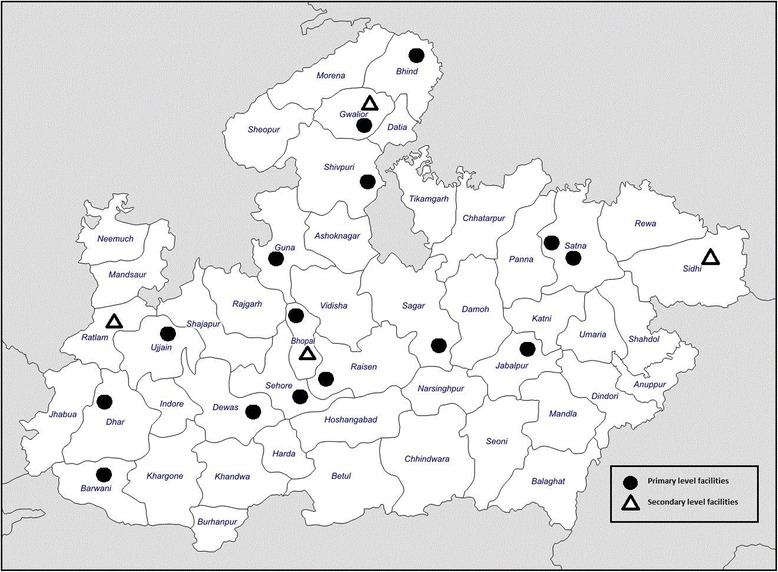
This study consisted of a cross-sectional client follow-up design. A total of 19 facilities were selected using two-stage random sampling and 1036 women presenting to chosen facilities with abortion and post-abortion complications were interviewed between May and December 2014. A structured data collection tool was developed. A composite wealth index computed using principal component analysis derived weights from consumer durables and asset holding and classified women into three categories, poor, moderate, and rich.
Findings highlight that overall 57% of women who received abortion care at public health facilities were poor, followed by 21% moderate and 22% rich. More poor women sought care at primary level facilities (58%) than secondary level facilities and among women presenting for postabortion complications (67%) than induced abortion. Women reported spending no money to access abortion services as abortion services are free of cost at public facilities. However, poor women spend INR 64 (1 USD) while visiting primary level facilities and INR 256 (USD 4) while visiting urban hospitals, primarily for transportation and food.
Improved availability of safe abortion services at the primary level in Madhya Pradesh has helped meeting the need of safe abortion services among poor, which eventually will help reducing the maternal mortality and morbidity due to unsafe abortion.
孕产妇死亡率主要影响发展中国家,反映了贫富之间最大的健康差距。这在获得安全堕胎服务方面尤为明显,仅在印度,安全堕胎服务就能避免每10例孕产妇死亡中的1例。主要由于保密问题,印度贫困妇女更喜欢由未经培训的提供者提供的私人服务,而且这些服务可能很昂贵。2006年,中央邦(人口7300万)州政府开始协同努力,确保农村和城市贫困妇女能够在公共卫生机构获得安全堕胎服务。本研究旨在了解该州公共卫生机构中寻求堕胎服务的妇女的社会经济状况以及获得堕胎服务的自付费用。特别是,我们研究了中央邦贫困妇女获得安全堕胎服务的程度。
本研究采用横断面客户随访设计。通过两阶段随机抽样选择了19个机构,并于2014年5月至12月期间对1036名到选定机构就诊的有堕胎及堕胎后并发症的妇女进行了访谈。开发了一种结构化数据收集工具。使用主成分分析计算得出的综合财富指数,根据耐用消费品和资产持有情况得出权重,并将妇女分为贫困、中等和富裕三类。
研究结果表明,总体而言,在公共卫生机构接受堕胎护理的妇女中,57%为贫困妇女,其次是21%的中等收入妇女和22%的富裕妇女。与二级机构相比,更多贫困妇女在初级机构寻求护理(58%),在出现堕胎后并发症的妇女中(67%)比人工流产的妇女更多。妇女报告称,由于公共机构的堕胎服务免费,她们无需花钱就能获得堕胎服务。然而,贫困妇女在前往初级机构时花费64印度卢比(1美元),在前往城市医院时花费256印度卢比(4美元),主要用于交通和食品。
中央邦初级层面安全堕胎服务可及性的提高有助于满足贫困妇女对安全堕胎服务的需求,最终将有助于降低不安全堕胎导致的孕产妇死亡率和发病率。