Jiang Juean, Liu Cuiping, Liu Mi, Shen Yu, Hu Xiaohan, Wang Qin, Wu Jian, Wu Min, Fang Qi, Zhang Xueguang
Jiangsu Institute of Clinical Immunology & Jiangsu Key Laboratory of Clinical Immunology, First Affiliated Hospital of Soochow University, No. 708 Renmin Road, Suzhou, 215006, Jiangsu, China.
Departments of Rheumatology, Third Affiliated Hospital of Soochow University, No. 185 Juqian Road, Changzhou, 213003, Jiangsu, China.
Arthritis Res Ther. 2017 Mar 21;19(1):67. doi: 10.1186/s13075-017-1261-9.
CD4CD28 T cells exhibit autoreactive potential in autoimmune disorders, including rheumatoid arthritis (RA). It is not well known which costimulator functions as an alternative second signal in the activation of this subset after CD28 expression is downregulated. Tumor necrosis factor receptor superfamily member OX40 is a key costimulator in the activation of T cells. The aim of this study was to investigate the costimulatory effects of OX40 on CD4CD28 T cells in autoimmune arthritis.
Clinical samples were collected from patients with RA and control subjects. Collagen-induced arthritis (CIA) was induced with collagen type II (CII) in DBA/1 mice. The CD4CD28OX40 T-cell subset and its cytokine production were detected by flow cytometry. After T-cell purification, adoptive transfer was performed in CIA mice. The regulatory role of OX40 was determined by blocking experiments in vitro and in vivo.
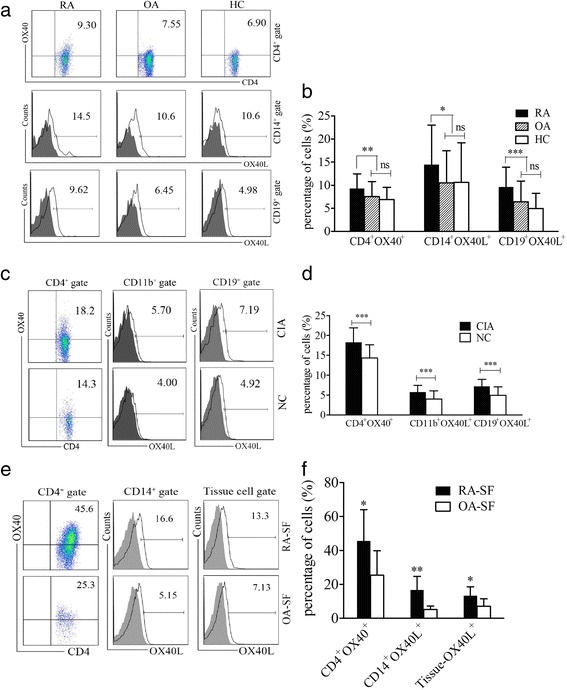
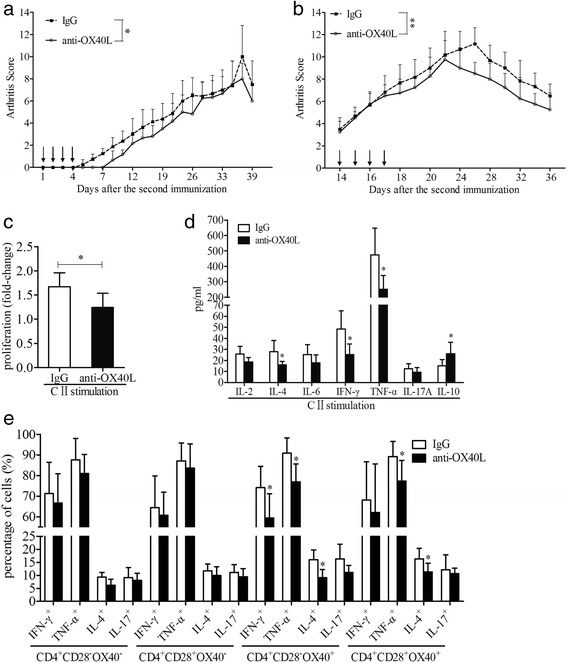
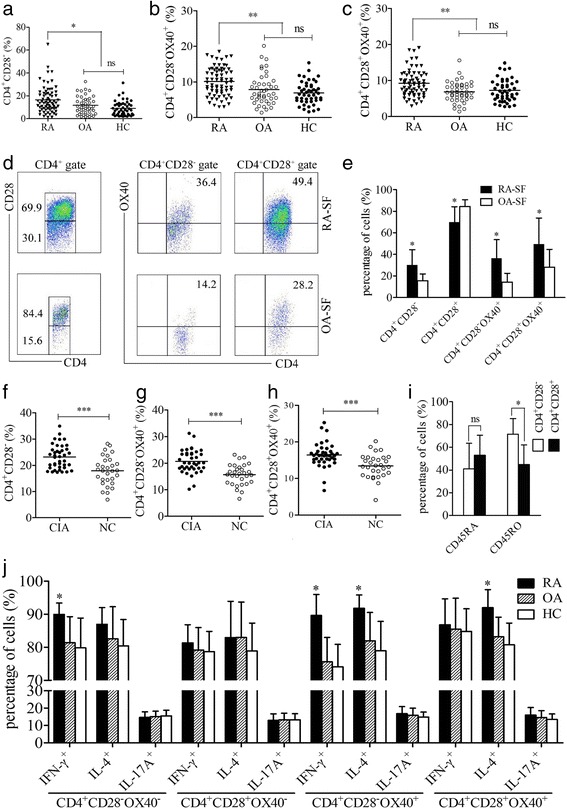
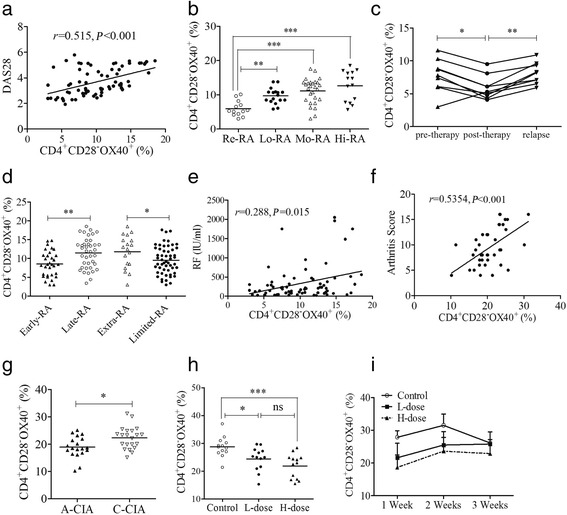
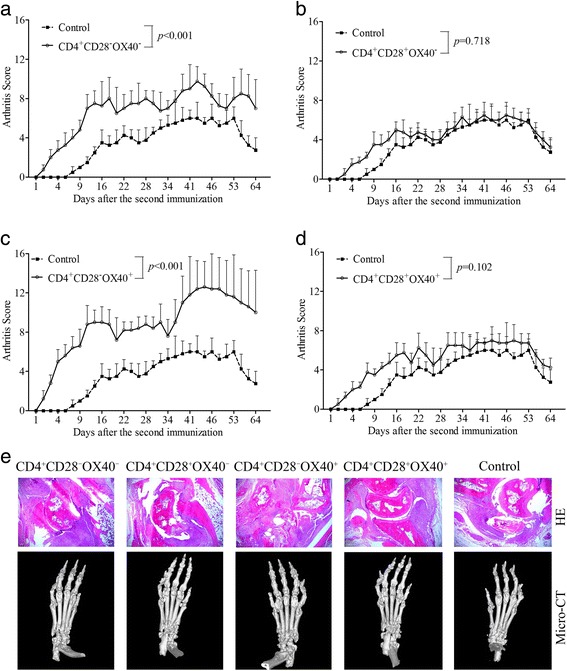
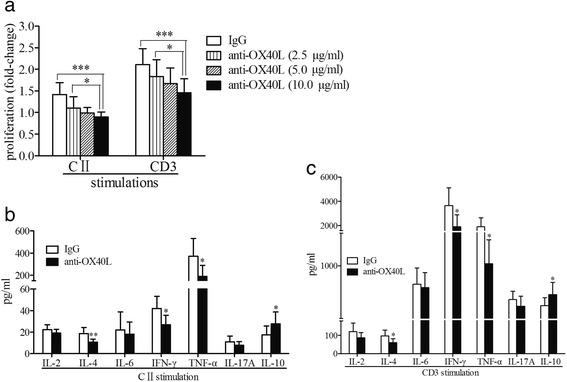
OX40 and OX40L were abnormally expressed in patients with RA and CIA mice. Further analysis showed that CD4CD28OX40 T cells accumulated in patients with RA and in animal models. These cells produced higher levels of proinflammatory cytokines and were closely correlated with the clinicopathological features of the affected individuals. Adoptive transfer of CII-specific CD4CD28OX40 T cells remarkably aggravated arthritic development and joint pathology in CIA mice. Moreover, OX40 blockade significantly reduced the proinflammatory responses and ameliorated arthritis development.
OX40 acts as an alternative costimulator of CD4CD28 T cells and plays a pathogenic role in autoimmune arthritic development, suggesting that it is a potential target for immunomodulatory therapy of RA.
CD4CD28 T细胞在包括类风湿关节炎(RA)在内的自身免疫性疾病中表现出自身反应性潜能。在CD28表达下调后,哪种共刺激分子作为该亚群激活的替代第二信号尚不清楚。肿瘤坏死因子受体超家族成员OX40是T细胞激活中的关键共刺激分子。本研究的目的是探讨OX40对自身免疫性关节炎中CD4CD28 T细胞的共刺激作用。
从RA患者和对照受试者中收集临床样本。用II型胶原(CII)在DBA/1小鼠中诱导胶原诱导性关节炎(CIA)。通过流式细胞术检测CD4CD28OX40 T细胞亚群及其细胞因子产生。T细胞纯化后,在CIA小鼠中进行过继转移。通过体外和体内阻断实验确定OX40的调节作用。
OX40和OX40L在RA患者和CIA小鼠中异常表达。进一步分析表明,CD4CD28OX40 T细胞在RA患者和动物模型中积累。这些细胞产生更高水平的促炎细胞因子,并且与受影响个体的临床病理特征密切相关。CII特异性CD4CD28OX40 T细胞的过继转移显著加重了CIA小鼠的关节炎发展和关节病理。此外,OX40阻断显著降低了促炎反应并改善了关节炎发展。
OX40作为CD4CD28 T细胞的替代共刺激分子,在自身免疫性关节炎发展中起致病作用,提示它是RA免疫调节治疗的潜在靶点。