Makri Olga E, Tsapardoni Foteini N, Plotas Panagiotis, Ifantis Nikistratos, Xanthopoulou Paraskevi T, Georgakopoulos Constantine D
Department of Ophthalmology, Medical School, University of Patras, 265 04, Patras, Greece.
Department of Ophthalmology, 401 General Military Hospital of Athens, Athens, Greece.
BMC Res Notes. 2017 Mar 20;10(1):127. doi: 10.1186/s13104-017-2448-5.
Cystoid macular edema associated with latanoprost administration has been reported in patients after complicated cataract surgery with coexisting risk factors. We present the first case of preservative free latanoprost associated cystoid macular edema that occurred many months after uncomplicated cataract surgery.
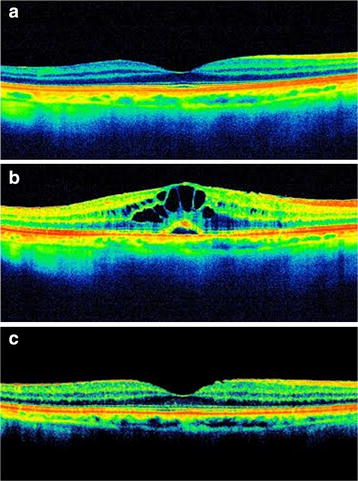
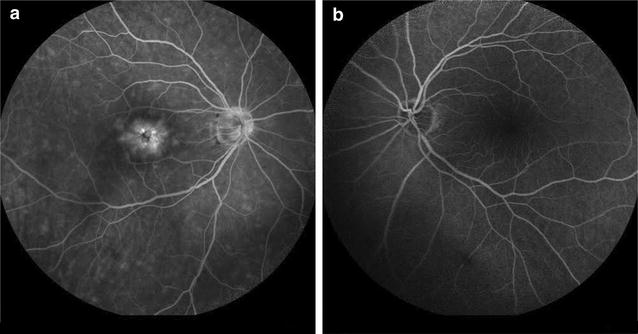
A 65-year old Caucasian female presented in the Outpatients Clinic complaining of reduced vision and metamorphopsia in the right eye. She had undergone uneventful phacoemulsification 19 months ago in the right eye and was under treatment with preservative free latanoprost eye drops for the last 7 months for ocular hypertension. Her remaining medical and ocular history were otherwise unremarkable. Cystoid macular edema with serous retinal detachment was diagnosed in the right eye using optical coherence tomography and fluorescein angiography. Latanoprost was discontinued and brinzolamide and nepafenac eye drops were administered in the right eye. Two months later, cystoid macular edema completely resolved with restoration of visual acuity. Nepafenac eye drops were administered for another 2 months. Eight months after latanoprost cessation optical coherence demonstrated no sign of cystoid macular edema whereas a subtle epiretinal membrane was noted.
Cystoid macular edema may potentially occur in patients receiving preservative free latanoprost. More interestingly, in our case it was diagnosed in a patient with a long standing pseudophakia after uncomplicated phacoemulsification. No obvious risk factor for macular edema development was recognized. Prompt diagnosis and latanoprost discontinuation resulted in complete resolution of the cystoid macular edema and functional restoration of the eye.
在伴有共存危险因素的复杂白内障手术后的患者中,已有使用拉坦前列素导致黄斑囊样水肿的报道。我们报告首例在无并发症白内障手术后数月出现的不含防腐剂拉坦前列素相关性黄斑囊样水肿病例。
一名65岁的白种女性到门诊就诊,主诉右眼视力下降和视物变形。她19个月前右眼接受了顺利的超声乳化白内障吸除术,在过去7个月中一直使用不含防腐剂的拉坦前列素滴眼液治疗眼压升高。她的其余病史和眼部病史均无异常。使用光学相干断层扫描和荧光素血管造影术诊断右眼为伴有浆液性视网膜脱离的黄斑囊样水肿。停用拉坦前列素,右眼给予布林佐胺和奈帕芬酸滴眼液。两个月后,黄斑囊样水肿完全消退,视力恢复。继续使用奈帕芬酸滴眼液2个月。停用拉坦前列素8个月后光学相干断层扫描显示无黄斑囊样水肿迹象,但可见轻微的视网膜前膜。
接受不含防腐剂拉坦前列素治疗的患者可能发生黄斑囊样水肿。更有趣的是,在我们的病例中,该患者在无并发症的超声乳化白内障吸除术后长期存在人工晶状体眼的情况下被诊断为此病。未发现黄斑水肿发生的明显危险因素。及时诊断并停用拉坦前列素导致黄斑囊样水肿完全消退,眼部功能恢复。