Chiu Ming-Jang, Fan Ling-Yun, Chen Ta-Fu, Chen Ya-Fang, Chieh Jen-Jei, Horng Herng-Er
Department of Neurology, National Taiwan University Hospital, College of Medicine, National Taiwan UniversityTaipei, Taiwan; Graduate Institute of Brain and Mind Sciences, College of Medicine, National Taiwan UniversityTaipei, Taiwan; Department of Psychology, National Taiwan UniversityTaipei, Taiwan; Graduate Institute of Biomedical Engineering and Bioinformatics, National Taiwan UniversityTaipei, Taiwan.
Graduate Institute of Brain and Mind Sciences, College of Medicine, National Taiwan UniversityTaipei, Taiwan; Section of Neurology, Department of Psychosomatic Medicine, Taipei City HospitalTaipei, Taiwan.
Front Aging Neurosci. 2017 Mar 6;9:51. doi: 10.3389/fnagi.2017.00051. eCollection 2017.
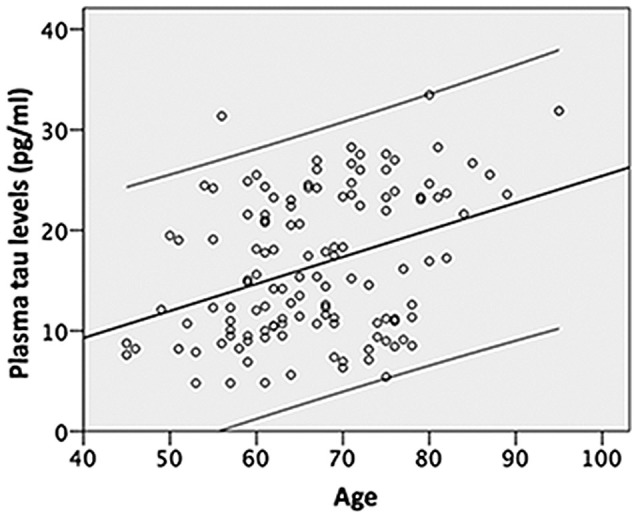
Using an ultra-sensitive technique, an immunomagnetic reduction assay, the plasma tau level can be measured to a limit of quantification of pg/ml. In total 126 cognitively normal middle-aged and older adults (45-95 years old) were recruited. The plasma tau levels were significantly higher in the older group (aged 65-95 years) 18.14 ± 7.33 pg/ml than those in the middle-aged group (aged 45-64 years) 14.35 ± 6.49 pg/ml when controlled gender and ε4 carrier status ( = 3.102, = 0.029). The ε4 carriers had higher plasma tau levels than the non-carriers when controlled age and gender ( = 6.149, = 0.001). Men had higher plasma tau levels than their women counterparts when controlled ε4 carrier status and gender ( = 6.149, = 0.001). The plasma tau levels were found to be positively associated with their ages ( = 0.359, < 0.001). Regression analysis showed that age explained approximately 13% of the variance in the plasma tau levels, and explained more than 10% of the variance in the volumes of the hippocampus and white matter hypodensity ( change 0.1230.167, all < 0.001), and explained less than 10% of the variance in the volume of the amygdala, and central part of the corpus callosum ( change 0.0850.097, all = 0.001). However, the plasma tau levels do not further explain any residual variance in the volume of brain structures. In conclusion, the effect of age on the plasma tau levels should always be considered in clinical applications of this surrogate biomarker to middle-aged and elderly subjects.
采用一种超灵敏技术——免疫磁珠还原分析,血浆tau水平的检测限可达pg/ml。共招募了126名认知正常的中老年人(45 - 95岁)。在控制性别和ε4携带者状态后(F = 3.102,P = 0.029),老年组(65 - 95岁)的血浆tau水平为18.14±7.33 pg/ml,显著高于中年组(45 - 64岁)的14.35±6.49 pg/ml。在控制年龄和性别后(F = 6.149,P = 0.001),ε4携带者的血浆tau水平高于非携带者。在控制ε4携带者状态和性别后(F = 6.149,P = 0.001),男性的血浆tau水平高于女性。血浆tau水平与年龄呈正相关(r = 0.359,P < 0.001)。回归分析表明,年龄可解释血浆tau水平约13%的变异,且可解释海马体和白质低密度体积变异的10%以上(β变化0.1230.167,均P < 0.001),可解释杏仁核和胼胝体中部体积变异的10%以下(β变化0.0850.097,均P = 0.001)。然而,血浆tau水平并不能进一步解释脑结构体积的任何残余变异。总之,在将这种替代生物标志物应用于中年和老年受试者的临床应用中,应始终考虑年龄对血浆tau水平的影响。