Bucerius Jan, Barthel Henryk, Tiepolt Solveig, Werner Peter, Sluimer Judith C, Wildberger Joachim E, Patt Marianne, Hesse Swen, Gertz Hermann-Josef, Biessen Erik A L, Mottaghy Felix M, Sabri Osama
Department of Radiology/Nuclear Medicine, Maastricht University Medical Center (MUMC+), Maastricht, The Netherlands.
Cardiovascular Research Institute Maastricht (CARIM), Maastricht University Medical Center (MUMC+), Maastricht, The Netherlands.
Eur J Nucl Med Mol Imaging. 2017 Jul;44(7):1119-1128. doi: 10.1007/s00259-017-3651-2. Epub 2017 Mar 21.
Amyloid-beta (Aβ) peptides are involved in the inflammatory pathology of atherosclerosis. F-Florbetaben is a PET tracer for clinical imaging of cerebral Aβ plaques in Alzheimer's disease (AD). We sought to determine whether specific uptake of F-florbetaben in the carotid arteries can be identified using a fully integrated hybrid PET/MRI system and whether this uptake is associated with clinical cardiovascular disease (CVD) risk factors.
Carotid F-florbetaben uptake was quantified as the mean of the maximum target-to-background ratio (TBR) in 40 cognitively impaired subjects (age 68.2 ± 9.5 years) undergoing F-florbetaben PET/MRI to diagnose AD. Associations between carotid F-florbetaben uptake and several CVD risk factors were assessed by univariate analysis followed by a multivariate linear regression analysis. Furthermore, carotid F-florbetaben uptake was compared between patients with and without a positive cerebral Aβ PET scan.
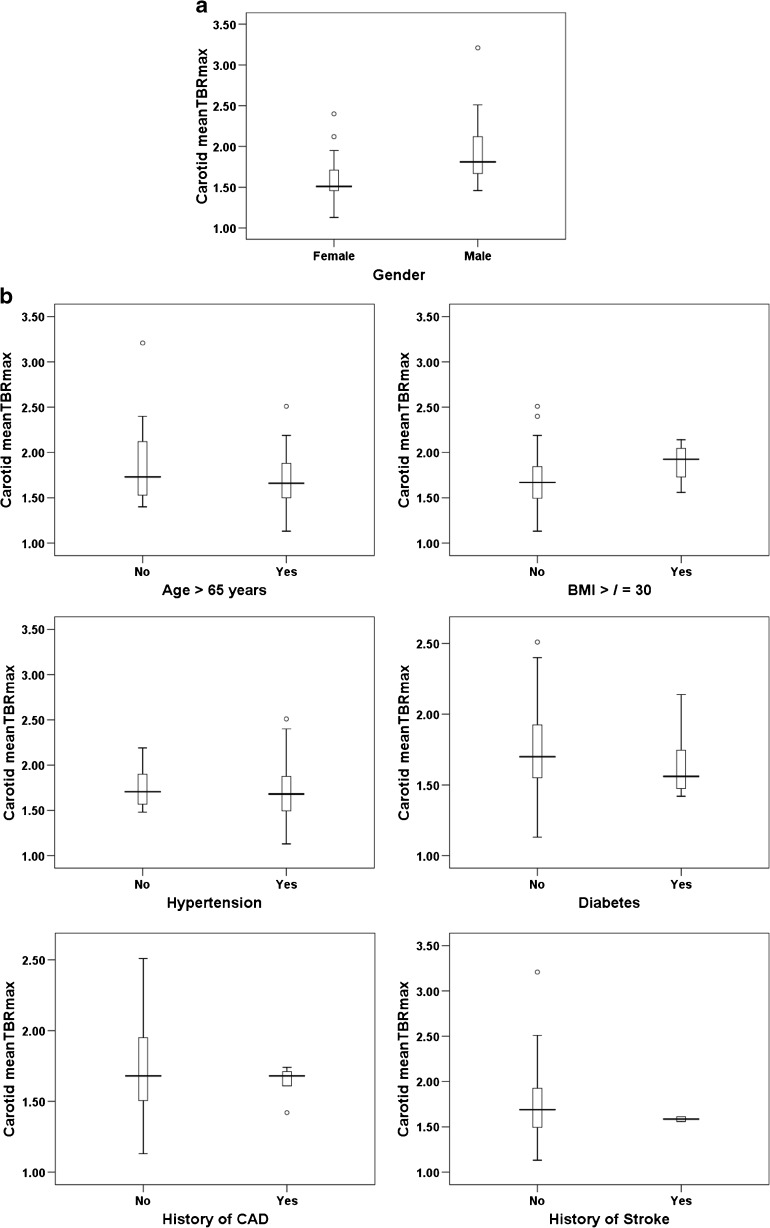
F-Florbetaben uptake was clearly visualized in the carotid arteries. Values of TBR corrected for the blood pool activity of the tracer showed specific F-florbetaben uptake in the carotid wall. Male gender was associated with carotid F-florbetaben uptake in the univariate analysis, and was found to be an independent predictor of F-florbetaben uptake in the multivariate regression analysis (standardized regression coefficient β = 0.407, p = 0.009). Carotid F-florbetaben TBR in patients with a positive cerebral Aβ scan did not differ from that in patients without cerebral Aβ deposits.
Specific F-florbetaben uptake in human carotid arteries was detected. Male gender was identified as an independent clinical risk factor. Therefore, F-florbetaben PET/MRI might provide new insights into the pathophysiological process in atherosclerosis.
β淀粉样蛋白(Aβ)肽参与动脉粥样硬化的炎症病理过程。F-氟代苯并噻唑(F-florbetaben)是一种用于阿尔茨海默病(AD)脑Aβ斑块临床成像的正电子发射断层显像(PET)示踪剂。我们试图确定能否使用完全集成的PET/MRI混合系统识别F-氟代苯并噻唑在颈动脉中的特异性摄取,以及这种摄取是否与临床心血管疾病(CVD)危险因素相关。
对40名认知障碍患者(年龄68.2±9.5岁)进行F-氟代苯并噻唑PET/MRI以诊断AD,将颈动脉F-氟代苯并噻唑摄取量量化为最大目标与背景比值(TBR)的平均值。通过单因素分析,随后进行多变量线性回归分析,评估颈动脉F-氟代苯并噻唑摄取与几种CVD危险因素之间的关联。此外,比较了脑Aβ PET扫描阳性和阴性患者的颈动脉F-氟代苯并噻唑摄取情况。
F-氟代苯并噻唑摄取在颈动脉中清晰可见。经示踪剂血池活性校正后的TBR值显示,颈动脉壁存在特异性F-氟代苯并噻唑摄取。在单因素分析中,男性与颈动脉F-氟代苯并噻唑摄取相关,在多变量回归分析中发现男性是F-氟代苯并噻唑摄取的独立预测因子(标准化回归系数β = 0.407,p = 0.009)。脑Aβ扫描阳性患者的颈动脉F-氟代苯并噻唑TBR与无脑Aβ沉积患者的TBR无差异。
检测到人体颈动脉中存在特异性F-氟代苯并噻唑摄取。男性被确定为独立的临床危险因素。因此,F-氟代苯并噻唑PET/MRI可能为动脉粥样硬化的病理生理过程提供新的见解。