Menzies Health Institute Queensland, School of Nursing and Midwifery, Griffith University, Nathan, Queensland, Australia
Department of Anaesthesia and Pain Management, Queensland Children's Hospital, South Brisbane, Queensland, Australia.
BMJ Qual Saf. 2021 Sep;30(9):722-730. doi: 10.1136/bmjqs-2020-011274. Epub 2020 Sep 22.
Data regarding vascular access device use and outcomes are limited. In part, this gap reflects the absence of guidance on what variables should be collected to assess patient outcomes. We sought to derive international consensus on a vascular access minimum dataset.
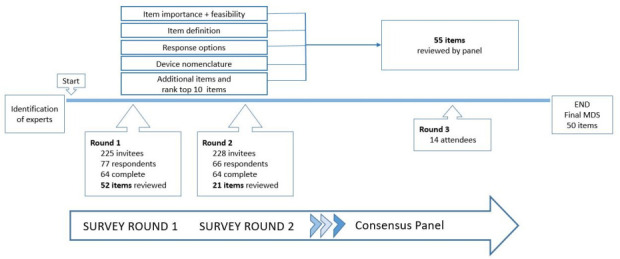
A modified Delphi study with three rounds (two electronic surveys and a face-to-face consensus panel) was conducted involving international vascular access specialists. In Rounds 1 and 2, electronic surveys were distributed to healthcare professionals specialising in vascular access. Survey respondents were asked to rate the importance of variables, feasibility of data collection and acceptability of items, definitions and response options. In Round 3, a purposive expert panel met to review Round 1 and 2 ratings and reach consensus (defined as ≥70% agreement) on the final items to be included in a minimum dataset for vascular access devices.
A total of 64 of 225 interdisciplinary healthcare professionals from 11 countries responded to Round 1 and 2 surveys (response rate of 34% and 29%, respectively). From the original 52 items, 50 items across five domains emerged from the Delphi procedure.Items related to demographic and clinical characteristics (n=5; eg, age), device characteristics (n=5; eg, device type), insertion (n=16; eg, indication), management (n=9; eg, dressing and securement), and complication and removal (n=15, eg, occlusion) were identified as requirements for a minimum dataset to track and evaluate vascular access device use and outcomes.
We developed and internally validated a minimum dataset for vascular access device research. This study generated new knowledge to enable healthcare systems to collect relevant, useful and meaningful vascular access data. Use of this standardised approach can help benchmark clinical practice and target improvements worldwide.
血管通路装置的使用和结果数据有限。在某种程度上,这一差距反映了缺乏关于应收集哪些变量来评估患者结局的指导。我们旨在就血管通路最小数据集达成国际共识。
采用三轮改良 Delphi 研究(两轮电子调查和一次面对面共识小组会议),涉及国际血管通路专家。在第 1 轮和第 2 轮中,向专门从事血管通路的医疗保健专业人员分发了电子调查。调查受访者被要求对变量的重要性、数据收集的可行性以及项目、定义和应答选项的可接受性进行评分。在第 3 轮中,一个有目的的专家小组开会审查第 1 轮和第 2 轮的评分,并就血管通路装置最小数据集应包含的最终项目达成共识(定义为≥70%的一致性)。
共有来自 11 个国家的 225 名跨学科医疗保健专业人员中的 64 人回复了第 1 轮和第 2 轮调查(回复率分别为 34%和 29%)。经过 Delphi 程序,从最初的 52 个项目中,确定了五个领域的 50 个项目。与人口统计学和临床特征(n=5;例如,年龄)、装置特征(n=5;例如,装置类型)、插入(n=16;例如,适应证)、管理(n=9;例如,敷料和固定)以及并发症和移除(n=15,例如,闭塞)相关的项目被确定为跟踪和评估血管通路装置使用和结果的最小数据集要求。
我们开发并内部验证了血管通路装置研究的最小数据集。这项研究产生了新知识,使医疗保健系统能够收集相关、有用和有意义的血管通路数据。使用这种标准化方法可以帮助在全球范围内对临床实践进行基准测试和改进。