Yu Eun-Jeong, Hooker Erika, Johnson Daniel T, Kwak Mi Kyung, Zou Kang, Luong Richard, He Yongfeng, Sun Zijie
Department of Cancer Biology, Beckman Research Institute, City of Hope, Duarte, California, United States of America.
Department of Urology, Stanford University School of Medicine, Stanford, California, United States of America.
PLoS One. 2017 Mar 21;12(3):e0174357. doi: 10.1371/journal.pone.0174357. eCollection 2017.
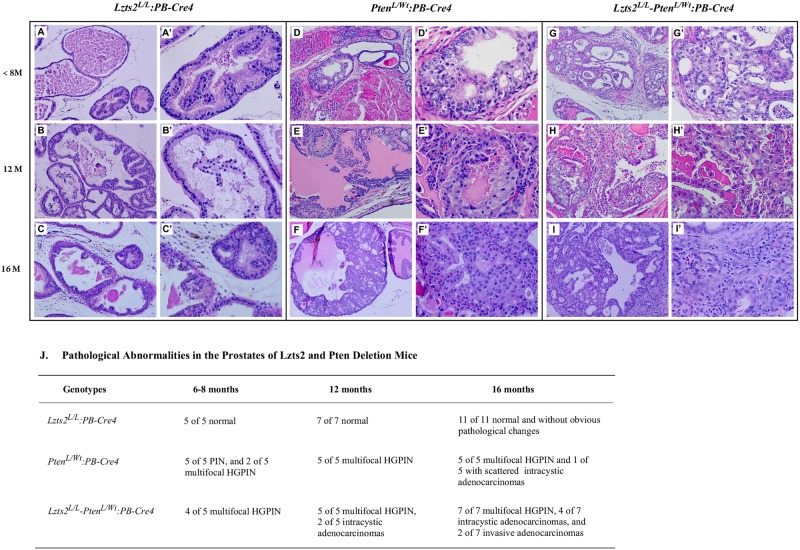
The leucine zipper tumor suppressor 2 (LZTS2) was identified as a tumor susceptibility gene within the 10q24.3 chromosomal region, and is approximately 15Mb from the PTEN locus. This region containing the both loci is frequently deleted in a variety of human malignancies, including prostate cancer. LZTS2 is a ß-catenin-binding protein and a negative regulator of Wnt signaling. Overexpression of PTEN in prostate cancer cell lines reduces ß-catenin-mediated transcriptional activity. In this study, we examined the collaborative effect of PTEN and LZTS2 using multiple in vitro and in vivo approaches. Co-expression of PTEN and LZTS2 in prostate cancer cells shows stronger repressive effect on ß-catenin mediated transcription. Using a newly generated mouse model, we further assessed the effect of simultaneous deletion of Pten and Lzts2 in the murine prostate. We observed that mice with both Lzts2 and Pten deletion have an earlier onset of prostate carcinomas as well as an accelerated tumor progression compared to mice with Pten or Lzts2 deletion alone. Immunohistochemical analyses show that atypical and tumor cells from compound mice with both Pten and Lzts2 deletion are mainly composed of prostate luminal epithelial cells and possess higher levels of cytoplasmic and nuclear β-catenin. These cells also exhibit a higher proliferative capacity than cells isolated from single deletion mice. These data demonstrate the significance of simultaneous Pten and Lzts2 deletion in oncogenic transformation in prostate cells and implicates a new mechanism for the dysregulation of Wnt/β-catenin signaling in prostate tumorigenesis.
亮氨酸拉链肿瘤抑制因子2(LZTS2)被鉴定为位于10q24.3染色体区域内的肿瘤易感基因,距离PTEN基因座约15兆碱基。包含这两个基因座的区域在包括前列腺癌在内的多种人类恶性肿瘤中经常缺失。LZTS2是一种β-连环蛋白结合蛋白,也是Wnt信号通路的负调节因子。在前列腺癌细胞系中过表达PTEN可降低β-连环蛋白介导的转录活性。在本研究中,我们使用多种体外和体内方法研究了PTEN和LZTS2的协同作用。PTEN和LZTS2在前列腺癌细胞中的共表达对β-连环蛋白介导的转录显示出更强的抑制作用。使用新建立的小鼠模型,我们进一步评估了在小鼠前列腺中同时缺失Pten和Lzts2的影响。我们观察到,与单独缺失Pten或Lzts2的小鼠相比,同时缺失Lzts2和Pten的小鼠前列腺癌发病更早,肿瘤进展更快。免疫组织化学分析表明,同时缺失Pten和Lzts2的复合小鼠的非典型细胞和肿瘤细胞主要由前列腺腔上皮细胞组成,并且细胞质和细胞核β-连环蛋白水平较高。这些细胞也比从单基因缺失小鼠分离的细胞表现出更高的增殖能力。这些数据证明了同时缺失Pten和Lzts2在前列腺细胞致癌转化中的重要性,并暗示了Wnt/β-连环蛋白信号通路在前列腺肿瘤发生中失调的新机制。