Department of Lung Cancer, Tianjin Medical University Cancer Institute and Hospital, National Clinical Research Center for Cancer, Tianjin, China.
Key Laboratory of Cancer Prevention and Therapy, Tianjin, China.
Cell Biochem Funct. 2018 Jun;36(4):194-202. doi: 10.1002/cbf.3331. Epub 2018 Apr 13.
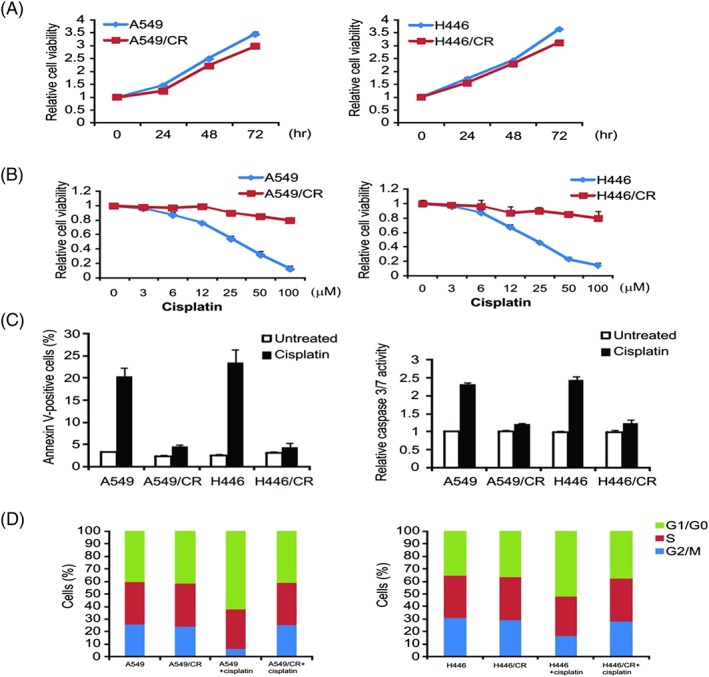
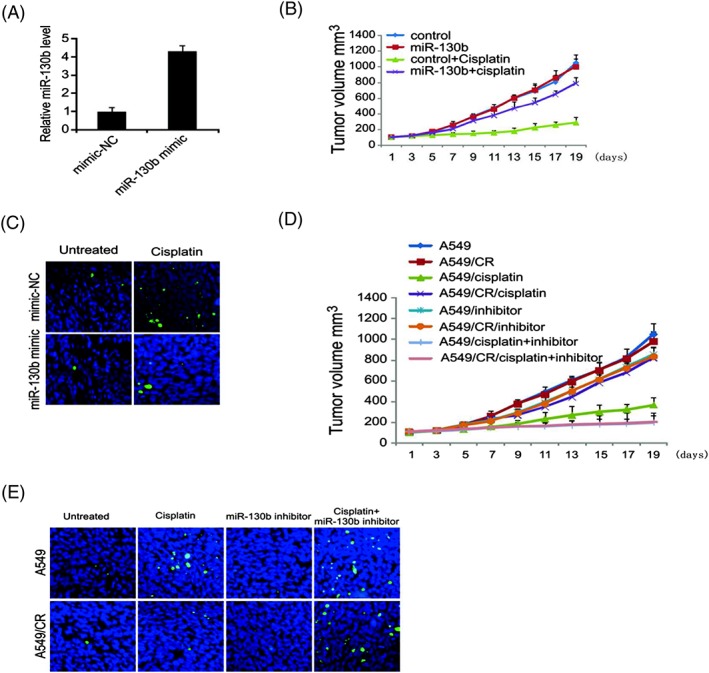
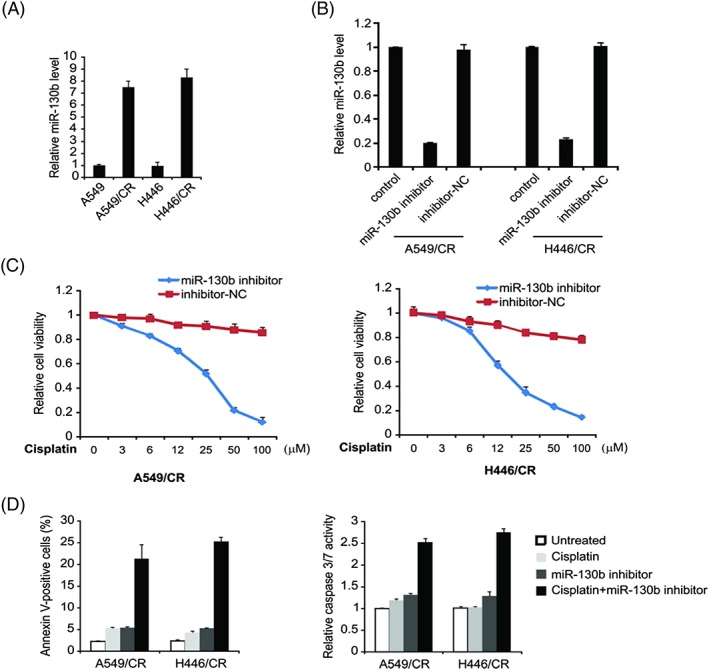
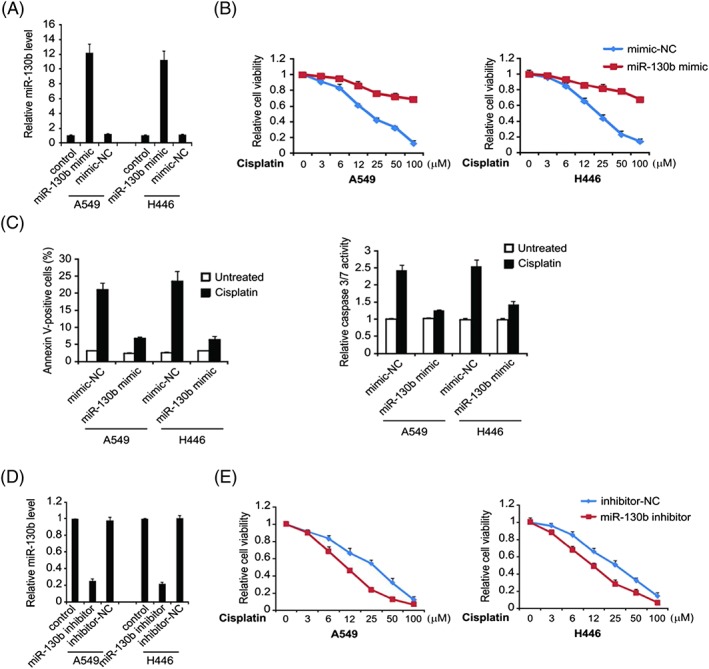
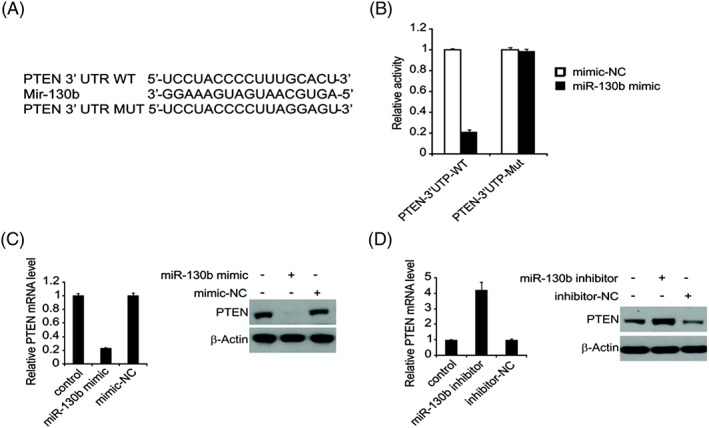
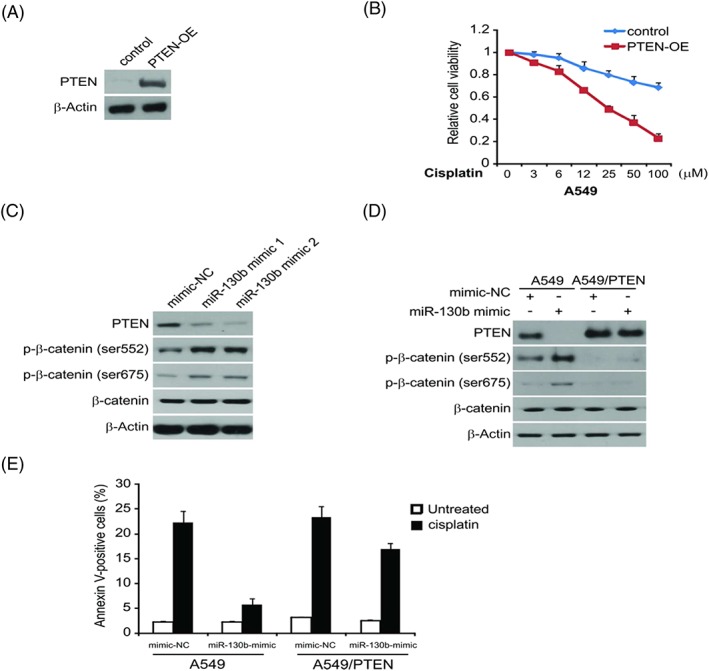
More and more studies indicate the relevance of miRNAs in inducing certain drug resistance. Our study aimed to investigate whether microRNA-130b-3p (miR-130b) mediates the chemoresistance as well as proliferation of lung cancer (LC) cells. MTS assay and apoptosis analysis were conducted to determine cell proliferation and apoptosis, respectively. Binding sites were identified using a luciferase reporter system, whereas mRNA and protein expression of target genes was determined by RT-PCR and immunoblot, respectively. Mouse xenograft model was used to evaluate the role of miR-130b in cisplatin resistance in vivo. The rising level of miR-130b in cisplatin resistance LC cell lines (A549/CR and H446/CR) versus its parental cell lines, indicated its crucial relevance for LC biology. We identified PTEN as miR-130b's major target and inversely correlated with miR-130b expression in LC. Moreover, excessive miR-130b expression promoted drug resistance and proliferation, decreased apoptosis of A549 cells. Suppression of miR-130b enhanced drug cytotoxicity and reduced proliferation of A549/CR cells both internally and externally. Particularly, miR-130b mediated Wnt/β-catenin signalling pathway activities, chemoresistance and proliferation in LC cell, which was partially blocked following knockdown of PTEN. These findings suggest that miR-130b targets PTEN to mediate chemoresistance, proliferation, and apoptosis via Wnt/β-catenin pathway. The rising level of miR-130b in cisplatin resistance LC cell lines (A549/CR and H446/CR) versus its parental cell lines, indicated its crucial relevance for LC biology. Moreover, excessive miR-130b expression promoted drug resistance and proliferation, decreased apoptosis of A549 cells. These findings suggest that miR-130b targets PTEN to mediate chemoresistance, proliferation, and apoptosis via Wnt/β-catenin pathway.
越来越多的研究表明 miRNA 在诱导某些耐药性方面具有相关性。本研究旨在探讨 microRNA-130b-3p(miR-130b)是否介导肺癌(LC)细胞的化疗耐药性和增殖。通过 MTS 分析和凋亡分析分别确定细胞增殖和凋亡。使用荧光素酶报告系统鉴定结合位点,分别通过 RT-PCR 和免疫印迹法确定靶基因的 mRNA 和蛋白表达。使用小鼠异种移植模型来评估 miR-130b 在体内顺铂耐药中的作用。顺铂耐药 LC 细胞系(A549/CR 和 H446/CR)中 miR-130b 水平的升高表明其对 LC 生物学具有重要意义。我们鉴定出 PTEN 是 miR-130b 的主要靶基因,与 LC 中 miR-130b 的表达呈负相关。此外,过量表达 miR-130b 可促进 A549 细胞的耐药性和增殖,减少细胞凋亡。抑制 miR-130b 可增强 A549/CR 细胞的内源性和外源性药物细胞毒性,并降低其增殖能力。特别是,miR-130b 介导 LC 细胞中的 Wnt/β-catenin 信号通路活性、化疗耐药性和增殖,而在敲低 PTEN 后,该作用部分被阻断。这些发现表明,miR-130b 通过 Wnt/β-catenin 途径靶向 PTEN 来介导化疗耐药性、增殖和凋亡。顺铂耐药 LC 细胞系(A549/CR 和 H446/CR)中 miR-130b 水平的升高表明其对 LC 生物学具有重要意义。此外,过量表达 miR-130b 可促进 A549 细胞的耐药性和增殖,减少细胞凋亡。这些发现表明,miR-130b 通过 Wnt/β-catenin 途径靶向 PTEN 来介导化疗耐药性、增殖和凋亡。