Gupta Komal, Garg Shashank, Singh Joginder, Kumar Manoj
NIT, Surathkal, Karnataka, India.
Department of Biotechnology, Lovely Professional University, Punjab, India.
3 Biotech. 2014 Jun;4(3):263-273. doi: 10.1007/s13205-013-0149-x. Epub 2013 Jun 9.
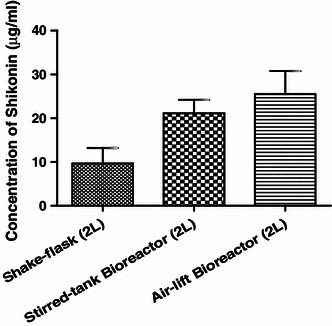
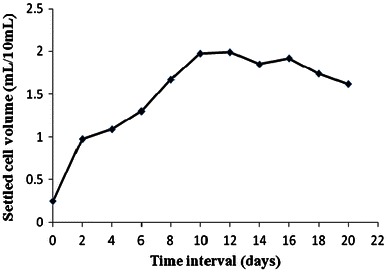
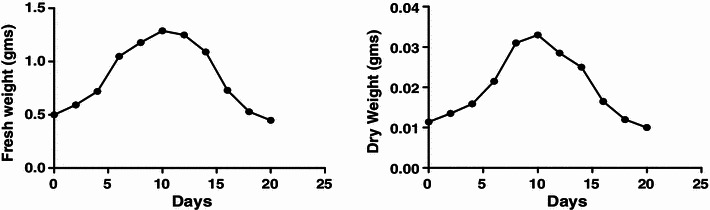
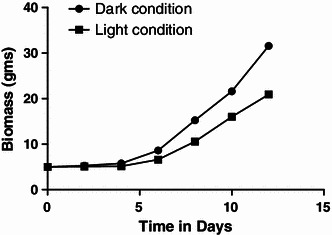
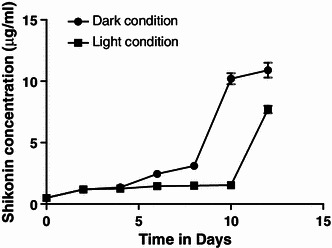
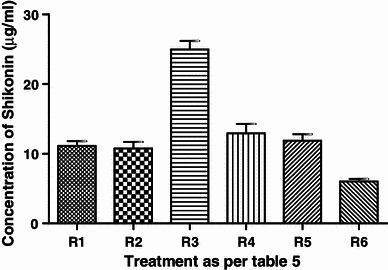
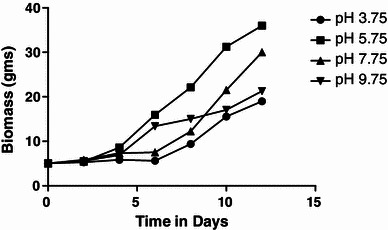
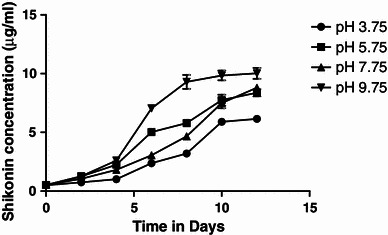
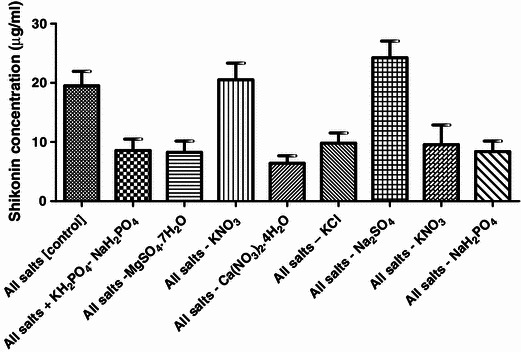
Cell culture in shake flask and air-lift bioreactor was carried out to exploit the potential of Arnebia sp. for napthoquinone metabolite production. Cell suspension cultures of Arnebia were established from friable callus in liquid MS medium supplemented with 6-benzylaminopurine (BAP) (10 μM) and indole-3-butyric acid (IBA) (5 μM). Growth kinetic studies were done by using settled cell volume and fresh/dry cell weight method. Suspension cultures were maintained by sub-culturing at 10 days interval. A two-stage culture system is employed using growth medium (GM) and modified M9 medium (production medium) for cell biomass and naphthoquinone pigment production, respectively. Results showed that cultivation of cells under dark conditions at room temperature (25 ± 2 °C) enhanced the cell biomass from 100 to 625 g l. The pigment production was also found to be increased in dark conditions at room temperature. Alkaline pH found to have positive effect on pigment yield. In case of M9 medium constituents, absence of NaSO does not affect the pigment yield. The current approaches have the cumulative effect to meet an increased level of (25.5 μg/ml) metabolite production in air-lift bioreactor.
在摇瓶和空气提升生物反应器中进行细胞培养,以开发新疆紫草属植物生产萘醌代谢产物的潜力。新疆紫草的细胞悬浮培养物是从添加了6-苄基腺嘌呤(BAP)(10 μM)和吲哚-3-丁酸(IBA)(5 μM)的液体MS培养基中的易碎愈伤组织建立的。通过使用沉降细胞体积和鲜/干细胞重量法进行生长动力学研究。悬浮培养物通过每隔10天传代培养来维持。采用两阶段培养系统,分别使用生长培养基(GM)和改良的M9培养基(生产培养基)来生产细胞生物量和萘醌色素。结果表明,在室温(25±2°C)的黑暗条件下培养细胞可使细胞生物量从100 g/L提高到625 g/L。还发现室温黑暗条件下色素产量增加。碱性pH对色素产量有积极影响。就M9培养基成分而言,不存在NaSO不会影响色素产量。目前的方法具有累积效应,可使空气提升生物反应器中的代谢产物产量提高到25.5 μg/ml。