Strand Vibeke, Reaney Matthew, Chen Chieh-I, Proudfoot Clare W J, Guillonneau Sophie, Bauer Deborah, Mangan Erin, Graham Neil M H, van Hoogstraten Hubert, Lin Yong, Pacheco-Tena César, Fleischmann Roy
Stanford University School of Medicine , Palo Alto, California , USA.
Sanofi , Guildford , UK.
RMD Open. 2017 Mar 7;3(1):e000416. doi: 10.1136/rmdopen-2016-000416. eCollection 2017.
To evaluate effects of the anti-interleukin-6 receptor monoclonal antibody sarilumab administered with conventional synthetic disease-modifying antirheumatic drugs (csDMARDs) on patient-reported outcomes (PROs) in the TARGET trial in patients with rheumatoid arthritis (RA) with inadequate response or intolerance to tumour necrosis factor inhibitors (TNF-IR).
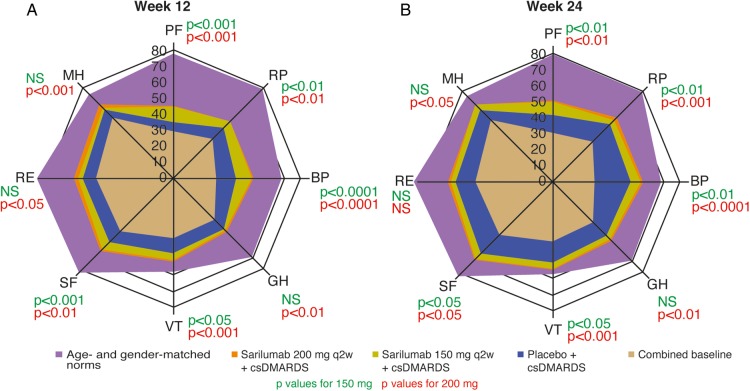
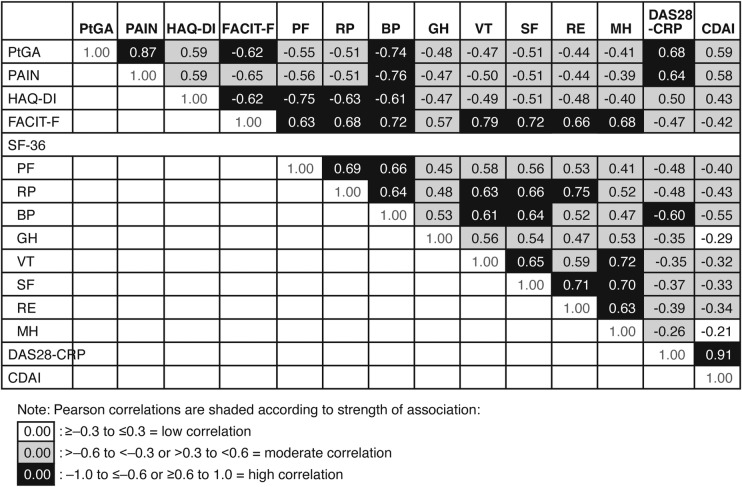
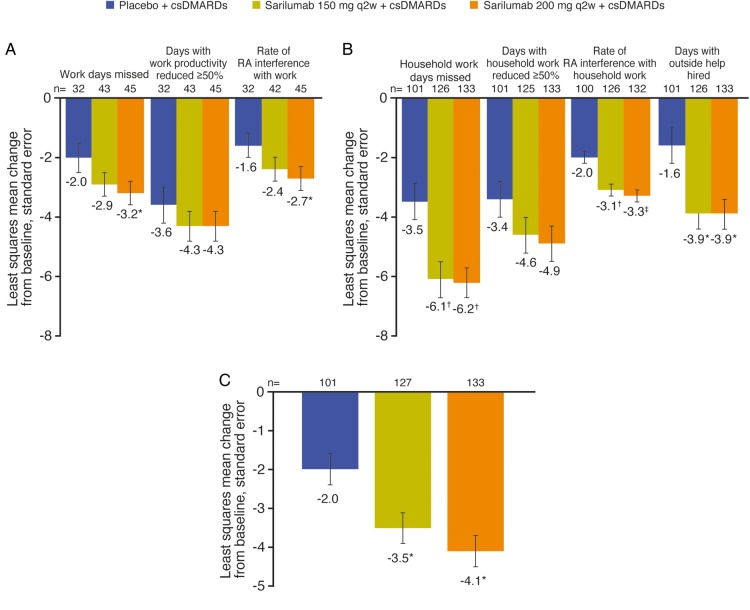
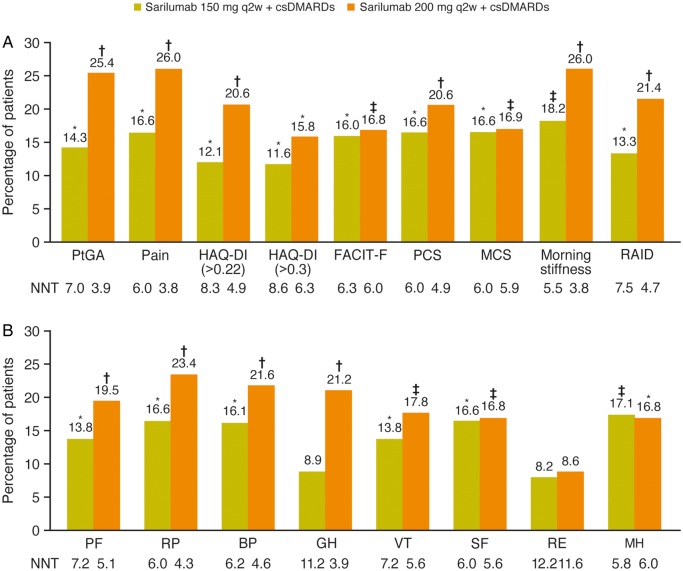
546 patients (81.9% female, mean age 52.9 years) were randomised to placebo, sarilumab 150 or 200 mg subcutaneously every 2 weeks + csDMARDs. PROs included patient global assessment (PtGA); pain and morning stiffness visual analogue scales; Health Assessment Questionnaire Disability Index (HAQ-DI); Short Form-36 Health Survey (SF-36); FACIT-Fatigue (FACIT-F); Work Productivity Survey-Rheumatoid Arthritis (WPS-RA) and Rheumatoid Arthritis Impact of Disease (RAID). Changes from baseline at weeks 12 and 24 were analysed using a mixed model for repeated measures; post hoc analyses included percentages of patients reporting improvements ≥ minimum clinically important differences (MCID) and scores ≥ normative values.
Sarilumab + csDMARDs doses resulted in improvements from baseline at week 12 vs placebo + csDMARDs in PtGA, pain, HAQ-DI, SF-36 and FACIT-F that were maintained at week 24. Sarilumab improved morning stiffness and reduced the impact of RA on work, family, social/leisure activities participation (WPS-RA) and on patients' lives (RAID). Percentages of patients reporting improvements ≥MCID and ≥ normative scores were greater with sarilumab than placebo.
In patients with TNF-IR RA, 150 and 200 mg sarilumab + csDMARDs resulted in clinically meaningful patient-reported benefits on pain, fatigue, function, participation and health status at 12 and 24 weeks that exceeded placebo + csDMARDs, and were consistent with the clinical profile previously reported.
NCT01709578; Results.
在针对对肿瘤坏死因子抑制剂(TNF-IR)反应不足或不耐受的类风湿关节炎(RA)患者的TARGET试验中,评估抗白细胞介素-6受体单克隆抗体萨立尤单抗与传统合成抗风湿药物(csDMARDs)联合使用对患者报告结局(PROs)的影响。
546例患者(81.9%为女性,平均年龄52.9岁)被随机分为安慰剂组、每2周皮下注射150或200mg萨立尤单抗+csDMARDs组。PROs包括患者整体评估(PtGA);疼痛和晨僵视觉模拟量表;健康评估问卷残疾指数(HAQ-DI);简明健康调查36项量表(SF-36);功能性评估癌症治疗-疲劳量表(FACIT-F);类风湿关节炎工作效率调查(WPS-RA)和类风湿关节炎疾病影响(RAID)。使用重复测量混合模型分析第12周和第24周相对于基线的变化;事后分析包括报告改善程度≥最小临床重要差异(MCID)和得分≥正常参考值的患者百分比。
与安慰剂+csDMARDs相比,第12周时萨立尤单抗+csDMARDs剂量组在PtGA、疼痛、HAQ-DI、SF-36和FACIT-F方面相对于基线有所改善,并在第24周时得以维持。萨立尤单抗改善了晨僵,并减轻了RA对工作、家庭、社交/休闲活动参与度(WPS-RA)以及患者生活(RAID)的影响。报告改善程度≥MCID和≥正常参考值的患者百分比,萨立尤单抗组高于安慰剂组。
在TNF-IR RA患者中,150mg和200mg萨立尤单抗+csDMARDs在第12周和第24周时,在疼痛、疲劳、功能、活动参与度和健康状况方面给患者带来了具有临床意义的益处,超过了安慰剂+csDMARDs组,且与先前报告的临床特征一致。
NCT01709578;结果