Kaprilian Christina, Horti Maria, Kandilaris Kosmas, Skolarikos Andreas, Trakas Nikolaos, Kastriotis Ioannis, Deliveliotis Charalambos
Department of Pathology, Sismanoglio General Hospital, Sismanogliou 1, Marousi 15126, Athens, Greece; Department of Clinical Chemistry Sismanoglio General Hospital of Attica; 2nd Department of Urology Athens Medical School, Sismanoglio Hospital, Sismanogliou 1, Marousi 15126, Athens, Greece.
J Kidney Cancer VHL. 2015 Feb 22;2(1):25-29. doi: 10.15586/jkcvhl.2015.22. eCollection 2015.
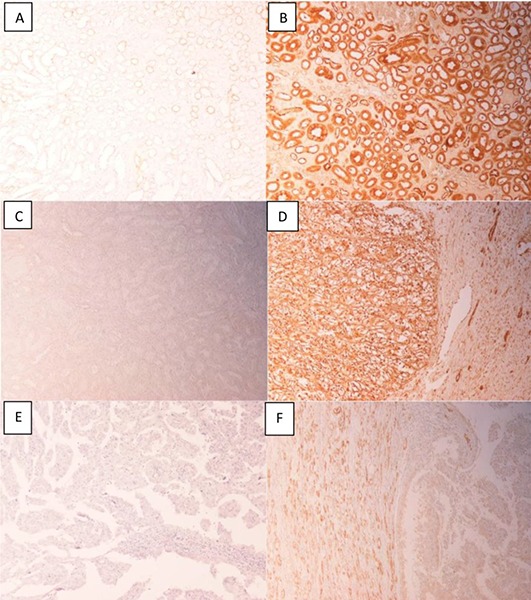
Multidrug resistance correlates with unfavourable treatment outcomes in numerous cancers including renal cell carcinoma. The expression and clinical relevance of Glutathione-S-transferase-pi (GST-pi), a multidrug resistance factor, in kidney tumors remain controversial. We analyzed the expression of GST-pi in 60 formalin-fixed, paraffin-embedded renal cell carcinoma samples by immunohistochemistry and compared them with matched normal regions of the kidney. A significantly higher expression of GST-pi was observed in 87% of clear cell carcinoma and 50% of papillary subtypes. GST-pi expression did not correlate with tumor grade or patient survival. GST-pi is unlikely to be a prognostic factor for renal cell carcinoma. However, further studies with large number of samples are warranted to establish the role of GST-pi, if any, in intrinsic or acquired resistance of renal cell carcinoma to conventional treatments.
多药耐药与包括肾细胞癌在内的多种癌症的不良治疗结果相关。多药耐药因子谷胱甘肽 - S - 转移酶 - π(GST - π)在肾肿瘤中的表达及临床相关性仍存在争议。我们通过免疫组织化学分析了60例福尔马林固定、石蜡包埋的肾细胞癌样本中GST - π的表达,并将其与配对的正常肾组织区域进行比较。在87%的透明细胞癌和50%的乳头状亚型中观察到GST - π表达显著更高。GST - π表达与肿瘤分级或患者生存率无关。GST - π不太可能是肾细胞癌的预后因素。然而,有必要进行更多样本的进一步研究,以确定GST - π在肾细胞癌对传统治疗的内在或获得性耐药中是否起作用(如果有作用的话)。