Takehana Shiori, Kubota Yoshiko, Uotsu Nobuo, Yui Kei, Iwata Koichi, Shimazu Yoshihito, Takeda Mamoru
1 Laboratory of Food and Physiological Sciences, Department of Life and Food Sciences, School of Life and Environmental Sciences, Azabu University, Kanagawa, Japan.
2 FANCL Health Science Research Center, Research Institute, FANCL Corporation, Kanagawa, Japan.
Mol Pain. 2017 Jan;13:1744806917697010. doi: 10.1177/1744806917697010.
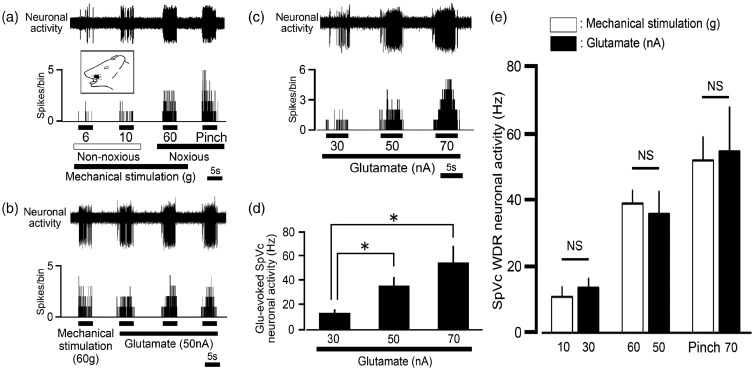
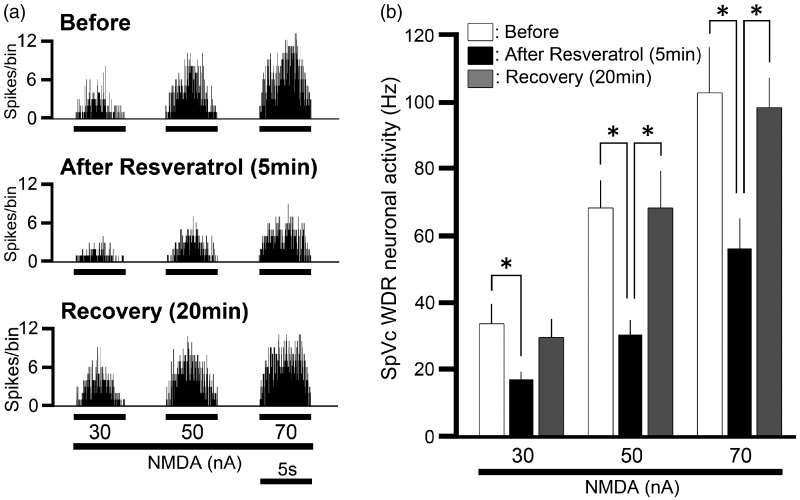
Background Although we have previously reported that intravenous resveratrol administration inhibits the nociceptive neuronal activity of spinal trigeminal nucleus caudalis neurons, the site of the central effect remains unclear. The aim of the present study was to examine whether acute intravenous resveratrol administration in the rat attenuates central glutamatergic transmission of spinal trigeminal nucleus caudalis neurons responding to nociceptive mechanical stimulation in vivo, using extracellular single-unit recordings and microiontophoretic techniques. Results Extracellular single-unit recordings using multibarrel electrodes were made from the spinal trigeminal nucleus caudalis wide dynamic range neurons responding to orofacial mechanical stimulation in pentobarbital anesthetized rats. These neurons also responded to iontophoretic application of glutamate, and the evoked neuronal discharge frequency was significantly increased in a current-dependent and reversible manner. The mean firing frequency evoked by the iontophoretic application of glutamate (30, 50, and 70 nA) was mimicked by the application of 10 g, 60 g, and noxious pinch mechanical stimulation, respectively. The mean firing frequency of spinal trigeminal nucleus caudalis wide dynamic range neurons responding to iontophoretic application of glutamate and N-methyl-D-aspartate were also significantly inhibited by intravenous administration of resveratrol (2 mg/kg) and the maximal inhibition of discharge frequency was observed within 10 min. These inhibitory effects lasted approximately 20 min. The relative magnitude of inhibition by resveratrol of the glutamate-evoked spinal trigeminal nucleus caudalis wide dynamic range neuronal discharge frequency was similar to that for N-methyl-D-aspartate iontophoretic application. Conclusion These results suggest that resveratrol suppresses glutamatergic neurotransmission of the spinal trigeminal nucleus caudalis neurons responding to nociceptive mechanical stimulation via the N-methyl-D-aspartate receptor in vivo, and resveratrol may be useful as a complementary or alternative therapeutic agent for the treatment of trigeminal nociceptive pain.
背景 尽管我们之前报道过静脉注射白藜芦醇可抑制三叉神经脊束核尾部神经元的伤害性神经元活动,但其中枢作用位点仍不清楚。本研究的目的是利用细胞外单单位记录和微离子电泳技术,研究大鼠急性静脉注射白藜芦醇是否能减弱三叉神经脊束核尾部神经元在体内对伤害性机械刺激的中枢谷氨酸能传递。结果 在戊巴比妥麻醉的大鼠中,使用多管电极对三叉神经脊束核尾部的广动力范围神经元进行细胞外单单位记录,这些神经元对口腔面部机械刺激有反应。这些神经元也对谷氨酸的离子电泳应用有反应,并且诱发的神经元放电频率以电流依赖和可逆的方式显著增加。谷氨酸离子电泳应用(30、50和70 nA)诱发的平均放电频率分别被10 g、60 g和伤害性捏压机械刺激模拟。静脉注射白藜芦醇(2 mg/kg)也显著抑制了三叉神经脊束核尾部广动力范围神经元对谷氨酸和N-甲基-D-天冬氨酸离子电泳应用的反应,并且在10分钟内观察到放电频率的最大抑制。这些抑制作用持续约20分钟。白藜芦醇对谷氨酸诱发的三叉神经脊束核尾部广动力范围神经元放电频率的抑制程度与N-甲基-D-天冬氨酸离子电泳应用相似。结论 这些结果表明,白藜芦醇在体内通过N-甲基-D-天冬氨酸受体抑制三叉神经脊束核尾部神经元对伤害性机械刺激的谷氨酸能神经传递,白藜芦醇可能作为治疗三叉神经伤害性疼痛的补充或替代治疗药物。