Lin Wenqing, Zhao Yajuan, Cheng Baixiang, Zhao Haidan, Miao Li, Li Qiang, Chen Yongjin, Zhang Min
State Key Laboratory of Military Stomatology, Department of General Dentistry and Emergency, National Clinical Research Center for Oral Diseases, Shaanxi International Joint Research Center for Oral Diseases, School of Stomatology, Fourth Military Medical University, Xi'an, China.
Department of Stomatology, Air Force Medical Center, Beijing, China.
Front Cell Neurosci. 2019 Nov 14;13:495. doi: 10.3389/fncel.2019.00495. eCollection 2019.
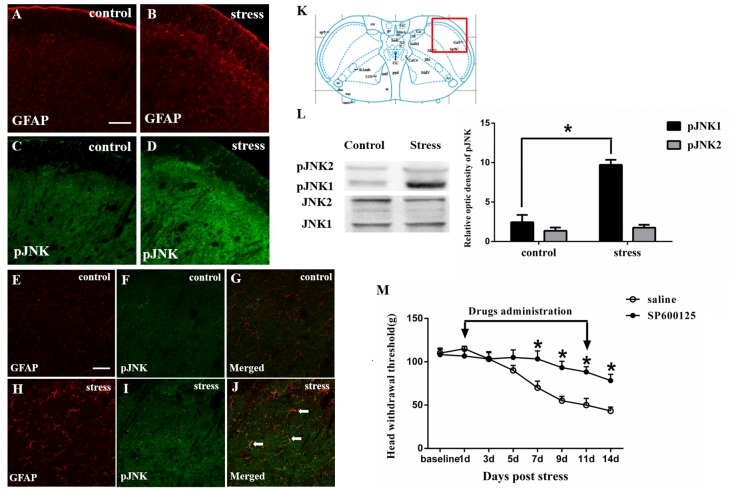
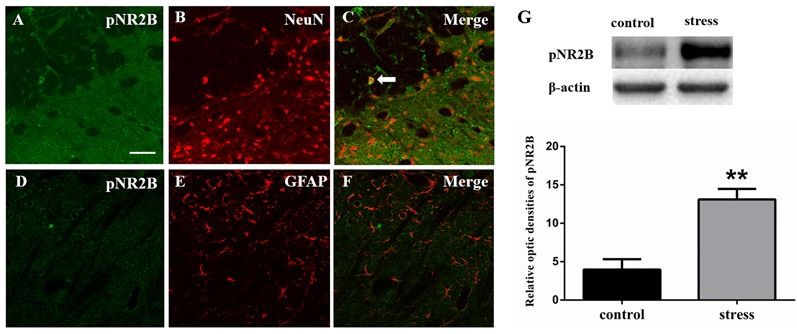
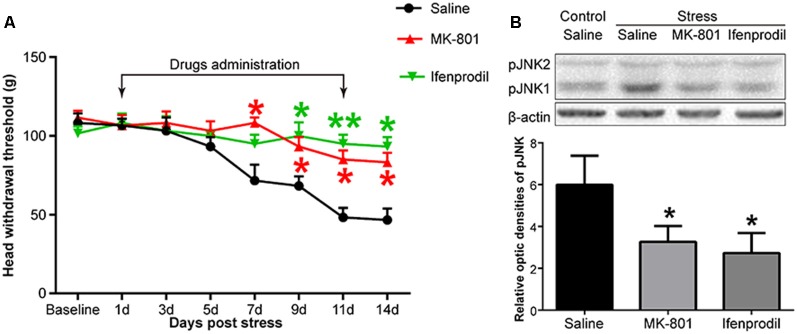
It is commonly accepted that psychological stress is closely associated with the occurrence and development of chronic orofacial pain. However, the pathogenesis underlying this process has not been fully elucidated. In the present study, we explored the role of N-methyl-D-aspartate receptors (NMDARs) and Jun N-terminal kinase (JNK) mediated intercellular communication between neurons and astrocytes in the spinal trigeminal nucleus caudalis (Vc) in the induction of masseter hyperalgesia by psychological stress in rats. We found that subjecting rats to 14 days of restraint stress (8 h/d) caused a significant decrease in body weight gain, behavioral changes and marked masseter hyperalgesia in the rats. We also found that exposure to restraint stress for 14 days caused the expression of pJNK in astrocytes in the Vc to significantly increase, and intrathecally infusing a JNK inhibitor significantly prevented restraint stress-induced masseter hyperalgesia in the rats. In addition, after exposure to restraint stress for 14 days, the stressed group exhibited a noticeably increased expression level of pNR2B in neurons in the Vc. Then, we intrathecally injected MK-801 (an NMDAR inhibitor) and ifenprodil (a selective NR2B subunit antagonist) and observed that the two types of inhibitors not only alleviated masseter hyperalgesia but also significantly inhibited the phosphorylation of JNK in the Vc after restraint stress; this indicates that the effect of NMDAR antagonists may influence the activation of astrocytic JNK. Furthermore, inhibitors of neuronal nitric oxide synthase (nNOS) activation and guanylate cyclase (GC) inhibitor could not only inhibit the expression of pJNK in the Vc, but also effectively alleviate masseter hyperalgesia induced by restraint stress. Taken together, our results suggest that NMDAR activation could increase JNK phosphorylation in astrocytes after restraint stress, which may depend on the nNOS-GC pathway. The intercellular communication between neurons and astrocytes in the Vc may play a key role in the induction of masseter muscle hyperalgesia by psychological stress in rats.
人们普遍认为,心理压力与慢性口面部疼痛的发生和发展密切相关。然而,这一过程背后的发病机制尚未完全阐明。在本研究中,我们探讨了N-甲基-D-天冬氨酸受体(NMDARs)和c-Jun氨基末端激酶(JNK)介导的三叉神经脊束核尾侧亚核(Vc)中神经元与星形胶质细胞之间的细胞间通讯在大鼠心理应激诱导咬肌痛觉过敏中的作用。我们发现,让大鼠接受14天的束缚应激(8小时/天)会导致大鼠体重增加显著下降、行为改变以及明显的咬肌痛觉过敏。我们还发现,暴露于束缚应激14天会导致Vc中星形胶质细胞中pJNK的表达显著增加,鞘内注入JNK抑制剂可显著预防束缚应激诱导的大鼠咬肌痛觉过敏。此外,在暴露于束缚应激14天后,应激组Vc中神经元的pNR2B表达水平明显升高。然后,我们鞘内注射MK-801(一种NMDAR抑制剂)和艾芬地尔(一种选择性NR2B亚基拮抗剂),观察到这两种抑制剂不仅减轻了咬肌痛觉过敏,还显著抑制了束缚应激后Vc中JNK的磷酸化;这表明NMDAR拮抗剂的作用可能会影响星形胶质细胞JNK的激活。此外,神经元型一氧化氮合酶(nNOS)激活抑制剂和鸟苷酸环化酶(GC)抑制剂不仅可以抑制Vc中pJNK的表达,还能有效减轻束缚应激诱导的咬肌痛觉过敏。综上所述,我们的结果表明,束缚应激后NMDAR激活可增加星形胶质细胞中JNK磷酸化,这可能依赖于nNOS-GC途径。Vc中神经元与星形胶质细胞之间的细胞间通讯可能在大鼠心理应激诱导咬肌肌肉痛觉过敏中起关键作用。