Tarifeño-Saldivia Estefania, Lavergne Arnaud, Bernard Alice, Padamata Keerthana, Bergemann David, Voz Marianne L, Manfroid Isabelle, Peers Bernard
Laboratory of Zebrafish Development and Disease Models (ZDDM), GIGA, University of Liège, Avenue de l'Hôpital 1, B34, 4000 Sart Tilman, Liege, Belgium.
BMC Biol. 2017 Mar 21;15(1):21. doi: 10.1186/s12915-017-0362-x.
Defining the transcriptome and the genetic pathways of pancreatic cells is of great interest for elucidating the molecular attributes of pancreas disorders such as diabetes and cancer. As the function of the different pancreatic cell types has been maintained during vertebrate evolution, the comparison of their transcriptomes across distant vertebrate species is a means to pinpoint genes under strong evolutionary constraints due to their crucial function, which have therefore preserved their selective expression in these pancreatic cell types.
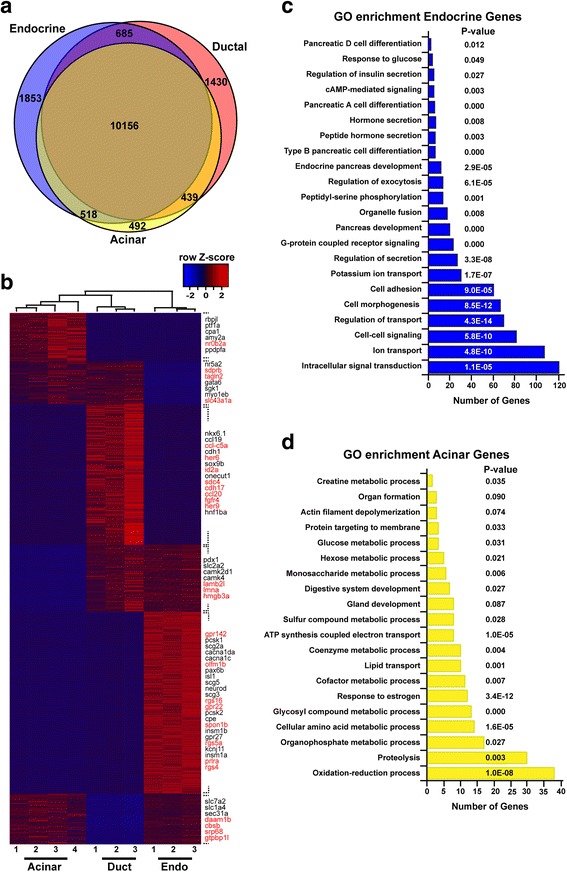
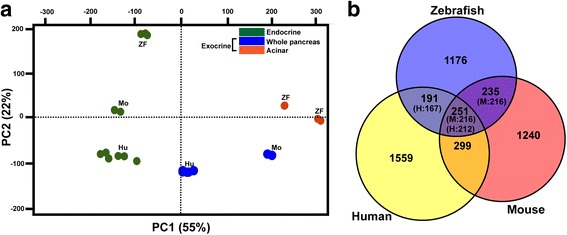
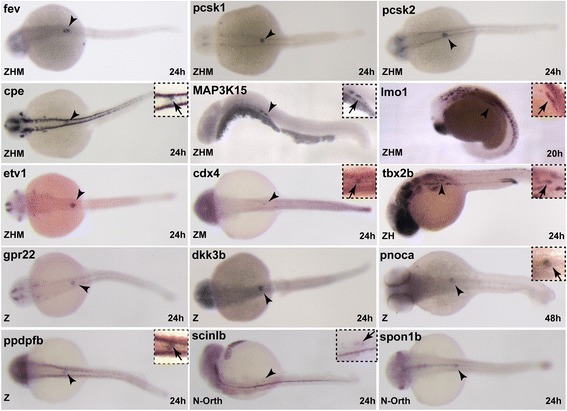
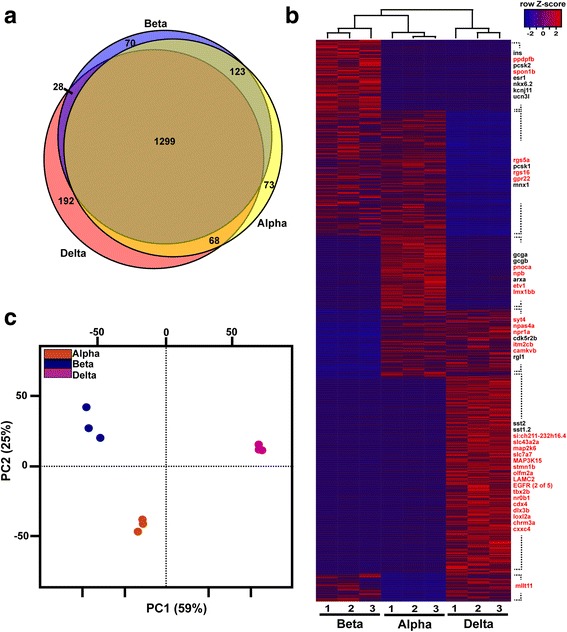
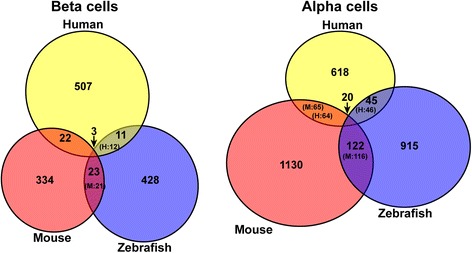
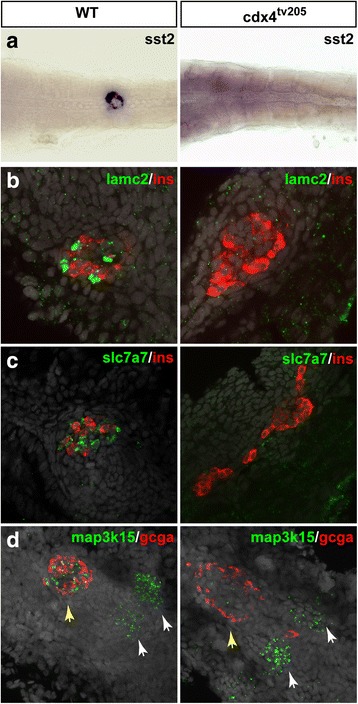
In this study, RNA-sequencing was performed on pancreatic alpha, beta, and delta endocrine cells as well as the acinar and ductal exocrine cells isolated from adult zebrafish transgenic lines. Comparison of these transcriptomes identified many novel markers, including transcription factors and signaling pathway components, specific for each cell type. By performing interspecies comparisons, we identified hundreds of genes with conserved enriched expression in endocrine and exocrine cells among human, mouse, and zebrafish. This list includes many genes known as crucial for pancreatic cell formation or function, but also pinpoints many factors whose pancreatic function is still unknown. A large set of endocrine-enriched genes can already be detected at early developmental stages as revealed by the transcriptomic profiling of embryonic endocrine cells, indicating a potential role in cell differentiation. The actual involvement of conserved endocrine genes in pancreatic cell differentiation was demonstrated in zebrafish for myt1b, whose invalidation leads to a reduction of alpha cells, and for cdx4, selectively expressed in endocrine delta cells and crucial for their specification. Intriguingly, comparison of the endocrine alpha and beta cell subtypes from human, mouse, and zebrafish reveals a much lower conservation of the transcriptomic signatures for these two endocrine cell subtypes compared to the signatures of pan-endocrine and exocrine cells. These data suggest that the identity of the alpha and beta cells relies on a few key factors, corroborating numerous examples of inter-conversion between these two endocrine cell subtypes.
This study highlights both evolutionary conserved and species-specific features that will help to unveil universal and fundamental regulatory pathways as well as pathways specific to human and laboratory animal models such as mouse and zebrafish.
定义胰腺细胞的转录组和遗传途径对于阐明诸如糖尿病和癌症等胰腺疾病的分子特征具有重要意义。由于不同胰腺细胞类型的功能在脊椎动物进化过程中得以保留,因此比较不同脊椎动物物种间它们的转录组是一种确定因具有关键功能而在强烈进化限制下的基因的方法,这些基因因此在这些胰腺细胞类型中保留了选择性表达。
在本研究中,对从成年斑马鱼转基因品系中分离出的胰腺α、β和δ内分泌细胞以及腺泡和导管外分泌细胞进行了RNA测序。这些转录组的比较鉴定出了许多新的标志物,包括对每种细胞类型特异的转录因子和信号通路成分。通过进行种间比较,我们鉴定出了数百个在人、小鼠和斑马鱼的内分泌和外分泌细胞中具有保守富集表达的基因。这个列表包括许多已知对胰腺细胞形成或功能至关重要的基因,但也指出了许多胰腺功能仍未知的因子。如胚胎内分泌细胞的转录组分析所示,在发育早期阶段就能检测到大量内分泌富集基因,表明其在细胞分化中具有潜在作用。在斑马鱼中证实了保守的内分泌基因myt1b和cdx4在胰腺细胞分化中的实际作用,myt1b功能缺失导致α细胞减少,cdx4选择性地在内分泌δ细胞中表达且对其特化至关重要。有趣的是,人、小鼠和斑马鱼的内分泌α和β细胞亚型的比较显示,与全内分泌和外分泌细胞的特征相比,这两种内分泌细胞亚型的转录组特征的保守性要低得多。这些数据表明α和β细胞的特性依赖于一些关键因子,这证实了这两种内分泌细胞亚型之间相互转化的众多例子。
本研究突出了进化保守和物种特异性特征,这将有助于揭示通用和基本的调控途径以及人类和小鼠、斑马鱼等实验动物模型特有的途径。