Kalies Helen, Schöttmer Rieke, Simon Steffen T, Voltz Raymond, Crispin Alexander, Bausewein Claudia
Department of Palliative Medicine, Munich University Hospital, LMU Munich, Marchioninistr. 15, 81377, Munich, Germany.
Center for Palliative Medicine, University of Cologne, Kerpener Str. 62, 50924, Köln, Germany.
BMC Palliat Care. 2017 Mar 21;16(1):20. doi: 10.1186/s12904-017-0187-y.
Little is known about palliative care professionals' attitudes towards guidelines. In 2015, the German Association for Palliative Medicine (DGP) published an evidence based guideline for palliative care in adults with incurable cancer. Before publication we conducted a national survey among members of the DGP to detect possible barriers and facilitators for its implementation. The aim of the present publication was to evaluate critical attitudes and beliefs which could hinder the effective implementation of the new guideline and to evaluate differences within professional groups and medical specialisations.
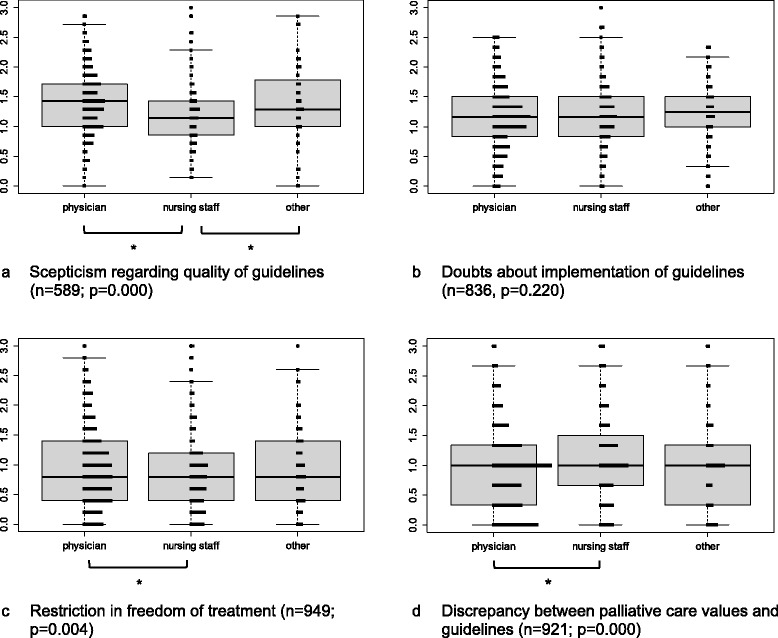
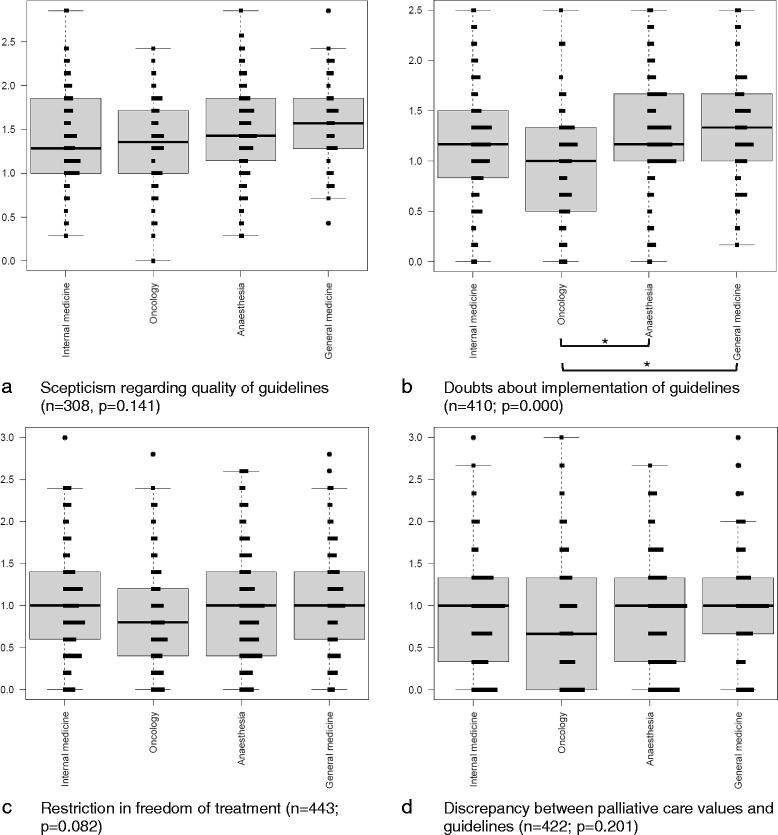
This web-based online survey was addressed to all members of the DGP in summer 2014. Twenty-one questions concerning attitudes and beliefs towards guidelines were a priori developed to represent the following topics: scepticism regarding the quality of guidelines, doubts about the implementation of guidelines, restrictions in treatment options through guidelines, discrepancy between palliative care values and guidelines. Differences within professions and specialisations were tested using Kruskal-Wallis tests.
All 4.786 members with known email address were invited, 1.181 followed the link, 1.138 began to answer the questionnaire and 1.031 completed the questionnaire. More than half of participating members were physicians and one third nurses. Scepticism regarding the quality of existing guidelines was high (range 12.8-73.2%). Doubts regarding practical aspects of guidelines were less prevalent but still high (range 21.8-57.6%). About one third (range 5.4-31.4%) think that guidelines restrict their treatment options. In addition, 38.8% believed that guidelines are a kind of cookbook and restrict the flexibility of individual patient care. The majority saw no or little discrepancy between palliative care values and guidelines (range 68.4-82.6%). There were relatively small but significant differences between professions and specialisations.
The person-centred and individual approach of palliative care does not seem to contradict the acceptance of guidelines. Main barriers were related to scepticism regarding the quality of guidelines and the implementation of guidelines in general.
关于姑息治疗专业人员对指南的态度,人们了解甚少。2015年,德国姑息医学协会(DGP)发布了一份针对无法治愈的成年癌症患者姑息治疗的循证指南。在发布之前,我们对DGP成员进行了一项全国性调查,以发现其实施过程中可能存在的障碍和促进因素。本出版物的目的是评估可能阻碍新指南有效实施的批判性态度和信念,并评估专业群体和医学专业之间的差异。
2014年夏天,这项基于网络的在线调查面向DGP的所有成员。事先设计了21个关于对指南的态度和信念的问题,以代表以下主题:对指南质量的怀疑、对指南实施的疑虑、指南对治疗选择的限制、姑息治疗价值观与指南之间的差异。使用Kruskal-Wallis检验来检验职业和专业之间的差异。
共邀请了所有4786名已知电子邮件地址的成员,1181人点击了链接,1138人开始回答问卷,1031人完成了问卷。超过一半的参与成员是医生,三分之一是护士。对现有指南质量的怀疑程度很高(范围为12.8%-73.2%)。对指南实际方面的疑虑不太普遍,但仍然很高(范围为21.8%-57.6%)。约三分之一(范围为5.4%-31.4%)的人认为指南限制了他们的治疗选择。此外,38.8%的人认为指南是一种菜谱,限制了对个体患者护理的灵活性。大多数人认为姑息治疗价值观与指南之间没有或几乎没有差异(范围为68.4%-82.6%)。职业和专业之间存在相对较小但显著的差异。
姑息治疗以人为本和个体化的方法似乎与对指南的接受并不矛盾。主要障碍与对指南质量的怀疑以及总体上对指南的实施有关。