From the University of Washington Division of Emergency Medicine and Harborview Medical Center (N.J.W.), Seattle, Washington; Michigan Center for Integrative Research in Critical Care and University of Michigan Department of Emergency Medicine (K.R.W.), Ann Arbor, Michigan; Blood Systems Research Institute and the University of California (S.P.), San Francisco, California; Norwegian Naval Special Operations Command and Department of Immunology and Transfusion Medicine (G.S.), Haukeland University Hospital, Bergen, Norway; and Coagulation and Blood Research (A.P.C.), US Army Institute of Surgical Research, JBSA Fort Sam, Houston, Texas.
J Trauma Acute Care Surg. 2017 Jun;82(6S Suppl 1):S41-S49. doi: 10.1097/TA.0000000000001436.
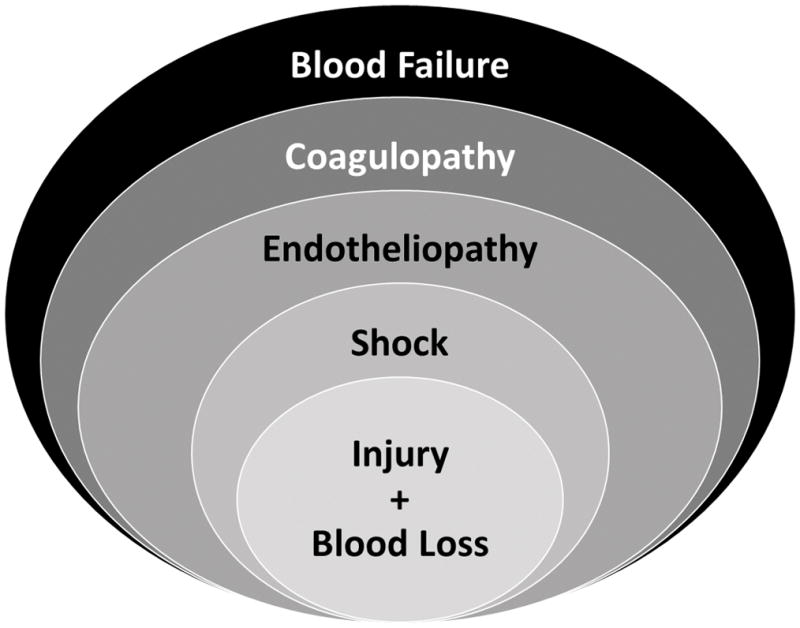
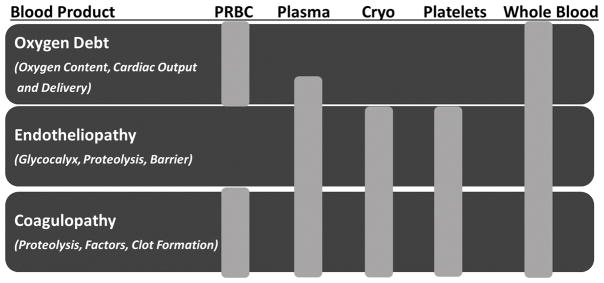
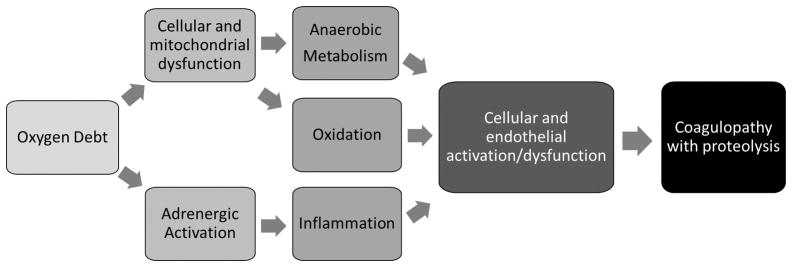
Our understanding of the events taking place within the blood following severe injury with hemorrhagic shock is quickly evolving. Traditional concepts have given way to a detailed and nuanced understanding of coagulopathy, bleeding, and shock at the cellular and biochemical levels. In doing so, the tremendous complexity of events taking place within the blood have been illuminated and present an additional challenge. In this review, we seek to understand shock, endotheliopathy, and coagulopathy not as isolated events, but rather as the result of changes taking place within a single dynamic organ system. This review will highlight the key linkages existing between blood and endothelium and how these processes are perturbed by hemorrhagic shock to produce a syndrome that we call “hemorrhagic blood failure.” From this perspective, it may be regarded that the blood organ system fails in providing its vital functions predictably after injury. We review how accumulation of oxygen debt during shock leads to endotheliopathy and coagulopathy, and how current transfusion strategies may impact the syndrome of hemorrhagic blood failure.
我们对严重创伤伴失血性休克时血液中发生的事件的理解正在迅速发展。传统观念已经让位于对细胞和生化水平的凝血障碍、出血和休克的详细和细微的理解。这样一来,血液中发生的事件的巨大复杂性就被揭示出来,并带来了额外的挑战。在这篇综述中,我们试图理解休克、血管内皮病变和凝血障碍,不是作为孤立的事件,而是作为一个单一的动态器官系统内发生的变化的结果。这篇综述将强调血液和血管内皮之间存在的关键联系,以及这些过程是如何被失血性休克扰乱的,从而产生我们称之为“失血性血液衰竭”的综合征。从这个角度来看,在受伤后,血液器官系统可能无法提供其重要功能,这是可以预见的。我们回顾了休克期间氧债的积累如何导致血管内皮病变和凝血障碍,以及当前的输血策略如何影响失血性血液衰竭综合征。