Li Qing-Min, Zhang Feng-Qin, Li Ya-Feng, Xian Qing-Jie, Zhang Yan-Qiang, Li Peng
Department of Clinical Laboratory, Liaocheng People's Hospital and Liaocheng Clinical School of Taishan Medical University Department of Infusion and Injuction Room, Liaocheng People's Hospital and Liaocheng Clinical School of Taishan Medical University Department of Gastroenterology, Liaocheng People's Hospital and Liaocheng Clinical School of Taishan Medical University, Liaocheng, Shandong Province, China.
Medicine (Baltimore). 2017 Mar;96(12):e6127. doi: 10.1097/MD.0000000000006127.
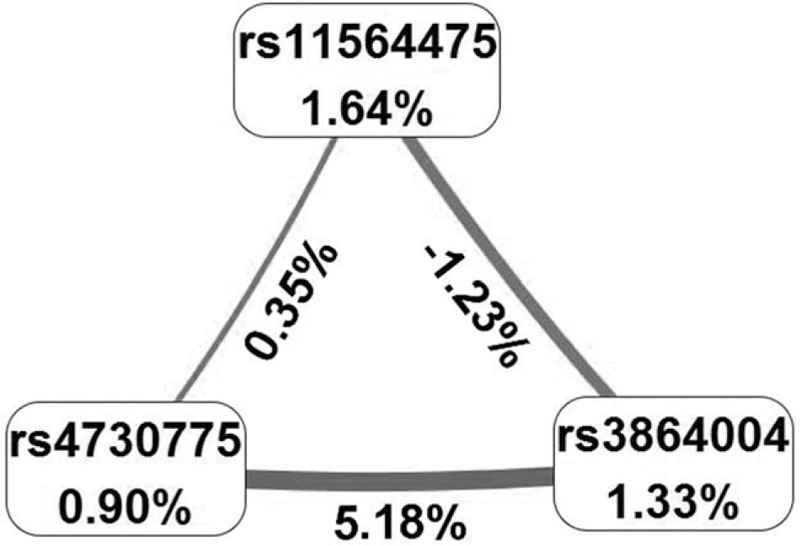
The Wnt/β-catenin pathway plays a vital role in initiating and sustaining hepatocellular carcinoma (HCC). However, few studies have investigated polymorphisms in the Wnt/β-catenin signaling pathway genes in the Chinese Han population. The aim of the present retrospective study was to investigate the correlations between polymorphisms of the Wnt/β-catenin signaling pathway genes (CTNNB1 and WNT2) and HCC susceptibility, development, and progression.Twenty tagging single nucleotide polymorphisms were chosen from HapMap data and genotyped in 320 patients with HCC, 320 chronic hepatitis B virus (HBV)-infected patients without HCC (N-HCC, including 95 liver cirrhosis, 164 chronic hepatitis B, and 61 asymptomatic HBV carriers), and 320 healthy controls. Associations between polymorphisms in the 2 Wnt/β-catenin signaling pathway genes (CTNNB1 and WNT2) and HCC susceptibility, development, and progression were investigated.Genotype AA (P = 0.002, odds ratio [OR] = 2.524) and allele A (P = 0.0003, OR = 1.613) of the WNT2 rs4730775 polymorphism were associated with HCC susceptibility compared with healthy controls. Genotype GA (P = 0.001, OR = 0.567) and allele A (P = 0.002, OR = 0.652) of rs3864004, and genotype AG (P = 0.0004, OR = 0.495) and allele G (P = 0.001, OR = 0.596) of rs11564475 in the CTNNB1 gene were correlated with HCC compared with N-HCC patients. These findings were consistent in dominant and recessive models. Multidimensionality reduction analysis revealed that interactions among rs3864004, rs11564475, and rs4730775 were significantly associated with HCC compared with N-HCC patients. The polymorphism rs4135385 of CTNNB1 genotype GA was associated with a higher risk for Stage III + IV HCC (modified Union for International Cancer Control) (P = 0.001, OR = 2.238).Genetic polymorphisms in the WNT2 and CTNNB1 genes were closely associated with HCC risk and progression in a Chinese Han population.
Wnt/β-连环蛋白信号通路在肝细胞癌(HCC)的起始和维持过程中起着至关重要的作用。然而,针对中国汉族人群Wnt/β-连环蛋白信号通路基因多态性的研究较少。本回顾性研究旨在探讨Wnt/β-连环蛋白信号通路基因(CTNNB1和WNT2)多态性与HCC易感性、发生及进展之间的相关性。从HapMap数据中选取20个标签单核苷酸多态性,对320例HCC患者、320例慢性乙型肝炎病毒(HBV)感染但无HCC的患者(非HCC,包括95例肝硬化、164例慢性乙型肝炎和61例无症状HBV携带者)以及320例健康对照进行基因分型。研究了Wnt/β-连环蛋白信号通路2个基因(CTNNB1和WNT2)的多态性与HCC易感性、发生及进展之间的关联。与健康对照相比,WNT2基因rs4730775多态性的AA基因型(P = 0.002,比值比[OR] = 2.524)和A等位基因(P = 0.0003,OR = 1.613)与HCC易感性相关。与非HCC患者相比,CTNNB1基因rs3864004的GA基因型(P = 0.001,OR = 0.567)和A等位基因(P = 0.002,OR = 0.652),以及rs11564475的AG基因型(P = 0.0004,OR = 0.495)和G等位基因(P = 0.001,OR = 0.596)与HCC相关。这些发现在显性和隐性模型中均一致。降维分析显示,与非HCC患者相比,rs3864004、rs11564475和rs4730775之间的相互作用与HCC显著相关。CTNNB1基因GA基因型的rs4135385多态性与国际癌症控制联盟(修改版)III + IV期HCC的较高风险相关(P = 0.001,OR = 2.238)。WNT2和CTNNB1基因的遗传多态性与中国汉族人群的HCC风险及进展密切相关。