Mak Winnie Ws, Chio Floria Hn, Chan Amy Ty, Lui Wacy Ws, Wu Ellery Ky
Department of Psychology, The Chinese University of Hong Kong, Hong Kong, China (Hong Kong).
Center for Personal Growth and Crisis Intervention of the Corporate Clinical Psychology Services, Hospital Authority, Hong Kong, China (Hong Kong).
J Med Internet Res. 2017 Mar 22;19(3):e84. doi: 10.2196/jmir.6737.
College students and working adults are particularly vulnerable to stress and other mental health problems, and mental health promotion and prevention are needed to promote their mental health. In recent decades, mindfulness-based training has demonstrated to be efficacious in treating physical and psychological conditions.
The aim of our study was to examine the efficacy of an Internet-based mindfulness training program (iMIND) in comparison with the well-established Internet-based cognitive-behavioral training program (iCBT) in promoting mental health among college students and young working adults.
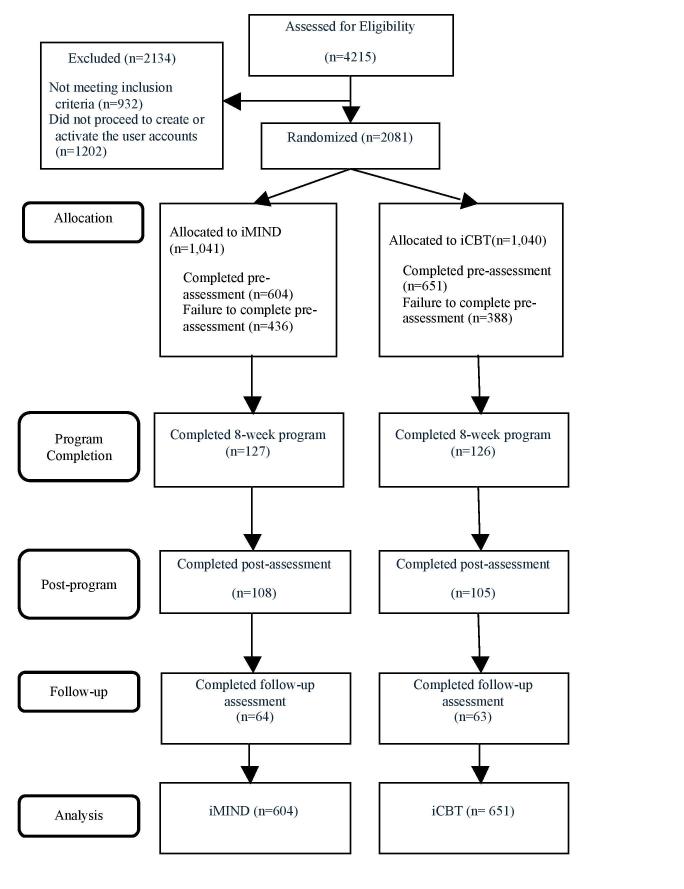
This study was a 2-arm, unblinded, randomized controlled trial comparing iMIND with iCBT. Participants were recruited online and offline via mass emails, advertisements in newspapers and magazines, announcement and leaflets in primary care clinics, and social networking sites. Eligible participants were randomized into either the iMIND (n=604) or the iCBT (n=651) condition. Participants received 8 Web-based sessions with information and exercises related to mindfulness or cognitive-behavioral principles. Telephone or email support was provided by trained first tier supporters who were supervised by the study's research team. Primary outcomes included mental and physical health-related measures, which were self-assessed online at preprogram, postprogram, and 3-month follow-up.
Among the 1255 study participants, 213 and 127 completed the post- and 3-month follow-up assessment, respectively. Missing data were treated using restricted maximum likelihood estimation. Both iMIND (n=604) and iCBT (n=651) were efficacious in improving mental health, psychological distress, life satisfaction, sleep disturbance, and energy level.
Both Internet-based mental health programs showed potential in improving the mental health from pre- to postassessment, and such improvement was sustained at the 3-month follow-up. The high attrition rate in this study suggests the need for refinement in future technology-based psychological programs. Mental health professionals need to team up with experts in information technology to increase personalization of Web-based interventions to enhance adherence.
Chinese Clinical Trial Registry (ChiCTR): ChiCTR-TRC-12002623; https://www2.ccrb.cuhk.edu.hk/ registry/public/191 (Archived by WebCite at http://www.webcitation.org/6kxt8DjM4).
大学生和在职成年人特别容易受到压力和其他心理健康问题的影响,需要通过促进心理健康和预防来提升他们的心理健康水平。近几十年来,基于正念的训练已被证明在治疗身体和心理疾病方面是有效的。
我们研究的目的是,将基于互联网的正念训练项目(iMIND)与成熟的基于互联网的认知行为训练项目(iCBT)相比较,考察二者在促进大学生和年轻在职成年人心理健康方面的效果。
本研究是一项双臂、非盲、随机对照试验,将iMIND与iCBT进行比较。通过群发电子邮件、报纸和杂志上的广告、基层医疗诊所的公告和传单以及社交网站,在线上和线下招募参与者。符合条件的参与者被随机分为iMIND组(n = 604)或iCBT组(n = 651)。参与者接受8次基于网络的课程,内容包括与正念或认知行为原则相关的信息和练习。由经过培训的一线支持者提供电话或电子邮件支持,这些支持者由研究团队监督。主要结局包括与身心健康相关的指标,这些指标在项目开始前、项目结束后以及3个月随访时通过在线自我评估获得。
在1255名研究参与者中,分别有213名和127名完成了项目结束后的评估和3个月随访评估。缺失数据采用限制最大似然估计法处理。iMIND组(n = 604)和iCBT组(n = 651)在改善心理健康、心理困扰、生活满意度、睡眠障碍和精力水平方面均有效。
两个基于互联网的心理健康项目在从评估前到评估后的过程中均显示出改善心理健康的潜力,且这种改善在3个月随访时得以维持。本研究中的高损耗率表明,未来基于技术的心理项目需要改进。心理健康专业人员需要与信息技术专家合作,增加基于网络干预的个性化程度,以提高依从性。
中国临床试验注册中心(ChiCTR):ChiCTR-TRC-12002623;https://www2.ccrb.cuhk.edu.hk/ registry/public/191(由WebCite存档于http://www.webcitation.org/6kxt8DjM4)