• 文献检索
  • 文档翻译
  • 深度研究
  • 学术资讯
  • Suppr Zotero 插件Zotero 插件
  • 邀请有礼
  • 套餐&价格
  • 历史记录
应用&插件
Suppr Zotero 插件Zotero 插件浏览器插件Mac 客户端Windows 客户端微信小程序
定价
高级版会员购买积分包购买API积分包
服务
文献检索文档翻译深度研究API 文档MCP 服务
关于我们
关于 Suppr公司介绍联系我们用户协议隐私条款
关注我们

Suppr 超能文献

核心技术专利:CN118964589B侵权必究
粤ICP备2023148730 号-1Suppr @ 2026

文献检索

告别复杂PubMed语法,用中文像聊天一样搜索,搜遍4000万医学文献。AI智能推荐,让科研检索更轻松。

立即免费搜索

文件翻译

保留排版,准确专业,支持PDF/Word/PPT等文件格式,支持 12+语言互译。

免费翻译文档

深度研究

AI帮你快速写综述,25分钟生成高质量综述,智能提取关键信息,辅助科研写作。

立即免费体验

基于移动应用程序的正念训练、自我同情训练和认知行为心理教育对心理健康的功效及适度性:随机对照非劣效性试验

Efficacy and Moderation of Mobile App-Based Programs for Mindfulness-Based Training, Self-Compassion Training, and Cognitive Behavioral Psychoeducation on Mental Health: Randomized Controlled Noninferiority Trial.

作者信息

Mak Winnie Ws, Tong Alan Cy, Yip Sindy Yc, Lui Wacy Ws, Chio Floria Hn, Chan Amy Ty, Wong Celia Cy

机构信息

Diversity and Well-being Laboratory, Department of Psychology, The Chinese University of Hong Kong, Shatin, NT, China (Hong Kong).

Center for Personal Growth and Crisis Intervention of the Corporate Clinical Psychology Services, Hospital Authority, Hong Kong, China (Hong Kong).

出版信息

JMIR Ment Health. 2018 Oct 11;5(4):e60. doi: 10.2196/mental.8597.

DOI:10.2196/mental.8597
PMID:30309837
原文链接:https://pmc.ncbi.nlm.nih.gov/articles/PMC6231823/
Abstract

BACKGROUND

Mindfulness-based interventions, self-compassion training, and cognitive behavioral therapy have garnered much evidence in its salutary effects on mental health. With increasing application of smartphone and mobile technology on health promotion, this study investigated the efficacy and possible moderators of mindfulness, self-compassion, and cognitive behavioral psychoeducation training mobile apps in the improvement of mental health.

OBJECTIVE

The aim of this study was to examine the efficacy of 3 mobile app-based programs: mindfulness-based program, self-compassion program, and cognitive behavioral psychoeducation program in improving mental well-being and reducing psychological distress. Changes in mindful awareness and self-compassion were also assessed. To further delineate the suitability of each program for different types of individuals, individual difference variables (ie, discomfort with emotions and tolerance for ambiguity) were explored for potential moderation.

METHODS

This study was a 3-arm, randomized, controlled, noninferiority trial examining the efficacy of mindfulness-based program, self-compassion program, and cognitive behavioral psychoeducation. Participants were randomized into either 1 of the 3 conditions. Throughout the 4-week, 28-session program, participants spent 10-15 min daily reviewing the course content and practicing various related exercises. At preprogram, postprogram, and 3-month follow-up, participants also completed Web-based measures of mental well-being, psychological distress, mindful-awareness, and self-compassion as well as the proposed moderators.

RESULTS

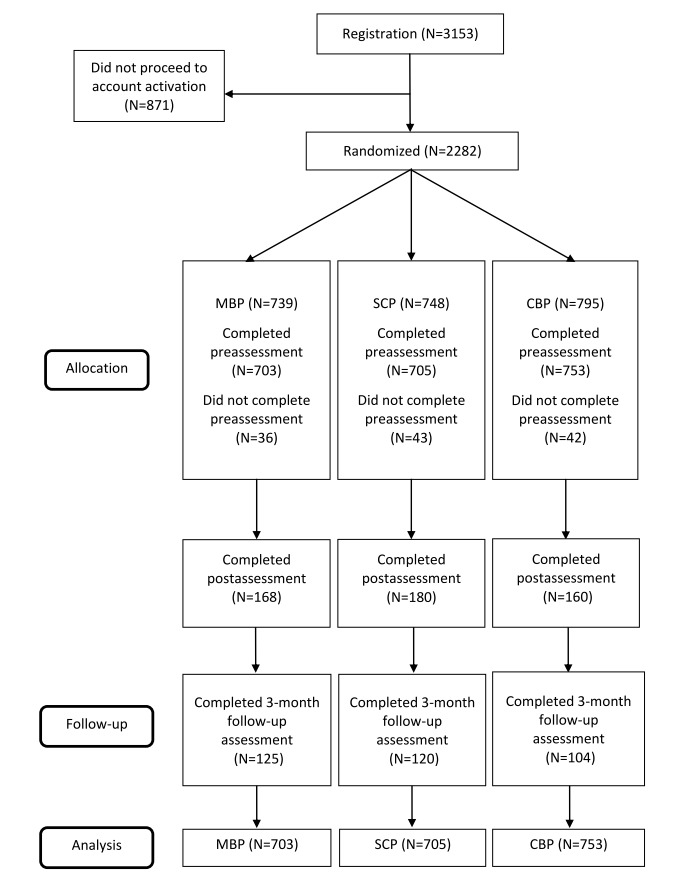
Among the 2161 study participants, 508 and 349 completed the post- and 3-month follow-up assessment, respectively. All 3 conditions (mindfulness-based program: N=703; cognitive behavioral psychoeducation: N=753; self-compassion program: N=705) were found to be efficacious in improving mental well-being and reducing psychological distress. All conditions enhanced mindful awareness at postprogram. Significant interaction effect was found on self-compassion; cognitive behavioral psychoeducation and self-compassion program, but not mindfulness-based program, significantly enhanced self-compassion at postprogram. No significant differences regarding usage and users' satisfaction were found among the 3 conditions. None of the proposed moderators were found to be significant.

CONCLUSIONS

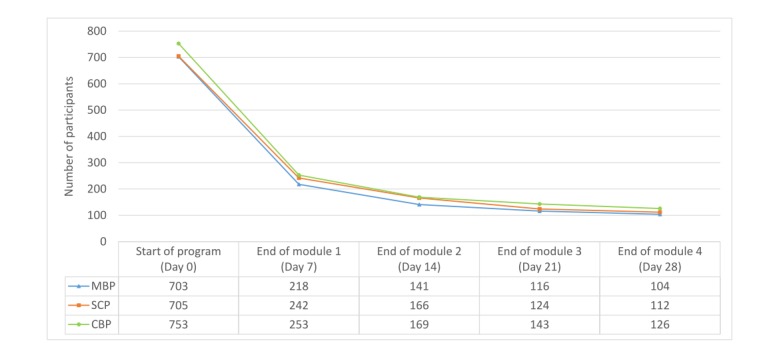
Mindfulness-based, self-compassion, and cognitive behavioral psychoeducation mobile apps were efficacious in improving mental well-being and reducing psychological distress among adults at postprogram and 3-month follow-up. Future app-based psychological training programs should consider gamification and personalization of content or feedback to enhance engagement and mitigate the high attrition rates that are common in app-based health promotion programs.

TRIAL REGISTRATION

Chinese Clinical Trial Registry (ChiCTR) ChiCTR-TRC-13003468; http://www.chictr.org.cn/hvshowproject.aspx?id=6220 (Archived by WebCite at http://www.webcitation.org/734PlOz50).
https://cdn.ncbi.nlm.nih.gov/pmc/blobs/0520/6231823/525ad3fa2140/mental_v5i4e60_fig2.jpg
https://cdn.ncbi.nlm.nih.gov/pmc/blobs/0520/6231823/bf62b4718660/mental_v5i4e60_fig1.jpg
https://cdn.ncbi.nlm.nih.gov/pmc/blobs/0520/6231823/525ad3fa2140/mental_v5i4e60_fig2.jpg
https://cdn.ncbi.nlm.nih.gov/pmc/blobs/0520/6231823/bf62b4718660/mental_v5i4e60_fig1.jpg
https://cdn.ncbi.nlm.nih.gov/pmc/blobs/0520/6231823/525ad3fa2140/mental_v5i4e60_fig2.jpg
摘要

背景

基于正念的干预、自我同情训练和认知行为疗法在对心理健康的有益影响方面已积累了大量证据。随着智能手机和移动技术在健康促进方面的应用日益增加,本研究调查了正念、自我同情和认知行为心理教育训练移动应用程序在改善心理健康方面的功效及可能的调节因素。

目的

本研究旨在检验3种基于移动应用程序的方案的功效:基于正念的方案、自我同情方案和认知行为心理教育方案,以改善心理健康和减轻心理困扰。还评估了正念意识和自我同情的变化。为进一步阐明每个方案对不同类型个体的适用性,探索了个体差异变量(即对情绪的不适感和对模糊性的耐受性)的潜在调节作用。

方法

本研究是一项三臂、随机、对照、非劣效性试验,检验基于正念的方案、自我同情方案和认知行为心理教育的功效。参与者被随机分为3种情况中的一种。在为期4周、共28节的课程中,参与者每天花10 - 15分钟复习课程内容并练习各种相关练习。在课程开始前、课程结束后和3个月随访时,参与者还完成了基于网络的心理健康、心理困扰、正念意识和自我同情的测量以及所提出的调节因素的测量。

结果

在2161名研究参与者中,分别有508名和349名完成了课程结束后的评估和3个月随访评估。发现所有3种情况(基于正念的方案:N = 703;认知行为心理教育:N = 753;自我同情方案:N = 705)在改善心理健康和减轻心理困扰方面均有效。所有情况在课程结束后均提高了正念意识。在自我同情方面发现了显著的交互作用;认知行为心理教育和自我同情方案,但基于正念的方案未显著提高课程结束后的自我同情。3种情况在使用和用户满意度方面未发现显著差异。未发现所提出的调节因素有显著意义。

结论

基于正念、自我同情和认知行为心理教育的移动应用程序在课程结束后和3个月随访时对改善成年人的心理健康和减轻心理困扰有效。未来基于应用程序的心理训练方案应考虑内容或反馈的游戏化和个性化,以提高参与度并减轻基于应用程序的健康促进方案中常见的高流失率。

试验注册

中国临床试验注册中心(ChiCTR)ChiCTR - TRC - 13003468;http://www.chictr.org.cn/hvshowproject.aspx?id=6220(由WebCite存档于http://www.webcitation.org/734PlOz50)

相似文献

1
Efficacy and Moderation of Mobile App-Based Programs for Mindfulness-Based Training, Self-Compassion Training, and Cognitive Behavioral Psychoeducation on Mental Health: Randomized Controlled Noninferiority Trial.基于移动应用程序的正念训练、自我同情训练和认知行为心理教育对心理健康的功效及适度性:随机对照非劣效性试验
JMIR Ment Health. 2018 Oct 11;5(4):e60. doi: 10.2196/mental.8597.
2
The Efficacy of Internet-Based Mindfulness Training and Cognitive-Behavioral Training With Telephone Support in the Enhancement of Mental Health Among College Students and Young Working Adults: Randomized Controlled Trial.基于互联网的正念训练和电话支持的认知行为训练对大学生和年轻在职成年人心理健康促进的效果:随机对照试验
J Med Internet Res. 2017 Mar 22;19(3):e84. doi: 10.2196/jmir.6737.
3
Enhancing Web-based mindfulness training for mental health promotion with the health action process approach: randomized controlled trial.采用健康行动过程方法增强基于网络的正念训练以促进心理健康:随机对照试验
J Med Internet Res. 2015 Jan 19;17(1):e8. doi: 10.2196/jmir.3746.
4
Mindful Self-Compassion Smartphone Intervention for Worker Mental Health in Japan: Protocol for a Randomized Controlled Trial.正念自我关怀智能手机干预对日本工人心理健康的影响:一项随机对照试验方案。
JMIR Res Protoc. 2024 Jul 15;13:e53541. doi: 10.2196/53541.
5
Effects of a Mindfulness App on Employee Stress in an Australian Public Sector Workforce: Randomized Controlled Trial.正念应用对澳大利亚公共部门员工压力的影响:随机对照试验。
JMIR Mhealth Uhealth. 2022 Feb 10;10(2):e30272. doi: 10.2196/30272.
6
Guided Self-Help Works: Randomized Waitlist Controlled Trial of Pacifica, a Mobile App Integrating Cognitive Behavioral Therapy and Mindfulness for Stress, Anxiety, and Depression.引导式自助疗法有效:针对Pacifica的随机等待列表对照试验,Pacifica是一款整合认知行为疗法和正念以应对压力、焦虑和抑郁的移动应用程序。
J Med Internet Res. 2019 Jun 8;21(6):e12556. doi: 10.2196/12556.
7
Efficacy of the Mindfulness Meditation Mobile App "Calm" to Reduce Stress Among College Students: Randomized Controlled Trial.正念冥想手机应用 "Calm" 对减少大学生压力的效果:随机对照试验。
JMIR Mhealth Uhealth. 2019 Jun 25;7(6):e14273. doi: 10.2196/14273.
8
Boosting Empathy and Compassion Through Mindfulness-Based and Socioemotional Dyadic Practice: Randomized Controlled Trial With App-Delivered Trainings.通过正念和社会情感二元实践提高同理心和同情心:基于应用程序的培训的随机对照试验。
J Med Internet Res. 2023 Jul 26;25:e45027. doi: 10.2196/45027.
9
A Self-Compassion and Mindfulness-Based Cognitive Mobile Intervention (Serene) for Depression, Anxiety, and Stress: Promoting Adaptive Emotional Regulation and Wisdom.一种基于自我同情和正念的抑郁症、焦虑症和压力认知移动干预(Serene):促进适应性情绪调节和智慧。
Front Psychol. 2021 Mar 22;12:648087. doi: 10.3389/fpsyg.2021.648087. eCollection 2021.
10
Design and Implementation of a Brief Digital Mindfulness and Compassion Training App for Health Care Professionals: Cluster Randomized Controlled Trial.设计并实现一款针对医疗保健专业人员的简短数字化正念与慈悲训练应用:集群随机对照试验。
JMIR Ment Health. 2024 Jan 22;11:e49467. doi: 10.2196/49467.

引用本文的文献

1
A synthesis of RCTs on psychological interventions fostering strengths and virtues: Evidence from 21 systematic reviews.关于促进优势和美德的心理干预的随机对照试验综述:来自21项系统评价的证据
Appl Psychol Health Well Being. 2025 Aug;17(4):e70069. doi: 10.1111/aphw.70069.
2
Unlocking mobile health adoption: A qualitative exploration of user experiences, barriers, and facilitators within integrated youth services in British Columbia, Canada.开启移动健康应用之路:对加拿大不列颠哥伦比亚省综合青年服务中用户体验、障碍及促进因素的定性探索。
Digit Health. 2025 Aug 3;11:20552076251365073. doi: 10.1177/20552076251365073. eCollection 2025 Jan-Dec.
3

本文引用的文献

1
Mindfulness-Based Cognitive Therapy Versus Pure Cognitive Behavioural Self-Help for Perfectionism: a Pilot Randomised Study.基于正念的认知疗法与纯粹的认知行为自助疗法治疗完美主义:一项初步随机研究。
Mindfulness (N Y). 2018;9(3):801-814. doi: 10.1007/s12671-017-0817-8. Epub 2017 Oct 13.
2
Assessing the Efficacy of Mobile Health Apps Using the Basic Principles of Cognitive Behavioral Therapy: Systematic Review.运用认知行为疗法基本原理评估移动健康应用程序的疗效:系统评价
J Med Internet Res. 2017 Nov 28;19(11):e399. doi: 10.2196/jmir.8598.
3
For Whom Does Mindfulness-Based Stress Reduction Work? Moderating Effects of Personality.
The Cumulative Effect of a 12-Week Online Mindfulness-Based Meditation Intervention Programme on Autonomic Nerve Functions by Pupillary Light Reflex: A Pilot Randomised Controlled Trial.
基于瞳孔光反射的为期12周在线正念冥想干预计划对自主神经功能的累积影响:一项初步随机对照试验
Stress Health. 2025 Aug;41(4):e70083. doi: 10.1002/smi.70083.
4
Internet-Based Cognitive Behavioral Therapy with Layperson Support: A mixed-Methods Evaluation of Empower@Home.基于互联网的认知行为疗法并获得非专业人员支持:对“居家赋能”的混合方法评估
Clin Gerontol. 2025 Jul 2:1-15. doi: 10.1080/07317115.2025.2528238.
5
Mindfulness in treatment-seeking adults with comorbid obsessive-compulsive and major depressive disorders: Mediating effects of obsessive beliefs and mental well-being.共病强迫症和重度抑郁症的成年求治者的正念:强迫观念与心理健康的中介作用
Indian J Psychiatry. 2025 May;67(5):513-521. doi: 10.4103/indianjpsychiatry.indianjpsychiatry_102_25. Epub 2025 May 15.
6
Invitation to Self-Compassion: Reshaping Burden of Care in the Light of Self-Compassion Training Given to Relatives of Patients Hospitalised in Palliative Care.自我同情的邀约:鉴于对姑息治疗住院患者亲属进行自我同情训练,重塑护理负担
Scand J Caring Sci. 2025 Jun;39(2):e70038. doi: 10.1111/scs.70038.
7
A meta-analysis of persuasive design, engagement, and efficacy in 92 RCTs of mental health apps.对92项心理健康应用随机对照试验中的说服性设计、参与度和疗效进行的荟萃分析。
NPJ Digit Med. 2025 Apr 29;8(1):229. doi: 10.1038/s41746-025-01567-5.
8
ReNeuWell mental well-being app: protocol for a randomised controlled trial.ReNeuWell心理健康应用程序:一项随机对照试验的方案
BMJ Open. 2025 Apr 15;15(4):e094557. doi: 10.1136/bmjopen-2024-094557.
9
Psychosocial Interventions to Improve Wellbeing in Teenage and Young Adult Post-Treatment Survivors of Childhood Cancer: A Systematic Review.改善青少年及青年期儿童癌症治疗后幸存者幸福感的心理社会干预措施:一项系统综述
Psychooncology. 2025 Feb;34(2):e70081. doi: 10.1002/pon.70081.
10
A Chatbot-Delivered Stress Management Coaching for Students (MISHA App): Pilot Randomized Controlled Trial.面向学生的聊天机器人提供的压力管理辅导(MISHA 应用):试点随机对照试验。
JMIR Mhealth Uhealth. 2024 Jun 26;12:e54945. doi: 10.2196/54945.
基于正念的减压疗法对谁有效?人格的调节作用。
Mindfulness (N Y). 2017;8(4):1106-1116. doi: 10.1007/s12671-017-0687-0. Epub 2017 Feb 15.
4
A Self-Regulation-Based eHealth Intervention to Promote a Healthy Lifestyle: Investigating User and Website Characteristics Related to Attrition.一种基于自我调节的电子健康干预措施以促进健康生活方式:调查与损耗相关的用户和网站特征。
J Med Internet Res. 2017 Jul 11;19(7):e241. doi: 10.2196/jmir.7277.
5
The Efficacy of Internet-Based Mindfulness Training and Cognitive-Behavioral Training With Telephone Support in the Enhancement of Mental Health Among College Students and Young Working Adults: Randomized Controlled Trial.基于互联网的正念训练和电话支持的认知行为训练对大学生和年轻在职成年人心理健康促进的效果:随机对照试验
J Med Internet Res. 2017 Mar 22;19(3):e84. doi: 10.2196/jmir.6737.
6
PNF 2.0? Initial evidence that gamification can increase the efficacy of brief, web-based personalized normative feedback alcohol interventions.PNF 2.0?有初步证据表明,游戏化可提高基于网络的简短个性化规范反馈酒精干预措施的效果。
Addict Behav. 2017 Apr;67:8-17. doi: 10.1016/j.addbeh.2016.11.024. Epub 2016 Dec 2.
7
Does Mindfulness-Based Cognitive Therapy benefit all people with diabetes and comorbid emotional complaints equally? Moderators in the DiaMind trial.基于正念的认知疗法对所有患有糖尿病和共病情绪问题的人都有同等益处吗?DiaMind试验中的调节因素。
J Psychosom Res. 2016 Dec;91:40-47. doi: 10.1016/j.jpsychores.2016.10.009. Epub 2016 Oct 27.
8
Effects of a transdiagnostic unguided Internet intervention ('velibra') for anxiety disorders in primary care: results of a randomized controlled trial.一项针对初级保健中焦虑症的跨诊断非指导性互联网干预措施(“velibra”)的效果:一项随机对照试验的结果
Psychol Med. 2017 Jan;47(1):67-80. doi: 10.1017/S0033291716002270. Epub 2016 Sep 22.
9
Mindfulness-based stress reduction and cognitive behavioral therapy for chronic low back pain: similar effects on mindfulness, catastrophizing, self-efficacy, and acceptance in a randomized controlled trial.基于正念减压疗法和认知行为疗法治疗慢性下腰痛:一项随机对照试验中对正念、灾难化思维、自我效能感和接纳度的相似影响
Pain. 2016 Nov;157(11):2434-2444. doi: 10.1097/j.pain.0000000000000635.
10
Effectiveness of online mindfulness-based interventions in improving mental health: A review and meta-analysis of randomised controlled trials.在线正念干预对改善心理健康的有效性:随机对照试验的综述和荟萃分析。
Clin Psychol Rev. 2016 Apr;45:102-14. doi: 10.1016/j.cpr.2016.03.009. Epub 2016 Apr 1.