• 文献检索
  • 文档翻译
  • 深度研究
  • 学术资讯
  • Suppr Zotero 插件Zotero 插件
  • 邀请有礼
  • 套餐&价格
  • 历史记录
应用&插件
Suppr Zotero 插件Zotero 插件浏览器插件Mac 客户端Windows 客户端微信小程序
定价
高级版会员购买积分包购买API积分包
服务
文献检索文档翻译深度研究API 文档MCP 服务
关于我们
关于 Suppr公司介绍联系我们用户协议隐私条款
关注我们

Suppr 超能文献

核心技术专利:CN118964589B侵权必究
粤ICP备2023148730 号-1Suppr @ 2026

文献检索

告别复杂PubMed语法,用中文像聊天一样搜索,搜遍4000万医学文献。AI智能推荐,让科研检索更轻松。

立即免费搜索

文件翻译

保留排版,准确专业,支持PDF/Word/PPT等文件格式,支持 12+语言互译。

免费翻译文档

深度研究

AI帮你快速写综述,25分钟生成高质量综述,智能提取关键信息,辅助科研写作。

立即免费体验

治疗师辅助的基于互联网的认知行为疗法与渐进性放松疗法治疗强迫症:随机对照试验

Therapist-Assisted Internet-Based Cognitive Behavioral Therapy Versus Progressive Relaxation in Obsessive-Compulsive Disorder: Randomized Controlled Trial.

作者信息

Kyrios Michael, Ahern Claire, Fassnacht Daniel B, Nedeljkovic Maja, Moulding Richard, Meyer Denny

机构信息

College of Education, Psychology & Social Work, Flinders University, Adelaide, Australia.

Research School of Psychology, The Australian National University, Canberra, Australia.

出版信息

J Med Internet Res. 2018 Aug 8;20(8):e242. doi: 10.2196/jmir.9566.

DOI:10.2196/jmir.9566
PMID:30089607
原文链接:https://pmc.ncbi.nlm.nih.gov/articles/PMC6105869/
Abstract

BACKGROUND

Obsessive-compulsive disorder (OCD) is a highly disabling psychological disorder with a chronic course if left untreated. Cognitive behavioral therapy (CBT) has been shown to be an effective treatment, but access to face-to-face CBT is not always possible. Internet-based CBT (iCBT) has become an increasingly viable option. However, no study has compared iCBT to an analogous control condition using a randomized controlled trial (RCT).

OBJECTIVE

A 2-armed RCT was used to compare a therapist-assisted 12-module iCBT to an analogous active attention control condition (therapist-assisted internet-based standard progressive relaxation training, iPRT) in adult OCD. This paper reports pre-post findings for OCD symptom severity.

METHOD

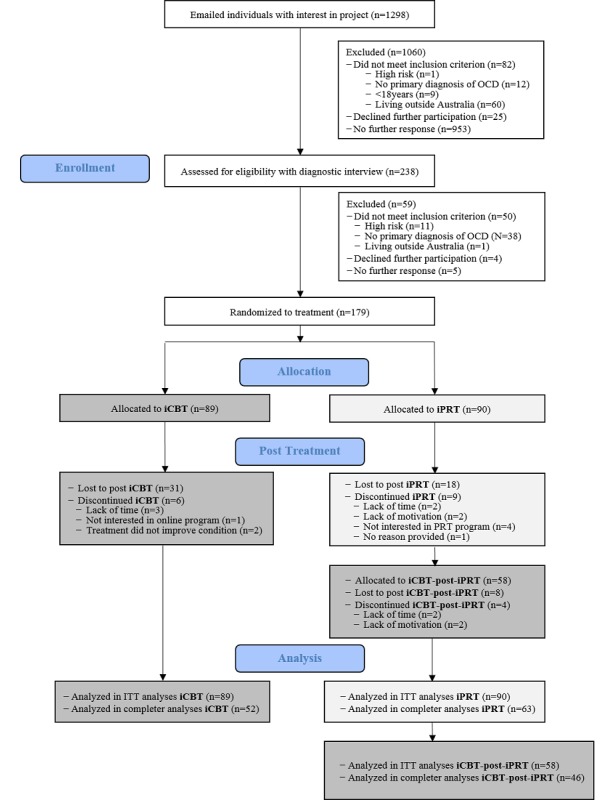
In total, 179 participants (117 females, 65.7%) were randomized (stratified by gender) into iCBT or iPRT. The iCBT intervention included psychoeducation, mood and behavioral management, exposure and response prevention (ERP), cognitive therapy, and relapse prevention; the iPRT intervention included psychoeducation and relaxation techniques as a way of managing OCD-related anxiety but did not incorporate ERP or other CBT elements. Both treatments included audiovisual content, case stories, demonstrations of techniques, downloadable audio content and worksheets, and expert commentary. All participants received 1 weekly email, with a maximum 15-minute preparation time per client from a remote therapist trained in e-therapy. Emails aimed to monitor progress, provide support and encouragement, and assist in individualizing the treatment. Participants were assessed for baseline and posttreatment OCD severity with the telephone-administered clinician-rated Yale-Brown Obsessive-Compulsive Scale and other measures by assessors who were blinded to treatment allocation.

RESULTS

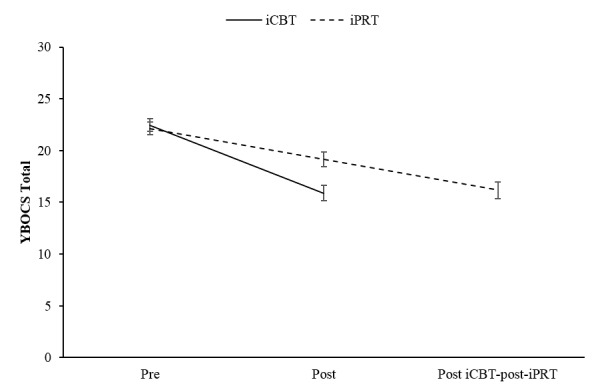
No pretreatment differences were found between the 2 conditions. Intention-to-treat analysis revealed significant pre-post improvements in OCD symptom severity for both conditions (P<.001). However, relative to iPRT, iCBT showed significantly greater symptom severity improvement (P=.001); Cohen d for iCBT was 1.05 (95% CI 0.72-1.37), whereas for iPRT it was 0.48 (95% CI 0.22-0.73). The iCBT condition was superior in regard to reliable improvement (25/51, 49% vs 16/55, 29%; P=.04) and clinically significant pre-post-treatment changes (17/51, 33% vs 6/55, 11%; P=.005). Those undertaking iCBT post completion of iPRT showed further significant symptom amelioration (P<.001), although the sequential treatment was no more efficacious than iCBT alone (P=.63).

CONCLUSION

This study is the first to compare a therapist-assisted iCBT program for OCD to an analogous active attention control condition using iPRT. Our findings demonstrate the large magnitude effect of iCBT for OCD; interestingly, iPRT was also moderately efficacious, albeit significantly less so than the iCBT intervention. The findings are compared to previous internet-based and face-to-face CBT treatment programs for OCD. Future directions for technology-enhanced programs for the treatment of OCD are outlined.

TRIAL REGISTRATION

Australian New Zealand Clinical Trials Registry ACTRN12611000321943; https://www.anzctr.org.au/Trial/Registration/TrialReview.aspx?id=336704 (Archived by WebCite at http://www.webcitation.org/70ovUiOmd).
https://cdn.ncbi.nlm.nih.gov/pmc/blobs/4c1b/6105869/e92300ed23f7/jmir_v20i8e242_fig2.jpg
https://cdn.ncbi.nlm.nih.gov/pmc/blobs/4c1b/6105869/69cad911ce4b/jmir_v20i8e242_fig1.jpg
https://cdn.ncbi.nlm.nih.gov/pmc/blobs/4c1b/6105869/e92300ed23f7/jmir_v20i8e242_fig2.jpg
https://cdn.ncbi.nlm.nih.gov/pmc/blobs/4c1b/6105869/69cad911ce4b/jmir_v20i8e242_fig1.jpg
https://cdn.ncbi.nlm.nih.gov/pmc/blobs/4c1b/6105869/e92300ed23f7/jmir_v20i8e242_fig2.jpg
摘要

背景

强迫症(OCD)是一种严重致残的心理障碍,若不治疗会呈慢性病程。认知行为疗法(CBT)已被证明是一种有效的治疗方法,但并非总能获得面对面的CBT治疗。基于互联网的CBT(iCBT)已成为越来越可行的选择。然而,尚无研究使用随机对照试验(RCT)将iCBT与类似的对照条件进行比较。

目的

采用双臂RCT比较成人强迫症患者中治疗师辅助的12模块iCBT与类似的积极注意力控制条件(治疗师辅助的基于互联网的标准渐进性放松训练,iPRT)。本文报告强迫症症状严重程度的前后结果。

方法

总共179名参与者(117名女性,65.7%)被随机分组(按性别分层)进入iCBT或iPRT组。iCBT干预包括心理教育、情绪和行为管理、暴露与反应阻止(ERP)、认知疗法以及复发预防;iPRT干预包括心理教育和放松技巧,作为管理与强迫症相关焦虑的一种方式,但未纳入ERP或其他CBT要素。两种治疗均包括视听内容、案例故事、技巧演示、可下载音频内容和工作表以及专家评论。所有参与者每周收到1封电子邮件,远程接受电子治疗培训的治疗师为每位客户准备时间最长15分钟。电子邮件旨在监测进展、提供支持和鼓励,并协助个性化治疗。通过电话管理的临床医生评定的耶鲁-布朗强迫症量表和其他测量方法,由对治疗分配不知情的评估人员对参与者的强迫症严重程度进行基线和治疗后评估。

结果

两种条件在治疗前未发现差异。意向性分析显示两种条件下强迫症症状严重程度在治疗前后均有显著改善(P<.001)。然而,相对于iPRT,iCBT显示出症状严重程度改善显著更大(P=.001);iCBT的Cohen d为1.05(95%CI 0.72 - 1.37),而iPRT为0.48(95%CI 0.22 - 0.73)。iCBT组在可靠改善方面更优(25/51,49%对16/55,29%;P=.04)以及治疗前后具有临床显著变化方面更优(17/51,33%对6/55,11%;P=.005)。在完成iPRT后进行iCBT的患者症状进一步显著改善(P<.001),尽管序贯治疗并不比单独的iCBT更有效(P=.63)。

结论

本研究首次将治疗师辅助的强迫症iCBT项目与使用iPRT的类似积极注意力控制条件进行比较。我们的研究结果证明了iCBT对强迫症的显著效果;有趣的是,iPRT也有一定疗效,尽管明显低于iCBT干预。将这些结果与先前针对强迫症的基于互联网和面对面的CBT治疗项目进行了比较。概述了技术增强型强迫症治疗项目的未来方向。

试验注册

澳大利亚新西兰临床试验注册中心ACTRN12611000321943;https://www.anzctr.org.au/Trial/Registration/TrialReview.aspx?id=336704(由WebCite存档于http://www.webcitation.org/70ovUiOmd)

相似文献

1
Therapist-Assisted Internet-Based Cognitive Behavioral Therapy Versus Progressive Relaxation in Obsessive-Compulsive Disorder: Randomized Controlled Trial.治疗师辅助的基于互联网的认知行为疗法与渐进性放松疗法治疗强迫症:随机对照试验
J Med Internet Res. 2018 Aug 8;20(8):e242. doi: 10.2196/jmir.9566.
2
Study protocol for a randomised controlled trial of internet-based cognitive-behavioural therapy for obsessive-compulsive disorder.一项针对强迫症的基于互联网的认知行为疗法随机对照试验的研究方案。
BMC Psychiatry. 2014 Jul 25;14:209. doi: 10.1186/1471-244X-14-209.
3
Effect of Internet-Based vs Face-to-Face Cognitive Behavioral Therapy for Adults With Obsessive-Compulsive Disorder: A Randomized Clinical Trial.基于互联网的与面对面认知行为疗法治疗成人强迫症的效果比较:一项随机临床试验。
JAMA Netw Open. 2022 Mar 1;5(3):e221967. doi: 10.1001/jamanetworkopen.2022.1967.
4
Study protocol for a single-blind, randomised controlled, non-inferiority trial of internet-based versus face-to-face cognitive behaviour therapy for obsessive-compulsive disorder.一项针对强迫症的基于互联网与面对面认知行为疗法的单盲、随机对照、非劣效性试验的研究方案。
BMJ Open. 2018 Sep 5;8(9):e022254. doi: 10.1136/bmjopen-2018-022254.
5
Therapist-supported Internet cognitive behavioural therapy for anxiety disorders in adults.成人焦虑症的治疗师辅助互联网认知行为疗法。
Cochrane Database Syst Rev. 2015 Mar 5(3):CD011565. doi: 10.1002/14651858.CD011565.
6
Therapist-Guided, Internet-Delivered Cognitive-Behavioral Therapy for Adolescents With Obsessive-Compulsive Disorder: A Randomized Controlled Trial.治疗师指导的、基于互联网的认知行为疗法治疗青少年强迫症:一项随机对照试验。
J Am Acad Child Adolesc Psychiatry. 2017 Jan;56(1):10-19.e2. doi: 10.1016/j.jaac.2016.09.515. Epub 2016 Oct 25.
7
Internet-Based Cognitive Behavioral Therapy With Real-Time Therapist Support via Videoconference for Patients With Obsessive-Compulsive Disorder, Panic Disorder, and Social Anxiety Disorder: Pilot Single-Arm Trial.针对强迫症、惊恐障碍和社交焦虑障碍患者,通过视频会议提供实时治疗师支持的基于互联网的认知行为疗法:单臂试验试点
J Med Internet Res. 2018 Dec 17;20(12):e12091. doi: 10.2196/12091.
8
Internet-based cognitive behaviour therapy for obsessive-compulsive disorder: a randomized controlled trial.基于互联网的认知行为疗法治疗强迫症:一项随机对照试验。
Psychol Med. 2012 Oct;42(10):2193-203. doi: 10.1017/S0033291712000244. Epub 2012 Feb 21.
9
Efficacy and Cost-Effectiveness Analysis of Internet-Based Cognitive Behavioral Therapy for Obsessive-Compulsive Disorder: Randomized Controlled Trial.基于互联网的认知行为疗法治疗强迫症的疗效和成本效益分析:随机对照试验。
J Med Internet Res. 2023 May 24;25:e41283. doi: 10.2196/41283.
10
Therapist-supported Internet cognitive behavioural therapy for anxiety disorders in adults.治疗师支持的针对成人焦虑症的互联网认知行为疗法。
Cochrane Database Syst Rev. 2016 Mar 12;3(3):CD011565. doi: 10.1002/14651858.CD011565.pub2.

引用本文的文献

1
Acceptability, feasibility, and effectiveness of internet-based cognitive behavior therapy for obsessive-compulsive disorder (OCD-NET): a naturalistic pilot trial during the COVID-19 pandemic in a psychiatric outpatient department in Germany.基于互联网的强迫症认知行为疗法(OCD-NET)的可接受性、可行性和有效性:德国一家精神科门诊部在新冠疫情期间进行的一项自然主义试点试验。
BMC Psychiatry. 2025 Jan 30;25(1):85. doi: 10.1186/s12888-025-06519-7.
2
Exploring the Potential and Challenges of Digital and AI-Driven Psychotherapy for ADHD, OCD, Schizophrenia, and Substance Use Disorders: A Comprehensive Narrative Review.探索数字和人工智能驱动的心理治疗对注意力缺陷多动障碍、强迫症、精神分裂症和物质使用障碍的潜力与挑战:一项全面的叙述性综述
Indian J Psychol Med. 2024 Dec 14:02537176241300569. doi: 10.1177/02537176241300569.
3

本文引用的文献

1
Predictors of response to cognitive behaviour therapy for obsessive-compulsive disorder.强迫症认知行为疗法反应的预测因素。
Int J Clin Health Psychol. 2015 Sep-Dec;15(3):181-190. doi: 10.1016/j.ijchp.2015.07.003. Epub 2015 Aug 10.
2
Quantity and Quality of Homework Compliance: A Meta-Analysis of Relations With Outcome in Cognitive Behavior Therapy.家庭作业依从性的数量与质量:认知行为疗法中与治疗结果关系的元分析
Behav Ther. 2016 Sep;47(5):755-772. doi: 10.1016/j.beth.2016.05.002. Epub 2016 May 19.
3
Internet-Based Cognitive Behavioral Therapy for Obsessive-Compulsive Disorder in Korea.
Digital Mental Health: Role of Artificial Intelligence in Psychotherapy.数字心理健康:人工智能在心理治疗中的作用。
Ann Neurosci. 2025 Apr;32(2):117-127. doi: 10.1177/09727531231221612. Epub 2024 Apr 22.
4
Long-term effectiveness and cost-effectiveness of guided internet-based cognitive behavioral therapy for obsessive-compulsive disorder: 24-month follow-up.基于互联网的强迫症指导性认知行为疗法的长期有效性和成本效益:24个月随访
Internet Interv. 2024 Feb 8;35:100725. doi: 10.1016/j.invent.2024.100725. eCollection 2024 Mar.
5
Brazilian research consortium on obsessive-compulsive spectrum disorders guidelines for the treatment of adult obsessive-compulsive disorder. Part II: Cognitive-Behavior Therapy treatment.巴西强迫症谱系障碍研究联盟成人强迫症治疗指南。第二部分:认知行为疗法治疗
Braz J Psychiatry. 2023 Sep 17;45(5):431-47. doi: 10.47626/1516-4446-2023-3081.
6
Economic Analyses of Obsessive-Compulsive Disorder Interventions: A Systematic Review.强迫症干预措施的经济学分析:一项系统综述。
Pharmacoeconomics. 2023 May;41(5):499-527. doi: 10.1007/s40273-023-01250-1. Epub 2023 Feb 25.
7
Psychotherapies and digital interventions for OCD in adults: What do we know, what do we need still to explore?成人强迫症的心理治疗和数字干预措施:我们了解什么,我们还需要探索什么?
Compr Psychiatry. 2023 Jan;120:152357. doi: 10.1016/j.comppsych.2022.152357. Epub 2022 Nov 15.
8
Guided internet-based cognitive behavioral therapy for obsessive-compulsive disorder: A multicenter randomized controlled trial in Japan.基于互联网的强迫症认知行为疗法:日本的一项多中心随机对照试验。
Internet Interv. 2022 Feb 24;28:100515. doi: 10.1016/j.invent.2022.100515. eCollection 2022 Apr.
9
Internet-based psychotherapy in children with obsessive-compulsive disorder (OCD): protocol of a randomized controlled trial.基于互联网的儿童强迫症(OCD)心理治疗:一项随机对照试验方案。
Trials. 2022 Feb 21;23(1):164. doi: 10.1186/s13063-022-06062-w.
10
Low intensity technology-delivered cognitive behavioral therapy for obsessive-compulsive disorder: a meta-analysis.低强度技术传递的认知行为疗法治疗强迫症:一项荟萃分析。
BMC Psychiatry. 2021 Jun 30;21(1):322. doi: 10.1186/s12888-021-03272-5.
韩国针对强迫症的基于互联网的认知行为疗法
Psychiatry Investig. 2016 Jul;13(4):373-82. doi: 10.4306/pi.2016.13.4.373. Epub 2016 Jul 25.
4
The Efficacy and Cost-Effectiveness of Stepped Care Prevention and Treatment for Depressive and/or Anxiety Disorders: A Systematic Review and Meta-Analysis.阶梯式护理预防和治疗抑郁和/或焦虑障碍的疗效和成本效益:系统评价和荟萃分析。
Sci Rep. 2016 Jul 5;6:29281. doi: 10.1038/srep29281.
5
Short-Term Cognitive-Behavioural Group Treatment for Hoarding Disorder: A Naturalistic Treatment Outcome Study.囤积障碍的短期认知行为团体治疗:一项自然主义治疗结果研究。
Clin Psychol Psychother. 2017 Jan;24(1):235-244. doi: 10.1002/cpp.2001. Epub 2016 Jan 11.
6
Clinical Practice Models for the Use of E-Mental Health Resources in Primary Health Care by Health Professionals and Peer Workers: A Conceptual Framework.临床实践模型:医疗保健专业人员和同伴工作者在初级卫生保健中使用电子心理健康资源:概念框架。
JMIR Ment Health. 2015 Mar 23;2(1):e6. doi: 10.2196/mental.4200. eCollection 2015 Jan-Mar.
7
Treatment Outcome and Predictors of Internet Guided Self-Help for Obsessive-Compulsive Disorder.强迫症网络引导自助治疗的结果及预测因素
Behav Ther. 2015 Nov;46(6):764-74. doi: 10.1016/j.beth.2015.06.001. Epub 2015 Jun 12.
8
Remote cognitive-behavior therapy for obsessive-compulsive symptoms: A meta-analysis.远程认知行为疗法治疗强迫症症状:一项荟萃分析。
Clin Psychol Rev. 2016 Feb;43:103-13. doi: 10.1016/j.cpr.2015.10.001. Epub 2015 Oct 20.
9
Cognitive behavioral treatments of obsessive-compulsive disorder. A systematic review and meta-analysis of studies published 1993-2014.强迫症的认知行为治疗。1993-2014 年发表的研究的系统评价和荟萃分析。
Clin Psychol Rev. 2015 Aug;40:156-69. doi: 10.1016/j.cpr.2015.06.003. Epub 2015 Jun 14.
10
[Help-seeking behavior and pathways to care for patients with obsessive-compulsive disorders].[强迫症患者的求助行为及就医途径]
Nervenarzt. 2015 Sep;86(9):1130-9. doi: 10.1007/s00115-015-4298-5.