Mosk Christina A, Mus Marnix, Vroemen Jos Pam, van der Ploeg Tjeerd, Vos Dagmar I, Elmans Leon Hgj, van der Laan Lijckle
Department of Surgery, Amphia Hospital, Breda.
Department of Public Health, Erasmus MC-University Medical Center, Rotterdam.
Clin Interv Aging. 2017 Mar 10;12:421-430. doi: 10.2147/CIA.S115945. eCollection 2017.
Delirium in hip fractured patients is a frequent complication. Dementia is an important risk factor for delirium and is common in frail elderly. This study aimed to extend the previous knowledge on risk factors for delirium and the consequences. Special attention was given to patients with dementia and delirium.
This is a retrospective cohort study performed in the Amphia Hospital, Breda, the Netherlands. A full electronic patient file system (Hyperspace Version IU4: Epic, Inc., Verona, WI, USA) was used to assess data between January 2014 and September 2015. All patients presented were aged ≥70 years with a hip fracture, who underwent surgery with osteosynthesis or arthroplasty. Patients were excluded in case of a pathological or a periprosthetic hip fracture, multiple traumatic injuries, and high-energy trauma. Patient and surgical characteristics were documented. Postoperative outcomes were noted. Delirium was screened using Delirium Observation Screening Scale and dementia was assessed from medical notes.
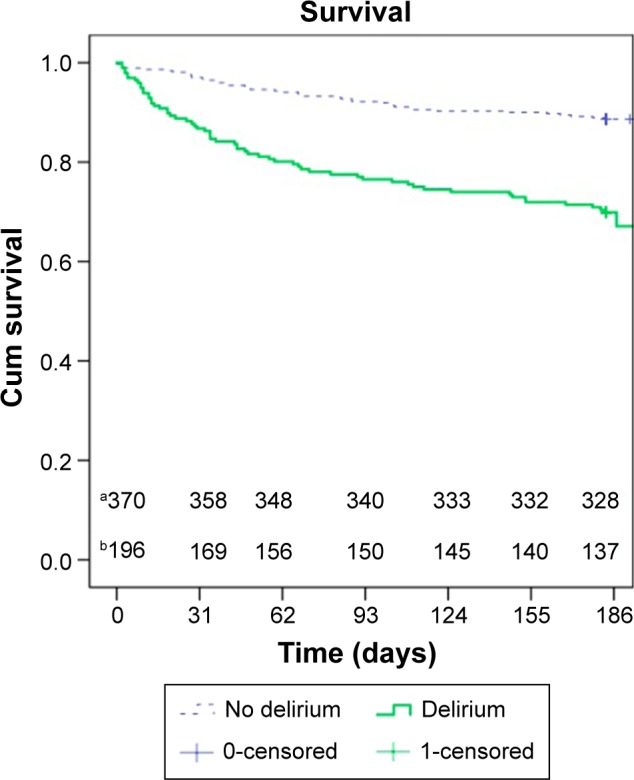
Of a total of 566 included patients, 75% were females. The median age was 84 years (interquartile range: 9). Delirium was observed in 35%. Significant risk factors for delirium were a high American Society of Anesthesiology score, delirium in medical history, functional dependency, preoperative institutionalization, low hemoglobin level, and high amount of blood transfusion. Delirium was correlated with a longer hospital stay (=0.001), increased association with complications (<0.001), institutionalization (<0.001), and 6-month mortality (<0.001). Patients with dementia (N=168) had a higher delirium rate (57.7%, <0.001) but a shorter hospital stay (<0.001). There was no significant difference in the 6-month mortality between delirious patients with (34.0%) and without dementia (26.3%).
Elderly patients with a hip fracture are vulnerable for delirium, especially when the patient has dementia. Patients who underwent an episode of delirium were at increased risk for adverse outcomes.
髋部骨折患者谵妄是一种常见并发症。痴呆是谵妄的重要危险因素,在体弱老年人中很常见。本研究旨在扩展先前关于谵妄危险因素及其后果的知识。特别关注患有痴呆和谵妄的患者。
这是一项在荷兰布雷达的安菲亚医院进行的回顾性队列研究。使用完整的电子病历系统(Hyperspace版本IU4:Epic公司,美国威斯康星州维罗纳)评估2014年1月至2015年9月期间的数据。所有就诊患者年龄≥70岁,因髋部骨折接受了骨固定术或关节置换术。若为病理性或假体周围髋部骨折、多发创伤性损伤和高能创伤,则将患者排除。记录患者和手术特征。记录术后结果。使用谵妄观察筛查量表筛查谵妄,并从病历中评估痴呆情况。
在总共纳入的566例患者中,75%为女性。中位年龄为84岁(四分位间距:9)。35%的患者出现谵妄。谵妄的显著危险因素包括美国麻醉医师协会评分高、有谵妄病史、功能依赖、术前入住养老院、血红蛋白水平低和输血量大。谵妄与住院时间延长(P=0.001)、并发症发生率增加(P<0.001)、入住养老院(P<0.001)和6个月死亡率(P<0.001)相关。患有痴呆的患者(N=168)谵妄发生率较高(57.7%,P<0.001),但住院时间较短(P<0.001)。有痴呆的谵妄患者(34.0%)和无痴呆的谵妄患者(26.3%)6个月死亡率无显著差异。
髋部骨折的老年患者易发生谵妄,尤其是患有痴呆的患者。经历过谵妄发作的患者不良结局风险增加。