Shin Joong Gon, Kim Jeong Hyun, Park Chul Soo, Kim Bong Jo, Kim Jae Won, Choi Ihn Geun, Hwang Jaeuk, Shin Hyoung Doo, Woo Sung Il
Department of Life Science, Sogang University, Seoul, Korea.
Research Institute for Basic Science, Sogang University, Seoul, Korea.
Yonsei Med J. 2017 May;58(3):619-625. doi: 10.3349/ymj.2017.58.3.619.
Schizophrenia is a devastating mental disorder and is known to be affected by genetic factors. The chromogranin B (CHGB), a member of the chromogranin gene family, has been proposed as a candidate gene associated with the risk of schizophrenia. The secretory pathway for peptide hormones and neuropeptides in the brain is regulated by chromogranin proteins. The aim of this study was to investigate the potential associations between genetic variants of CHGB and schizophrenia susceptibility.
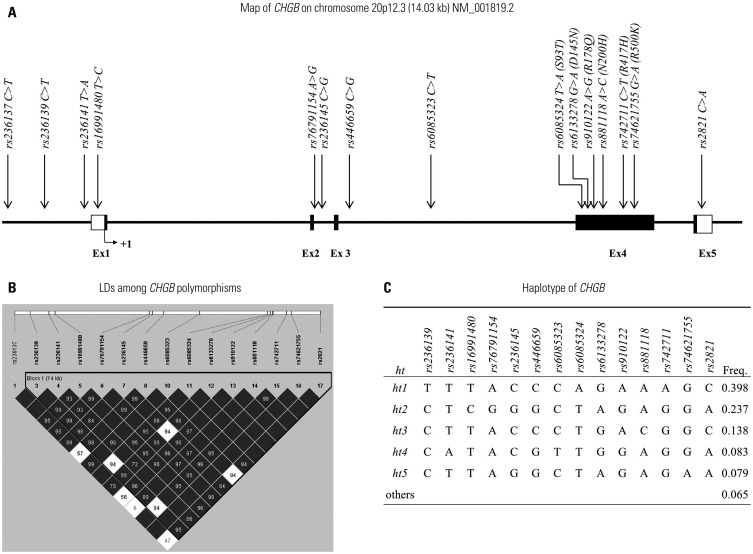
In the current study, 15 single nucleotide polymorphisms of CHGB were genotyped in 310 schizophrenia patients and 604 healthy controls.
Statistical analysis revealed that two genetic variants (non-synonymous rs910122; rs2821 in 3'-untranslated region) were associated with schizophrenia [minimum p=0.002; odds ratio (OR)=0.72], even after correction for multiple testing (p(corr)=0.02). Since schizophrenia is known to be differentially expressed between sexes, additional analysis for sex was performed. As a result, these two genetic variants (rs910122 and rs2821) and a haplotype (ht3) showed significant associations with schizophrenia in male subjects (p(corr)=0.02; OR=0.64), whereas the significance disappeared in female subjects (p>0.05).
Although this study has limitations including a small number of samples and lack of functional study, our results suggest that genetic variants of CHGB may have sex-specific effects on the risk of schizophrenia and provide useful preliminary information for further study.
精神分裂症是一种具有破坏性的精神障碍,已知受遗传因素影响。嗜铬粒蛋白B(CHGB)是嗜铬粒蛋白基因家族的成员,已被提出作为与精神分裂症风险相关的候选基因。大脑中肽类激素和神经肽的分泌途径受嗜铬粒蛋白调节。本研究的目的是调查CHGB基因变异与精神分裂症易感性之间的潜在关联。
在本研究中,对310例精神分裂症患者和604例健康对照进行了CHGB的15个单核苷酸多态性基因分型。
统计分析显示,即使在进行多重检验校正后(p(校正)=0.02),两个基因变异(非同义rs910122;3'非翻译区的rs2821)与精神分裂症相关[最小p=0.002;优势比(OR)=0.72]。由于已知精神分裂症在性别之间存在差异表达,因此进行了额外的性别分析。结果,这两个基因变异(rs910122和rs2821)和一个单倍型(ht3)在男性受试者中与精神分裂症显示出显著关联(p(校正)=0.02;OR=0.64),而在女性受试者中这种显著性消失(p>0.05)。
尽管本研究存在包括样本数量少和缺乏功能研究等局限性,但我们的结果表明,CHGB基因变异可能对精神分裂症风险具有性别特异性影响,并为进一步研究提供了有用的初步信息。