Abdullah Laila, Evans James E, Emmerich Tanja, Crynen Gogce, Shackleton Ben, Keegan Andrew P, Luis Cheryl, Tai Leon, LaDu Mary J, Mullan Michael, Crawford Fiona, Bachmeier Corbin
Roskamp Institute, Sarasota, FL 34234, USA.
University of Illinois at Chicago, Chicago, IL 60607, USA.
Aging (Albany NY). 2017 Mar 23;9(3):964-985. doi: 10.18632/aging.101203.
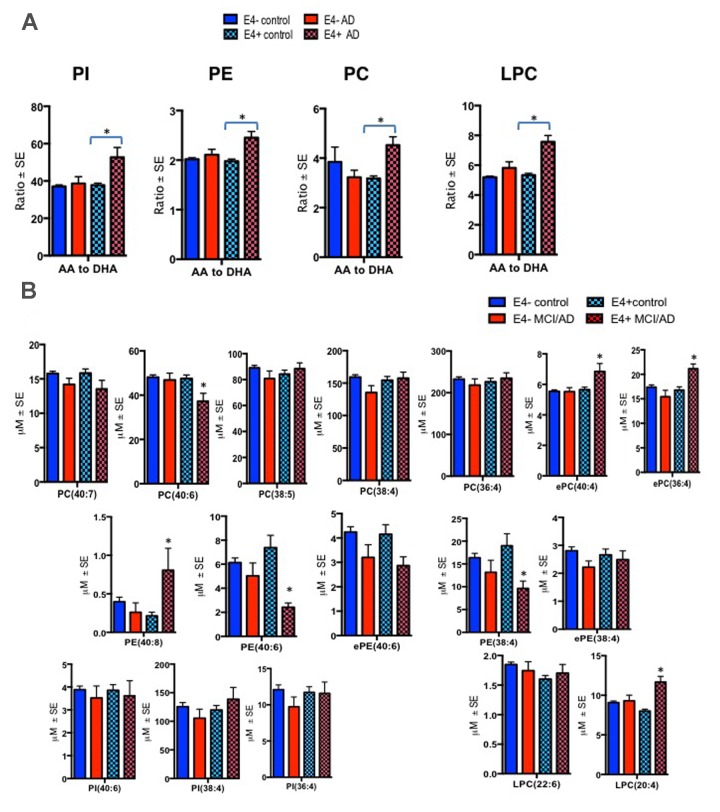
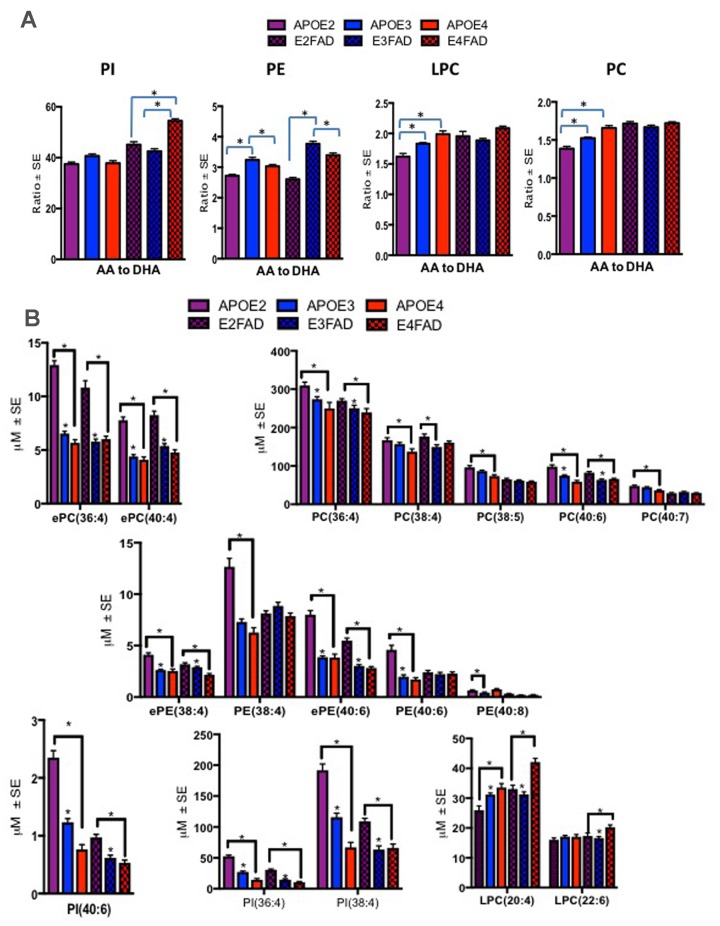
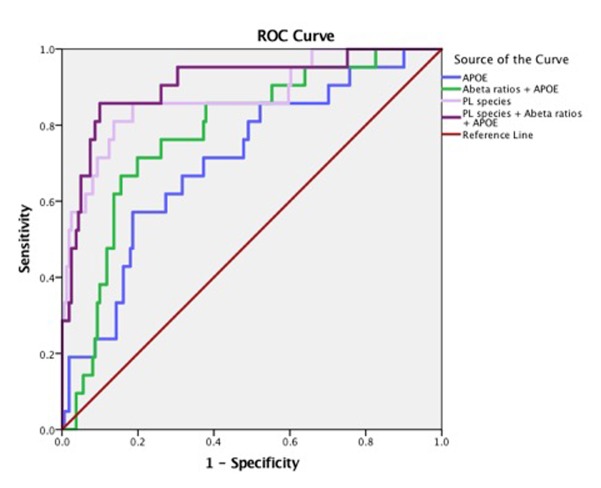
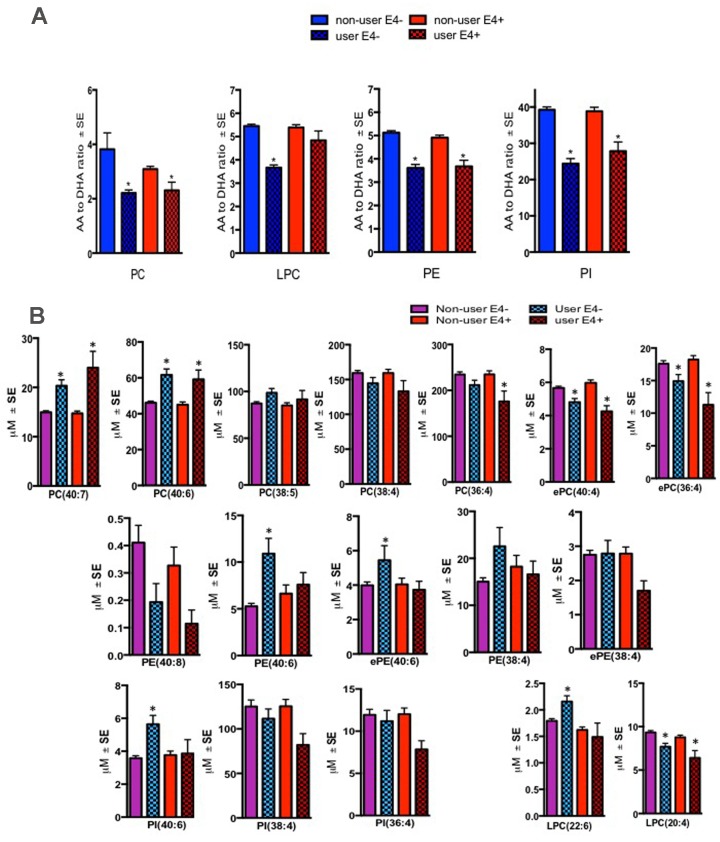
This study was designed to explore the influence of apolipoprotein E (APOE) on blood phospholipids (PL) in predicting preclinical Alzheimer's disease (AD). Lipidomic analyses were also performed on blood from an AD mouse model expressing human APOE isoforms (EFAD) and five AD mutations and from 195 cognitively normal participants, 23 of who converted to mild cognitive impairment (MCI)/AD within 3 years. APOE ε4-carriers converting to MCI/AD had high arachidonic acid (AA)/docosahexaenoic acid (DHA) ratios in PL compared to cognitively normal ε4 and non-ε4 carriers. Arachidonic acid and DHA containing PL species, ε4-status and Aβ42/Aβ40 ratios provided 91% accuracy in detecting MCI/AD. Fish oil/omega-3 fatty acid consumption was associated with lower AA/DHA ratios even among ε4 carriers. High plasma AA/DHA ratios were observed in E4FAD compared to EFAD mice with other isoforms. In particular, alterations in plasma AA and DHA containing PL species were also observed in the brains of E4FAD mice compared to E3FAD mice. Despite the small sample size and a short follow-up, these results suggest that blood PL could potentially serve as biomarkers of preclinical MCI/AD.
本研究旨在探讨载脂蛋白E(APOE)对血液磷脂(PL)在预测临床前阿尔茨海默病(AD)中的影响。还对表达人类APOE异构体(EFAD)和五种AD突变的AD小鼠模型以及195名认知正常参与者的血液进行了脂质组学分析,其中23名在3年内转变为轻度认知障碍(MCI)/AD。与认知正常的ε4携带者和非ε4携带者相比,转变为MCI/AD的APOE ε4携带者的PL中花生四烯酸(AA)/二十二碳六烯酸(DHA)比值较高。含花生四烯酸和DHA的PL种类、ε4状态以及Aβ42/Aβ40比值在检测MCI/AD方面的准确率为91%。即使在ε4携带者中,食用鱼油/ω-3脂肪酸也与较低的AA/DHA比值相关。与具有其他异构体的EFAD小鼠相比,E4FAD小鼠的血浆AA/DHA比值较高。特别是,与E3FAD小鼠相比,在E4FAD小鼠的大脑中也观察到含血浆AA和DHA的PL种类发生了变化。尽管样本量小且随访时间短,但这些结果表明血液PL有可能作为临床前MCI/AD的生物标志物。