Carroll Clint R, Noonan Carolyn, Garroutte Eva M, Navas-Acien Ana, Verney Steven P, Buchwald Dedra
Department of Ethnic Studies, University of Colorado, Boulder, CO, USA.
Initiative for Research and Education to Advance Community Health (IREACH), Washington State University, Spokane, WA, USA.
Environ Res. 2017 Jul;156:74-79. doi: 10.1016/j.envres.2017.03.018. Epub 2017 May 12.
Inorganic arsenic at high and prolonged doses is highly neurotoxic. Few studies have evaluated whether long-term, low-level arsenic exposure is associated with neuropsychological functioning in adults.
To investigate the association between long-term, low-level inorganic arsenic exposure and neuropsychological functioning among American Indians aged 64-95.
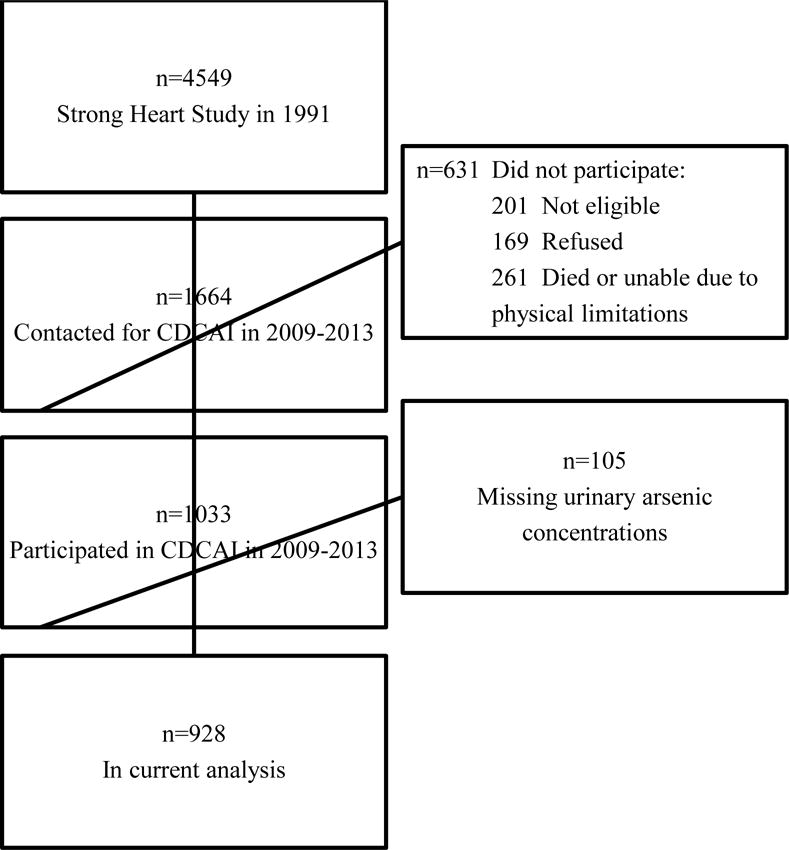
We assessed 928 participants in the Strong Heart Study by using data on arsenic species in urine samples collected at baseline (1989-1991) and results of standardized tests of global cognition, executive functioning, verbal learning and memory, fine motor functioning, and speed of mental processing administered during comprehensive follow-up evaluations in 2009-2013. We calculated the difference in neuropsychological functioning for a 10% increase in urinary arsenic with adjustment for sex, age, education, and study site.
The sum of inorganic and methylated arsenic species (∑As) in urine was associated with limited fine motor functioning and processing speed. A 10% increase in ∑As was associated with a .10 (95% CI -.20, -.01) decrease on the Finger Tapping Test for the dominant hand and a .13 decrease (95% CI -.21, -.04) for the non-dominant hand. Similarly, a 10% increase in ∑As was associated with a .15 (95% CI -.29, .00) decrease on the Wechsler Adult Intelligence Scale-Fourth Edition Coding Subtest. ∑As was not associated with other neuropsychological functions.
Findings indicate an adverse association between increased urinary arsenic fine motor functioning and processing speed, but not with other neuropsychological functioning, among elderly American Indians.
高剂量且长期接触无机砷具有高度神经毒性。很少有研究评估长期低水平砷暴露是否与成年人的神经心理功能有关。
调查64 - 95岁美国印第安人中,长期低水平无机砷暴露与神经心理功能之间的关联。
我们对“强心研究”中的928名参与者进行了评估,使用了1989 - 1991年基线时收集的尿样中砷形态的数据,以及在2009 - 2013年全面随访评估期间进行的全球认知、执行功能、言语学习和记忆、精细运动功能及心理加工速度标准化测试的结果。我们计算了尿砷增加10%时神经心理功能的差异,并对性别、年龄、教育程度和研究地点进行了调整。
尿中无机砷和甲基化砷形态之和(∑As)与有限的精细运动功能及加工速度有关。∑As增加10%与优势手的手指敲击测试得分降低0.10(95%可信区间 - 0.20, - 0.01)以及非优势手降低0.13(95%可信区间 - 0.21, - 0.04)有关。同样,∑As增加10%与韦氏成人智力量表第四版编码子测试得分降低0.15(95%可信区间 - 0.29,0.00)有关。∑As与其他神经心理功能无关。
研究结果表明,在老年美国印第安人中,尿砷增加与精细运动功能和加工速度下降存在不良关联,但与其他神经心理功能无关。