Jaganjac Morana, Almuraikhy Shamma, Al-Khelaifi Fatima, Al-Jaber Mashael, Bashah Moataz, Mazloum Nayef A, Zarkovic Kamelija, Zarkovic Neven, Waeg Georg, Kafienah Wael, Elrayess Mohamed A
Anti-Doping Lab Qatar, Sports City, Doha, Qatar.
Anti-Doping Lab Qatar, Sports City, Doha, Qatar; School of Cellular and Molecular Medicine, University of Bristol, Bristol, United Kingdom.
Redox Biol. 2017 Aug;12:483-490. doi: 10.1016/j.redox.2017.03.012. Epub 2017 Mar 16.
Obesity-associated impaired fat accumulation in the visceral adipose tissue can lead to ectopic fat deposition and increased risk of insulin resistance and type 2 diabetes mellitus (T2DM). This study investigated whether impaired adipogenesis of omental (OM) adipose tissues and elevated 4-hydroxynonenal (4-HNE) accumulation contribute to this process, and if combined metformin and insulin treatment in T2DM patients could rescue this phenotype.
OM adipose tissues were obtained from forty clinically well characterized obese individuals during weight reduction surgery. Levels of 4-HNE protein adducts, adipocyte size and number of macrophages were determined within these tissues by immunohistochemistry. Adipogenic capacity and gene expression profiles were assessed in preadipocytes derived from these tissues in relation to insulin resistance and in response to 4-HNE, metformin or combined metformin and insulin treatment.
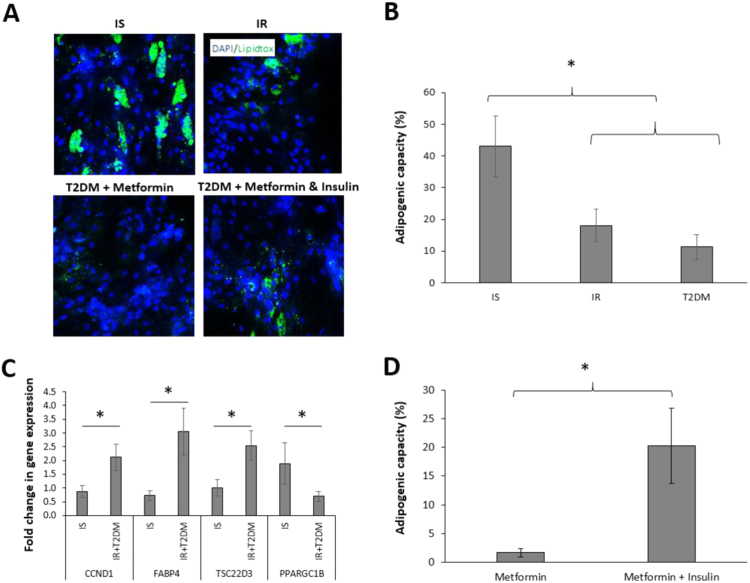
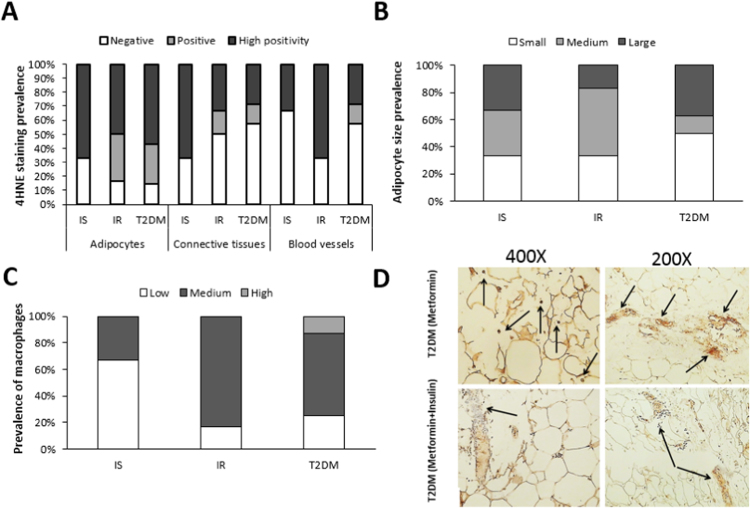
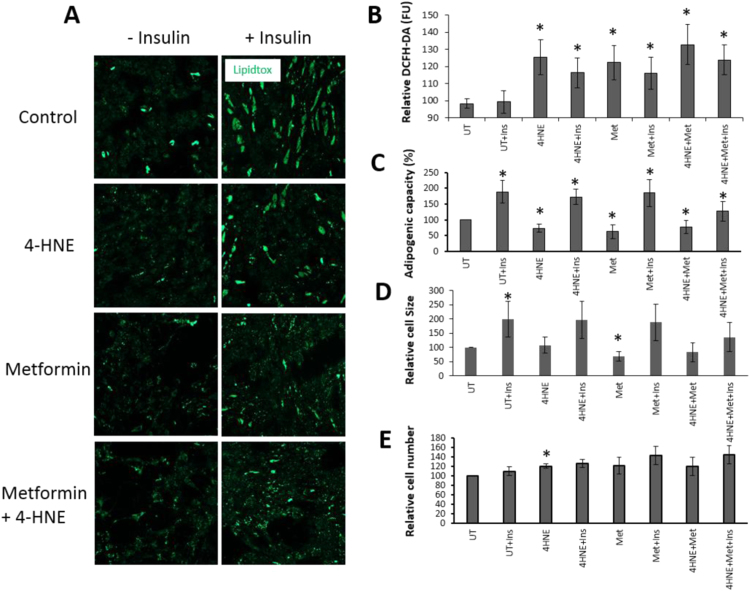
Preadipocytes isolated from insulin resistant (IR) and T2DM individuals exhibited lower adipogenesis, marked by upregulation of anti-adipogenic genes, compared to preadipocytes derived from insulin sensitive (IS) individuals. Impaired adipogenesis was also associated with increased 4-HNE levels, smaller adipocytes and greater macrophage presence in the adipose tissues. Within the T2DM group, preadipocytes from combined metformin and insulin treated subset showed better in vitro adipogenesis compared to metformin alone, which was associated with less presence of macrophages and 4-HNE in the adipose tissues. Treatment of preadipocytes in vitro with 4-HNE reduced their adipogenesis and increased proliferation, even in the presence of metformin, which was partially rescued by the presence of insulin.
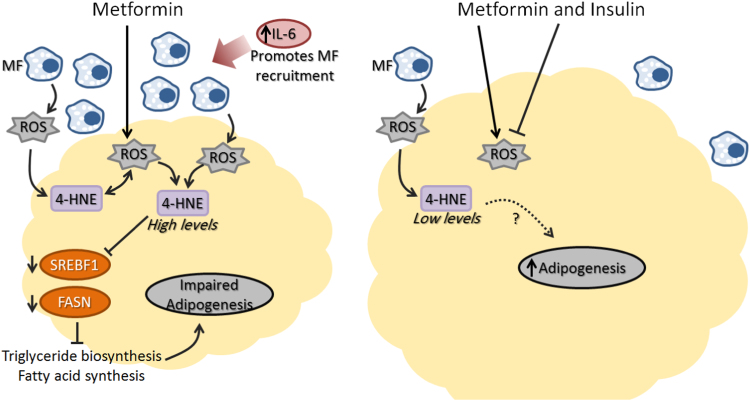
This study reveals involvement of 4-HNE in the impaired OM adipogenesis-associated with insulin resistance and T2DM and provides a proof of concept that this impairment can be reversed by the synergistic action of insulin and metformin. Further studies are needed to evaluate involvement of 4-HNE in metabolically impaired abdominal adipogenesis and to confirm benefits of combined metformin-insulin therapy in T2DM patients.
肥胖相关的内脏脂肪组织脂肪堆积受损可导致异位脂肪沉积,并增加胰岛素抵抗和2型糖尿病(T2DM)的风险。本研究调查网膜(OM)脂肪组织的脂肪生成受损和4-羟基壬烯醛(4-HNE)积累增加是否促成了这一过程,以及T2DM患者联合使用二甲双胍和胰岛素治疗是否能挽救这一表型。
在减重手术期间从40名临床特征明确的肥胖个体获取OM脂肪组织。通过免疫组织化学测定这些组织中4-HNE蛋白加合物水平、脂肪细胞大小和巨噬细胞数量。评估源自这些组织的前脂肪细胞的脂肪生成能力和基因表达谱,涉及胰岛素抵抗以及对4-HNE、二甲双胍或二甲双胍与胰岛素联合治疗的反应。
与源自胰岛素敏感(IS)个体的前脂肪细胞相比,从胰岛素抵抗(IR)和T2DM个体分离出的前脂肪细胞表现出较低的脂肪生成,其特征为抗脂肪生成基因上调。脂肪生成受损还与脂肪组织中4-HNE水平升高、脂肪细胞较小和巨噬细胞数量增加有关。在T2DM组中,与单独使用二甲双胍相比,联合使用二甲双胍和胰岛素治疗亚组的前脂肪细胞在体外表现出更好的脂肪生成,这与脂肪组织中巨噬细胞和4-HNE的存在较少有关。即使存在二甲双胍,用4-HNE体外处理前脂肪细胞也会降低其脂肪生成并增加增殖,而胰岛素的存在可部分挽救这一情况。
本研究揭示了4-HNE参与与胰岛素抵抗和T2DM相关的OM脂肪生成受损,并提供了一个概念证明,即这种损伤可通过胰岛素和二甲双胍的协同作用得到逆转。需要进一步研究来评估4-HNE在代谢受损的腹部脂肪生成中的作用,并确认二甲双胍-胰岛素联合治疗对T2DM患者的益处。