Division of Molecular Medicine, Ruder Boskovic Institute, HR-10000 Zagreb, Croatia.
Centro de Metabolómica y Bioanálisis (CEMBIO), Facultad de Farmacia, Universidad CEU San Pablo, Campus Montepríncipe, ES-28003 Madrid, Spain.
Biomolecules. 2023 Jan 10;13(1):145. doi: 10.3390/biom13010145.
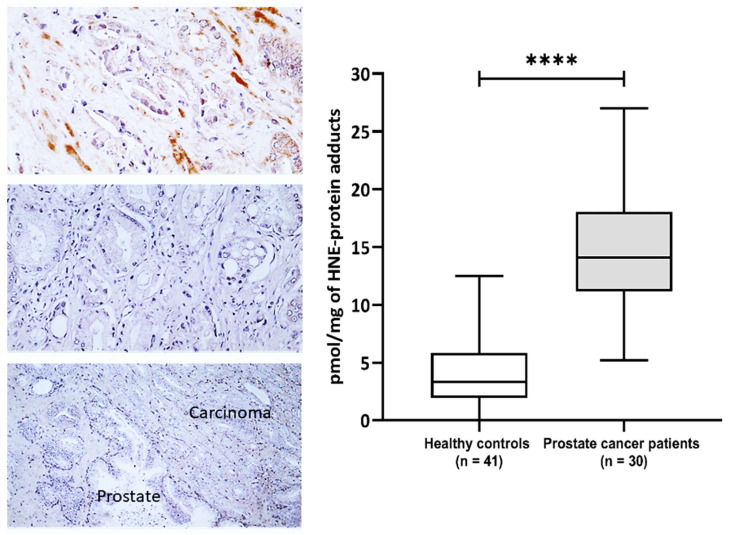
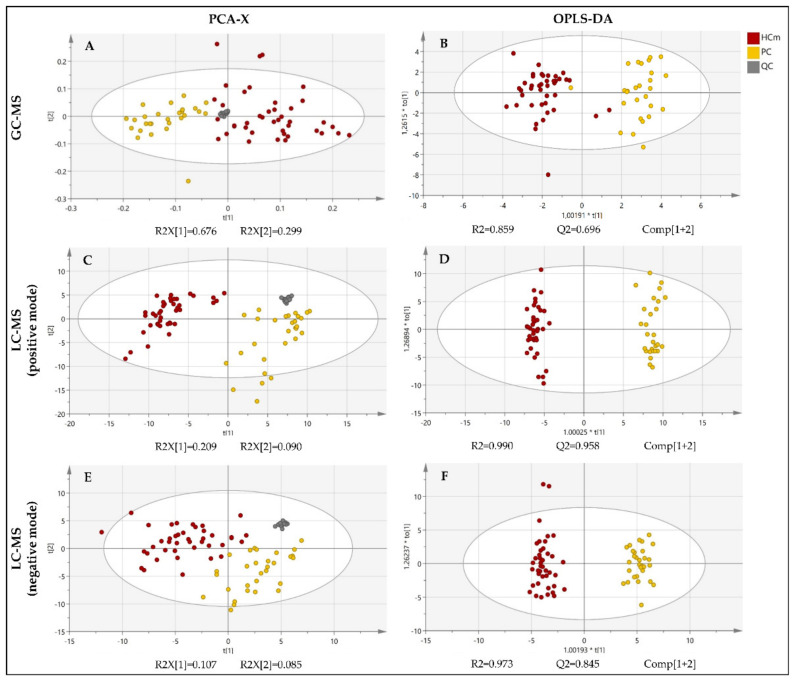
An oxidative degradation product of the polyunsaturated fatty acids, 4-hydroxynonenal (4-HNE), is of particular interest in cancer research due to its concentration-dependent pleiotropic activities affecting cellular antioxidants, metabolism, and growth control. Although an increase in oxidative stress and lipid peroxidation was already associated with prostate cancer progression a few decades ago, the knowledge of the involvement of 4-HNE in prostate cancer tumorigenesis is limited. This study investigated the appearance of 4-HNE-protein adducts in prostate cancer tissue by immunohistochemistry using a genuine 4-HNE monoclonal antibody. Plasma samples of the same patients and samples of the healthy controls were also analyzed for the presence of 4-HNE-protein adducts, followed by metabolic profiling using LC-ESI-QTOF-MS and GC-EI-Q-MS. Finally, the analysis of the metabolic pathways affected by 4-HNE was performed. The obtained results revealed the absence of 4-HNE-protein adducts in prostate carcinoma tissue but increased 4-HNE-protein levels in the plasma of these patients. Metabolomics revealed a positive association of different long-chain and medium-chain fatty acids with the presence of prostate cancer. Furthermore, while linoleic acid positively correlated with the levels of 4-HNE-protein adducts in the blood of healthy men, no correlation was obtained for cancer patients indicating altered lipid metabolism in this case. The metabolic pathway of unsaturated fatty acids biosynthesis emerged as significantly affected by 4-HNE. Overall, this is the first study linking 4-HNE adduction to plasma proteins with specific alterations in the plasma metabolome of prostate cancer patients. This study revealed that increased 4-HNE plasma protein adducts could modulate the unsaturated fatty acids biosynthesis pathway. It is yet to be determined if this is a direct result of 4-HNE or whether they are produced by the same underlying mechanisms. Further mechanistic studies are needed to grasp the biological significance of the observed changes in prostate cancer tumorigenesis.
多不饱和脂肪酸的氧化降解产物 4-羟壬烯醛(4-HNE)因其浓度依赖性的多效活性而引起人们的特别关注,这些活性影响细胞抗氧化剂、代谢和生长控制。尽管几十年前就已经发现氧化应激和脂质过氧化的增加与前列腺癌的进展有关,但 4-HNE 参与前列腺癌肿瘤发生的知识是有限的。本研究通过使用真正的 4-HNE 单克隆抗体,通过免疫组织化学研究了前列腺癌组织中 4-HNE-蛋白加合物的出现。还分析了相同患者的血浆样本和健康对照者的样本中是否存在 4-HNE-蛋白加合物,然后使用 LC-ESI-QTOF-MS 和 GC-EI-Q-MS 进行代谢物分析。最后,分析了 4-HNE 影响的代谢途径。结果表明,前列腺癌组织中不存在 4-HNE-蛋白加合物,但这些患者的血浆中 4-HNE-蛋白水平升高。代谢组学显示,不同的长链和中链脂肪酸与前列腺癌的存在呈正相关。此外,虽然亚油酸与健康男性血液中 4-HNE-蛋白加合物的水平呈正相关,但在癌症患者中未得到相关性,表明在这种情况下脂质代谢发生改变。不饱和脂肪酸生物合成的代谢途径被证明受到 4-HNE 的显著影响。总的来说,这是第一项将 4-HNE 加合物与血浆蛋白与前列腺癌患者的血浆代谢组学的特定改变联系起来的研究。本研究表明,增加的 4-HNE 血浆蛋白加合物可能调节不饱和脂肪酸生物合成途径。目前还不清楚这是 4-HNE 的直接结果,还是它们是由相同的潜在机制产生的。需要进一步的机制研究来掌握在前列腺癌肿瘤发生中观察到的变化的生物学意义。