Nakagawa So, Niimura Yoshihito, Gojobori Takashi
Department of Molecular Life Science, Tokai University School of Medicine, Isehara 259-1193, Japan.
Micro/Nano Technology Center, Tokai University, Hiratsuka 259-1292, Japan.
Nucleic Acids Res. 2017 Apr 20;45(7):3922-3931. doi: 10.1093/nar/gkx124.
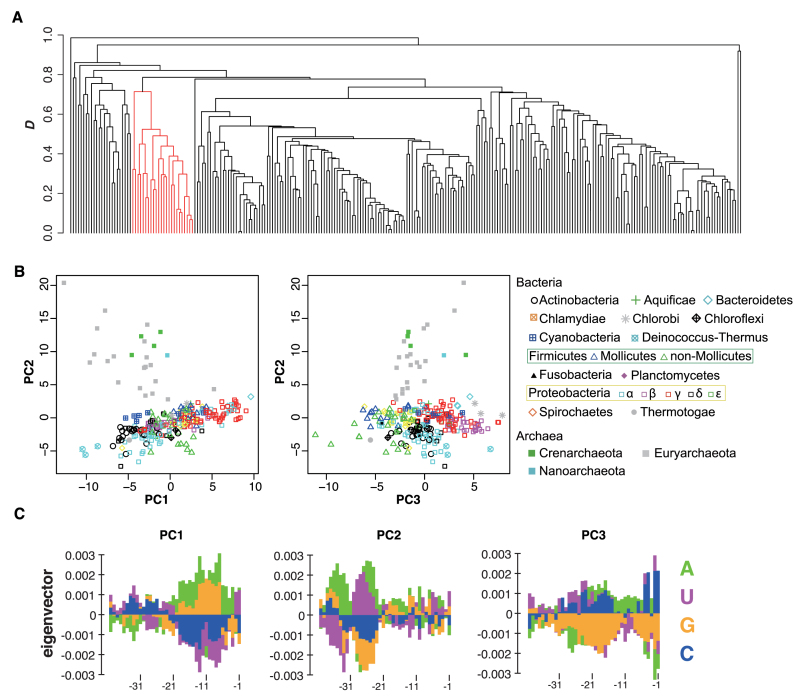
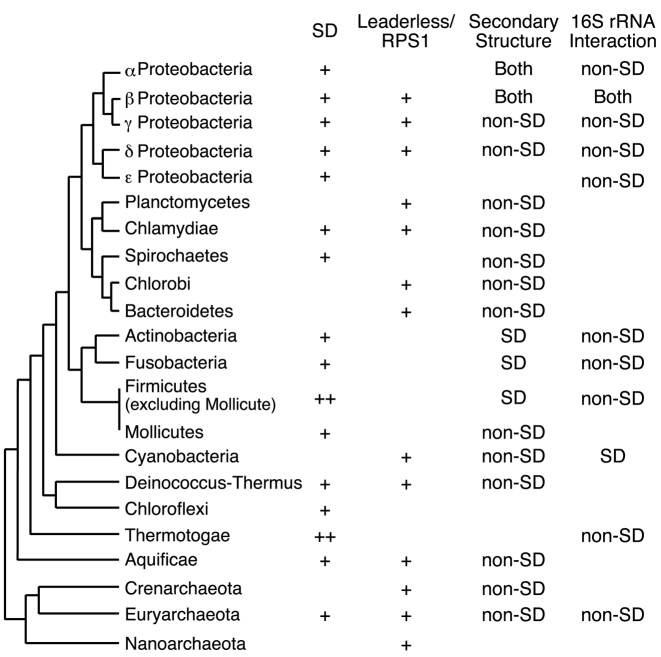
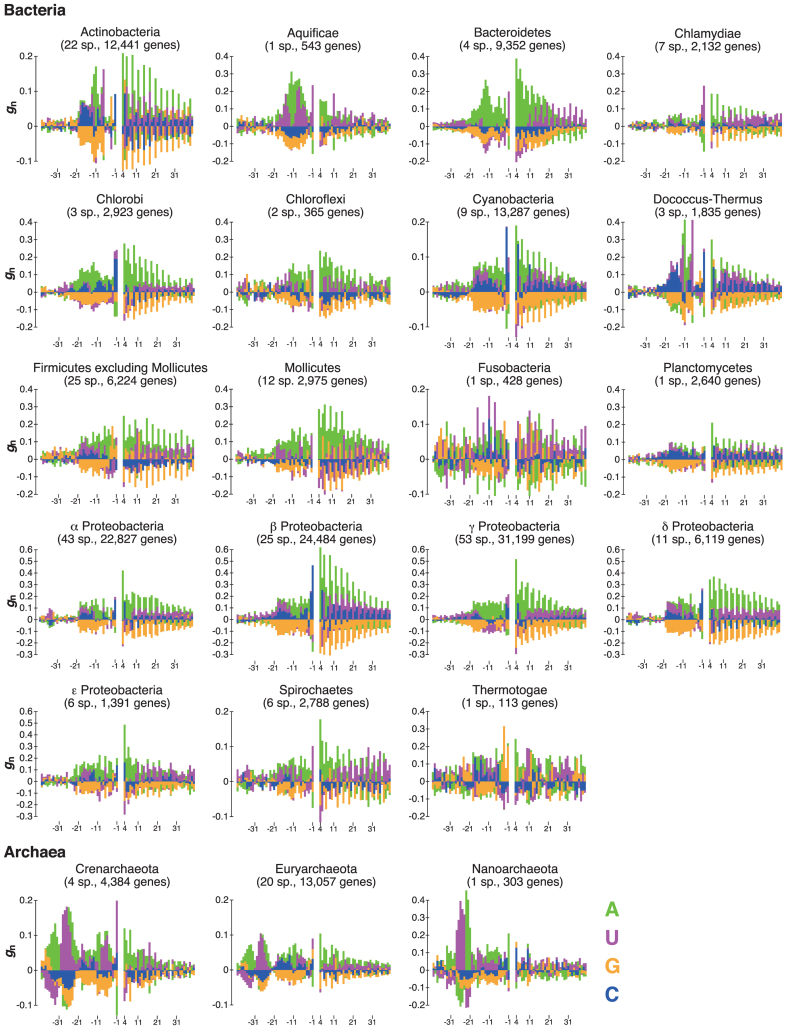
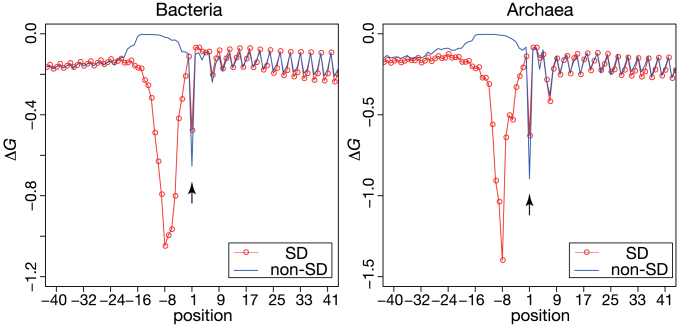
In prokaryotes, translation initiation is believed to occur through an interaction between the 3΄ tail of a 16S rRNA and a corresponding Shine-Dalgarno (SD) sequence in the 5΄ untranslated region (UTR) of an mRNA. However, some genes lack SD sequences (non-SD genes), and the fraction of non-SD genes in a genome varies depending on the prokaryotic species. To elucidate non-SD translation initiation mechanisms in prokaryotes from an evolutionary perspective, we statistically examined the nucleotide frequencies around the initiation codons in non-SD genes from 260 prokaryotes (235 bacteria and 25 archaea). We identified distinct nucleotide frequency biases upstream of the initiation codon in bacteria and archaea, likely because of the presence of leaderless mRNAs lacking a 5΄ UTR. Moreover, we observed overall similarities in the nucleotide patterns between upstream and downstream regions of the initiation codon in all examined phyla. Symmetric nucleotide frequency biases might facilitate translation initiation by preventing the formation of secondary structures around the initiation codon. These features are more prominent in species' genomes that harbor large fractions of non-SD sequences, suggesting that a reduced stability around the initiation codon is important for efficient translation initiation in prokaryotes.
在原核生物中,翻译起始被认为是通过16S rRNA的3΄尾与mRNA的5΄非翻译区(UTR)中相应的Shine-Dalgarno(SD)序列之间的相互作用来发生的。然而,一些基因缺乏SD序列(非SD基因),并且基因组中非SD基因的比例因原核生物物种而异。为了从进化的角度阐明原核生物中的非SD翻译起始机制,我们对来自260种原核生物(235种细菌和25种古细菌)的非SD基因起始密码子周围的核苷酸频率进行了统计分析。我们在细菌和古细菌的起始密码子上游发现了明显的核苷酸频率偏差,这可能是由于缺乏5΄UTR的无领导mRNA的存在。此外,我们在所有检测的门类中观察到起始密码子上游和下游区域之间核苷酸模式的总体相似性。对称的核苷酸频率偏差可能通过防止起始密码子周围二级结构的形成来促进翻译起始。这些特征在含有大量非SD序列的物种基因组中更为突出,这表明起始密码子周围稳定性的降低对原核生物中高效的翻译起始很重要。