Enax-Krumova Elena K, Pohl Stephanie, Westermann Andrea, Maier Christoph
Department of Neurology, BG University Hospital Bergmannsheil GmbH, Ruhr University Bochum, Bürkle-de-la-Camp-Platz 1, D-44789, Bochum, Germany.
Department of Pain Medicine, BG University Hospital Bergmannsheil GmbH Bochum, Ruhr University Bochum, Bochum, Germany.
BMC Neurol. 2017 Mar 23;17(1):60. doi: 10.1186/s12883-017-0839-9.
In unilateral neuropathic pain. e.g. after peripheral nerve injury, both positive and negative sensory signs occur often, accompanied by minor but equally directed contralateral sensory changes. To mimic this feature, we experimentally aimed to induce concomitant c-fibre sensitization and block in healthy subjects and analyzed the bilateral sensory changes by quantitative sensory testing (QST) using the protocol of the German Research Network on Neuropathic Pain.
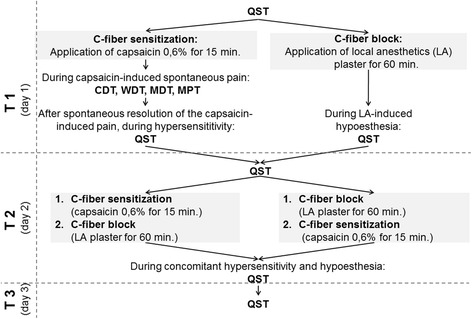
Twenty eight healthy subjects were firstly randomized in 2 groups to receive either topical capsaicin (0.6%, 12 cm, application duration: 15 min.) or a lidocaine/prilocaine patch (25/25 mg, 10 cm, application duration: 60 min.) on the right volar forearm. Secondly, 7-14 days later in the same area either at first capsaicin (for 15 min.) and immediately afterwards local anesthetics (for 60 min.) was applied (Cap/LA), or in inversed order with the same application duration (LA/Cap). Before, after each application and 7-14 days later a QST was performed bilaterally.
Wilcoxon-test, ANOVA, p < 0.05.
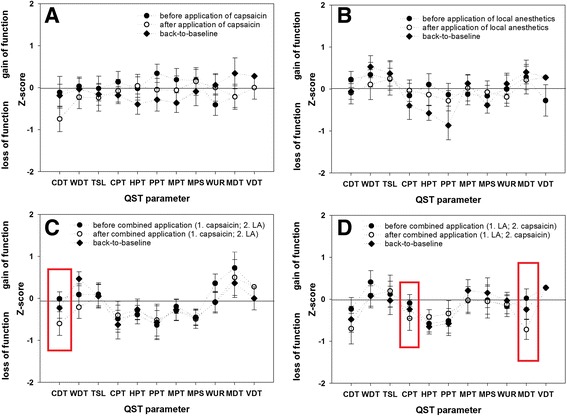
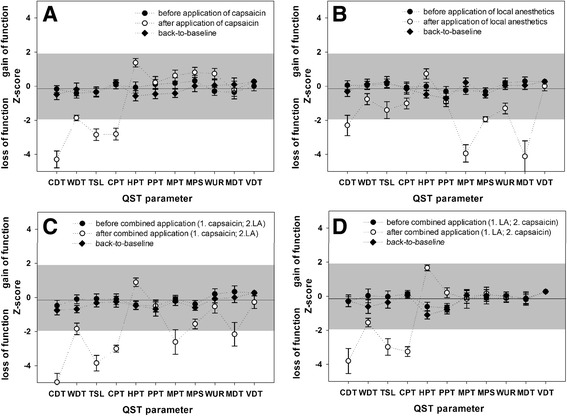
Single application of 0,6% capsaicin induced thermal hypoesthesia, cold hypoalgesia, heat hyperalgesia and tactile allodynia. Lidocaine/prilocaine alone induced thermal and tactile hypoesthesia as well as mechanical and cold hypoalgesia, and a heat hyperalgesia (to a smaller extent). Ipsilaterally both co-applications induced a combination of the above mentioned changes. Significant contralateral sensory changes occurred only after the co-application with concomitant sensitization and hypoesthesia and comprised increased cold (Cap/LA, LA/Cap) and mechanical detection as well as cold pain threshold (LA/Cap).
The present experimental model using combined application of capsaicin and LA imitates partly the complex sensory changes observed in patients with unilateral neuropathic pain and might be used as an additional surrogate model. Only the concomitant use both agents in the same area induces both positive and negative sensory signs ipsilaterally as well as parallel contralateral sensory changes (to a lesser extent).
ClinicalTrials.gov Identifier NCT01540877 , registered on 23 February 2012.
在单侧神经性疼痛中,例如在周围神经损伤后,常常会出现阳性和阴性感觉体征,同时伴有轻微但同样明显的对侧感觉变化。为了模拟这一特征,我们通过实验旨在在健康受试者中诱导伴随的C纤维致敏和阻滞,并使用德国神经性疼痛研究网络的方案通过定量感觉测试(QST)分析双侧感觉变化。
28名健康受试者首先被随机分为两组,分别在右侧掌侧前臂接受辣椒素(0.6%,12厘米,涂抹持续时间:15分钟)或利多卡因/丙胺卡因贴剂(25/25毫克,10厘米,涂抹持续时间:60分钟)。其次,7 - 14天后在同一区域,要么先涂抹辣椒素(15分钟),然后立即涂抹局部麻醉剂(60分钟)(辣椒素/局部麻醉剂组),要么以相反顺序涂抹相同的持续时间(局部麻醉剂/辣椒素组)。在每次涂抹前、涂抹后以及7 - 14天后双侧进行QST。
Wilcoxon检验、方差分析,p < 0.05。
单次涂抹0.6%辣椒素可诱导热感觉减退、冷痛觉减退、热痛觉过敏和触觉异常性疼痛。单独使用利多卡因/丙胺卡因可诱导热和触觉感觉减退以及机械性和冷痛觉减退,还有热痛觉过敏(程度较轻)。同侧两种联合应用均诱导了上述变化的组合。仅在联合应用且伴有致敏和感觉减退后才出现明显的对侧感觉变化,包括冷觉(辣椒素/局部麻醉剂组、局部麻醉剂/辣椒素组)和机械性检测以及冷痛阈值增加(局部麻醉剂/辣椒素组)。
本实验模型通过联合应用辣椒素和局部麻醉剂部分模拟了单侧神经性疼痛患者中观察到的复杂感觉变化,可作为一种额外的替代模型。仅在同一区域同时使用这两种药物可在同侧诱导阳性和阴性感觉体征以及平行的对侧感觉变化(程度较轻)。
ClinicalTrials.gov标识符NCT01540877,于2012年2月23日注册。