He Wei, Chen Bu-Dong, Lv Yan, Zhou Zhen, Xu Jin-Ping, Lv Ping-Xin, Zhou Xin-Hua, Ning Feng-Gang, Li Cheng-Hai, Wang Dong-Po, Zheng Jie
Beijing Chest Hospital, Capital Medical University, No. 97 Beimachang, Tongzhou District, Beijing, 101149, China.
The school hospital, Beijing Science and Technology University, Beijing, 100083, China.
Infect Dis Poverty. 2017 Mar 24;6(1):68. doi: 10.1186/s40249-017-0274-6.
According to the World Health Organization, China is one of 22 countries with serious tuberculosis (TB) infections and one of the 27 countries with serious multidrug-resistant TB strains. Despite the decline of tuberculosis in the overall population, healthcare workers (HCWs) are still at a high risk of infection. Compared with high-income countries, the TB prevalence among HCWs is higher in low- and middle-income countries. Low-dose computed tomography (LDCT) is becoming more popular due to its superior sensitivity and lower radiation dose. However, there have been no reports about active pulmonary tuberculosis (PTB) among HCWs as assessed with LDCT. The purposes of this study were to examine PTB statuses in HCWs in hospitals specializing in TB treatment and explore the significance of the application of LDCT to these workers.
This study retrospectively analysed the physical examination data of healthcare workers in the Beijing Chest Hospital from September 2012 to December 2015. Low-dose lung CT examinations were performed in all cases. The comparisons between active and inactive PTB according to the CT findings were made using the Pearson chi-square test or the Fisher's exact test. Comparisons between the incidences of active PTB in high-risk areas and non-high-risk areas were performed using the Pearson chi-square test. Analyses of active PTB were performed according to different ages, numbers of years on the job, and the risks of the working areas. Active PTB as diagnosed by the LDCT examinations alone was compared with the final comprehensive diagnoses, and the sensitivity and positive predictive value were calculated.
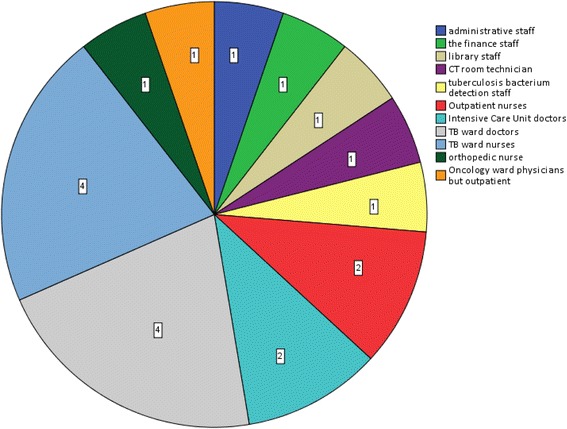
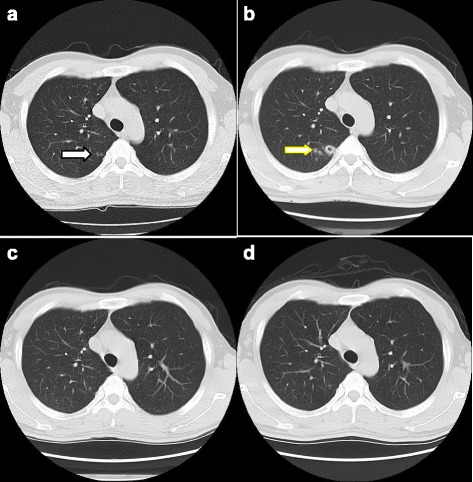
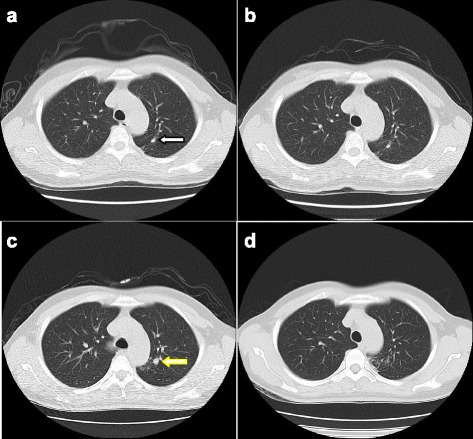
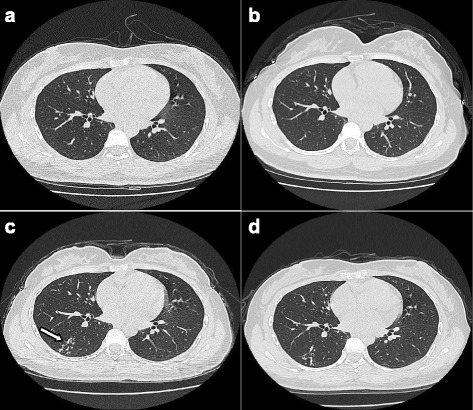
A total of 1 012 participants were included in this study. During the 4-year period of medical examinations, active PTB was found in 19 cases, and inactive PTB was found in 109 cases. The prevalence of active PTB in the participants was 1.24%, 0.67%, 0.81%, and 0.53% for years 2012 to 2015. The corresponding incidences of active PTB among the tuberculosis hospital participants were 0.86%, 0.41%, 0.54%, and 0.26%. Most HCWs with active TB (78.9%, 15/19) worked in the high-risk areas of the hospital. There was a significant difference in the incidences of active PTB between the HCWs who worked in the high-risk and non-high-risk areas (odds ratio [OR], 14.415; 95% confidence interval (CI): 4.733 - 43.896). Comparisons of the CT signs between the active and inactive groups via chi-square tests revealed that the tree-in-bud, cavity, fibrous shadow, and calcification signs exhibited significant differences (P = 0.000, 0.021, 0.001, and 0.024, respectively). Tree-in-bud and cavity opacities suggest active pulmonary tuberculosis, whereas fibrous shadow and calcification opacities are the main features of inactive pulmonary tuberculosis. Comparison with the final comprehensive diagnoses revealed that the sensitivity and positive predictive value of the diagnoses of active PTB based on LDCT alone were 100% and 86.4%, respectively.
Healthcare workers in tuberculosis hospitals are a high-risk group for active PTB. Yearly LDCT examinations of such high-risk groups are feasible and necessary.
根据世界卫生组织的数据,中国是22个结核病(TB)感染严重的国家之一,也是27个耐多药结核菌株严重的国家之一。尽管总体人群中的结核病有所下降,但医护人员(HCWs)仍面临较高的感染风险。与高收入国家相比,低收入和中等收入国家医护人员中的结核病患病率更高。低剂量计算机断层扫描(LDCT)因其更高的灵敏度和更低的辐射剂量而越来越受欢迎。然而,尚无关于用LDCT评估医护人员活动性肺结核(PTB)的报告。本研究的目的是检查结核病专科医院医护人员的PTB状况,并探讨LDCT应用于这些工作人员的意义。
本研究回顾性分析了2012年9月至2015年12月北京胸科医院医护人员的体检数据。所有病例均进行了低剂量肺部CT检查。根据CT结果对活动性和非活动性PTB进行比较,采用Pearson卡方检验或Fisher精确检验。采用Pearson卡方检验对高风险区域和非高风险区域活动性PTB的发病率进行比较。根据不同年龄、工作年限和工作区域风险对活动性PTB进行分析。将仅通过LDCT检查诊断的活动性PTB与最终综合诊断进行比较,并计算灵敏度和阳性预测值。
本研究共纳入1012名参与者。在4年的体检期间,发现活动性PTB 19例,非活动性PTB 109例。2012年至2015年参与者中活动性PTB的患病率分别为1.24%、0.67%、0.81%和0.53%。结核病医院参与者中活动性PTB的相应发病率分别为0.86%、0.41%、0.54%和0.26%。大多数活动性结核病医护人员(78.9%,15/19)在医院的高风险区域工作。在高风险和非高风险区域工作的医护人员中,活动性PTB的发病率存在显著差异(优势比[OR],14.415;95%置信区间(CI):4.733 - 43.896)。通过卡方检验对活动组和非活动组的CT征象进行比较,发现树芽征、空洞、纤维影和钙化征有显著差异(P分别为0.000、0.021、0.001和0.024)。树芽征和空洞影提示活动性肺结核,而纤维影和钙化影是非活动性肺结核的主要特征。与最终综合诊断结果比较,仅基于LDCT诊断活动性PTB的灵敏度和阳性预测值分别为100%和86.4%。
结核病医院的医护人员是活动性PTB的高危人群。对此类高危人群每年进行LDCT检查是可行且必要的。