Baskaran Praveen, Jaleta Tegegn G, Streit Adrian, Rödelsperger Christian
Department for Evolutionary Biology, Max-Planck-Institute for Developmental Biology, Tübingen, Germany.
Genome Biol Evol. 2017 Mar 1;9(3):790-801. doi: 10.1093/gbe/evx040.
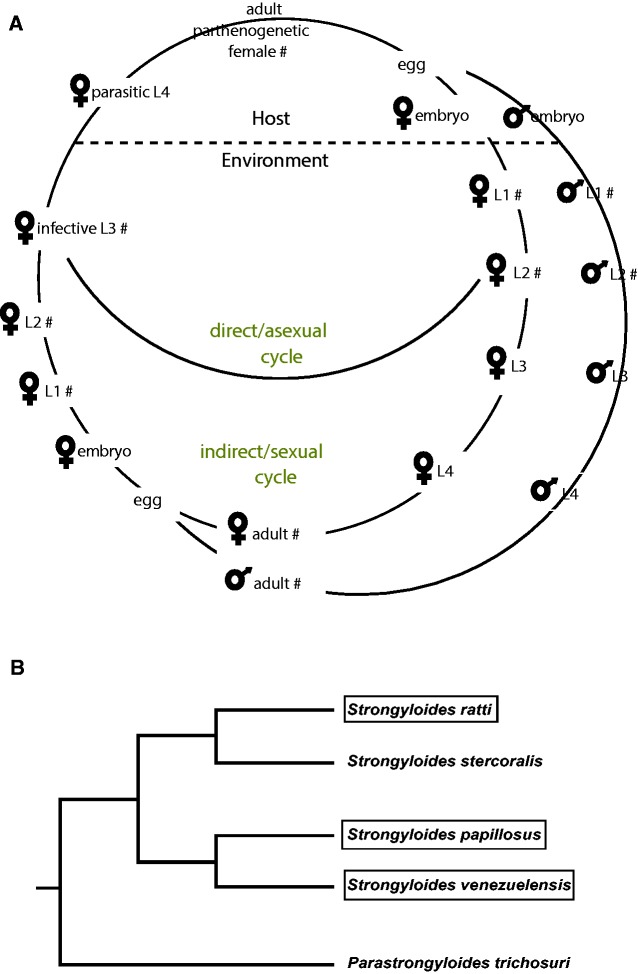
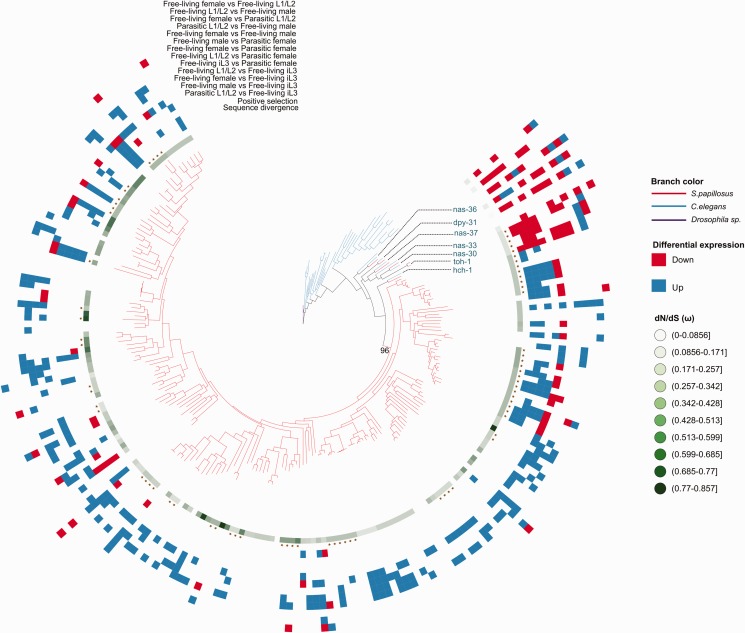
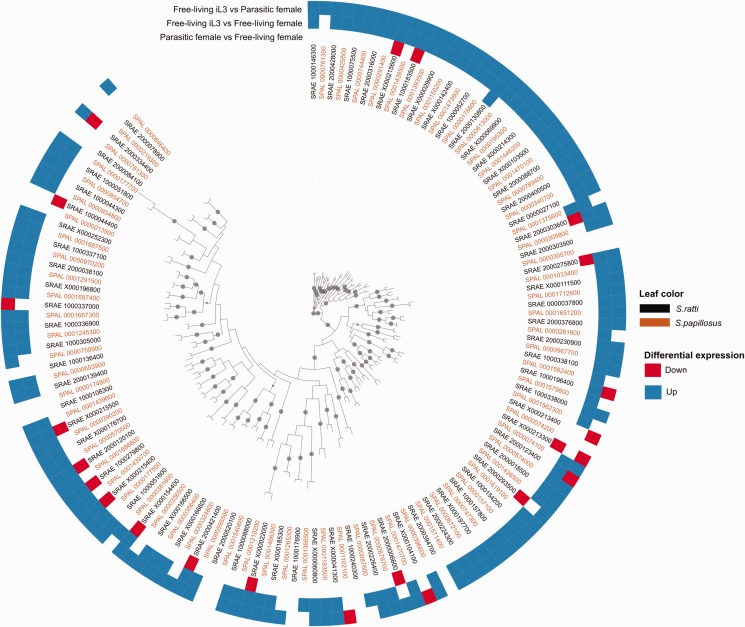
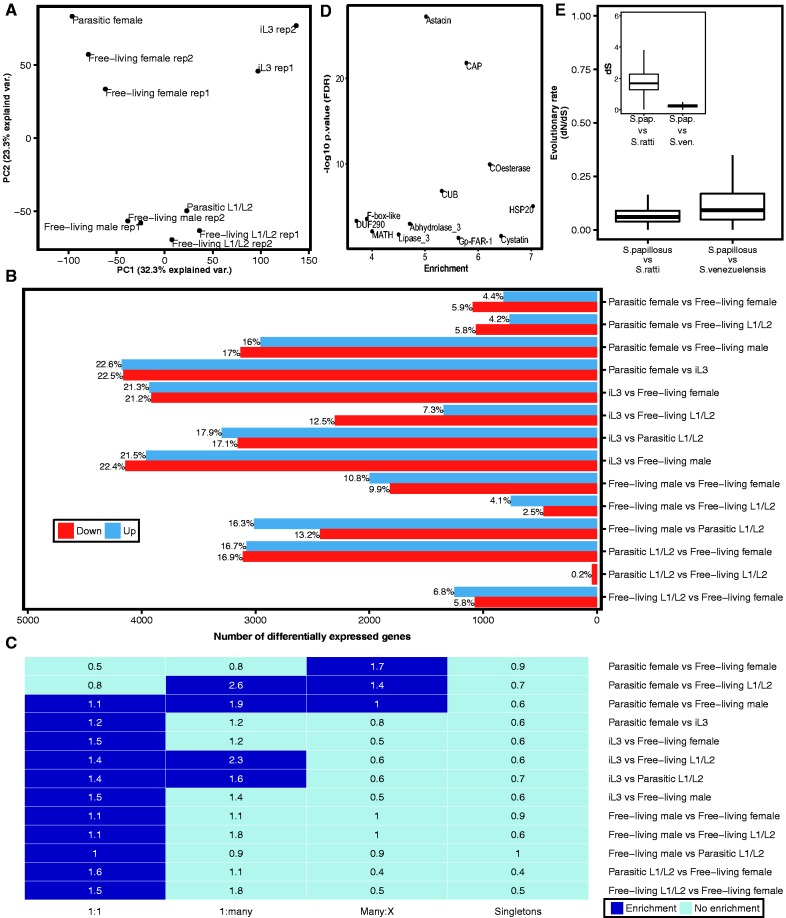
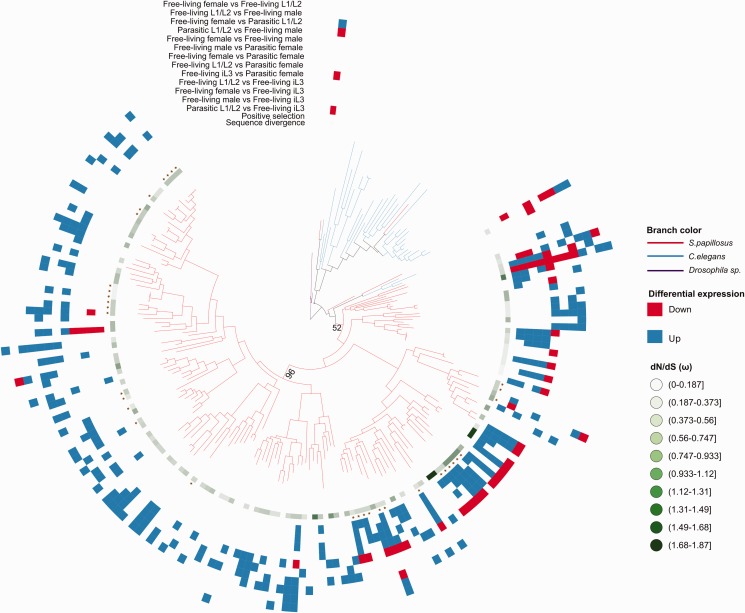
Gene duplication is a major mechanism playing a role in the evolution of phenotypic complexity and in the generation of novel traits. By comparing parasitic and nonparasitic nematodes, a recent study found that the evolution of parasitism in Strongyloididae is associated with a large expansion in the Astacin and CAP gene families.To gain novel insights into the developmental processes in the sheep parasite Strongyloides papillosus, we sequenced transcriptomes of different developmental stages and sexes. Overall, we found that the majority of genes are developmentally regulated and have one-to-one orthologs in the diverged S. ratti genome. Together with the finding of similar expression profiles between S. papillosus and S. ratti, these results indicate a strong evolutionary constraint acting against change at sequence and expression levels. However, the comparison between parasitic and free-living females demonstrates a quite divergent pattern that is mostly due to the previously mentioned expansion in the Astacin and CAP gene families. More detailed phylogenetic analysis of both gene families shows that most members date back to single expansion events early in the Strongyloides lineage and have undergone subfunctionalization resulting in clusters that are highly expressed either in infective larvae or in parasitic females. Finally, we found increased evidence for positive selection in both gene families relative to the genome-wide expectation.In summary, our study reveals first insights into the developmental transcriptomes of S. papillosus and provides a detailed analysis of sequence and expression evolution in parasitism-associated gene families.
基因复制是一种主要机制,在表型复杂性的进化和新性状的产生中发挥作用。通过比较寄生性和非寄生性线虫,最近的一项研究发现,类圆线虫科寄生现象的进化与虾红素和CAP基因家族的大量扩张有关。为了深入了解绵羊寄生虫乳头类圆线虫的发育过程,我们对不同发育阶段和性别的转录组进行了测序。总体而言,我们发现大多数基因受到发育调控,并且在分化的鼠类圆线虫基因组中有一对一的直系同源基因。结合乳头类圆线虫和鼠类圆线虫之间相似表达谱的发现,这些结果表明存在强大的进化限制,阻碍了序列和表达水平的变化。然而,寄生性和自由生活雌性之间的比较显示出一种截然不同的模式,这主要归因于前面提到的虾红素和CAP基因家族的扩张。对这两个基因家族进行更详细的系统发育分析表明,大多数成员可追溯到类圆线虫谱系早期的单一扩张事件,并经历了亚功能化,导致在感染性幼虫或寄生性雌性中高表达的簇。最后,我们发现相对于全基因组预期,这两个基因家族中正向选择的证据增加。总之,我们的研究首次揭示了乳头类圆线虫的发育转录组,并对与寄生相关的基因家族的序列和表达进化进行了详细分析。