Health Center, Keio University, Yokohama, Japan.
Department of Internal Medicine, School of Medicine, Keio University, Tokyo, Japan.
Nephrol Dial Transplant. 2018 Feb 1;33(2):304-310. doi: 10.1093/ndt/gfw428.
Low birthweight (LBW) is a worldwide public health problem, demonstrating an increasing incidence in developed countries, including Japan. LBW is also a risk factor for later development of chronic kidney disease (CKD). To date, studies have not evaluated the population impacts of increasing LBW rates on renal function.
Estimated glomerular filtration rate (eGFR) was evaluated in 3737 Japanese adolescent males (15-16 years old) using annual cross-sectional data over an 18-year period (1998-2015).
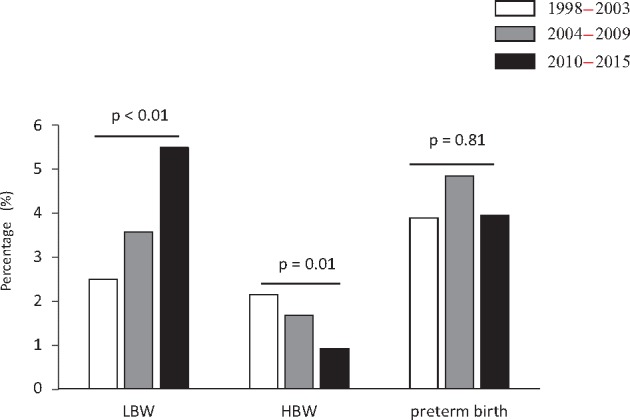
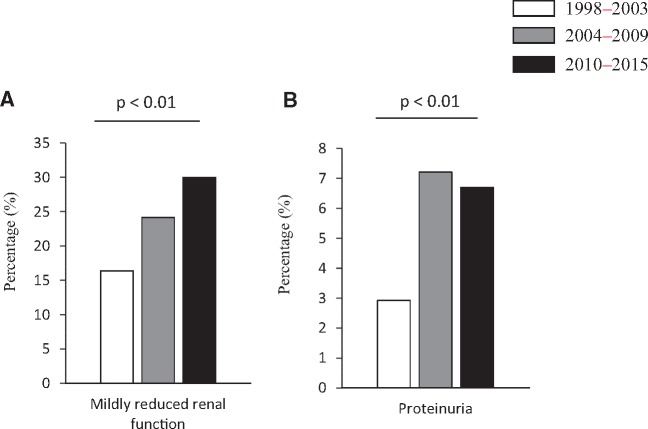
Between the initial (1998-2003) and final (2010-15) periods of the study, the mean birthweight decreased from 3213.4 ± 383.8 to 3116.2 ± 382.3 g and the LBW rate increased from 2.5 to 5.5% (both P ≤ 0.01). Additionally, the mean eGFR decreased from 105.1 ± 15.9 to 97.4 ± 13.8 mL/min/1.73 m2 and the prevalence of mildly reduced renal function (eGFR ≤ 60- <90 mL/min/1.73 m2) increased from 16.4 to 30.0% (both P ≤ 0.01), most evident in the LBW group (from 10.3 to 41.7%, P ≤0.01). The prevalence of proteinuria also increased significantly. Mildly reduced renal function was significantly associated with LBW [odds ratio (LBW 3000-3999 g) 1.51; 95% confidence interval 1.00-2.55; P = 0.047].
In this population of Japanese adolescents, the frequency of mildly reduced renal function increased as the LBW frequency increased. Our findings may have implications for the broader Japanese population as well as for other populations in which the prevalence of LBW is increasing.
低出生体重(LBW)是一个全球性的公共卫生问题,在发达国家(包括日本)的发病率呈上升趋势。LBW 也是慢性肾脏病(CKD)发展的危险因素。迄今为止,尚未有研究评估 LBW 发生率的增加对肾功能的人群影响。
使用 18 年(1998-2015 年)的年度横断面数据,对 3737 名日本青少年男性(15-16 岁)进行估算肾小球滤过率(eGFR)评估。
在研究的初始(1998-2003 年)和最终(2010-15 年)期间,平均出生体重从 3213.4±383.8 降至 3116.2±382.3 克,LBW 率从 2.5%升至 5.5%(均 P≤0.01)。此外,平均 eGFR 从 105.1±15.9 降至 97.4±13.8 毫升/分钟/1.73 平方米,轻度肾功能降低(eGFR≤60-<90 毫升/分钟/1.73 平方米)的患病率从 16.4%升至 30.0%(均 P≤0.01),在 LBW 组中最为明显(从 10.3%升至 41.7%,P≤0.01)。蛋白尿的患病率也显著增加。轻度肾功能降低与 LBW 显著相关[比值比(LBW 3000-3999 克)1.51;95%置信区间 1.00-2.55;P=0.047]。
在日本青少年人群中,随着 LBW 频率的增加,轻度肾功能降低的频率增加。我们的研究结果可能对更广泛的日本人群以及 LBW 发生率增加的其他人群具有重要意义。