Burdon Sanderson Cardiac Science Centre, Department of Physiology, Anatomy and Genetics, Oxford, OX1 3PT, UK.
Department of Physics and Astronomy "G. Galilei", University of Padua, 35121 Padua, Italy.
Cardiovasc Res. 2017 Jul 1;113(8):984-995. doi: 10.1093/cvr/cvx033.
Spontaneous Ca2+ waves in cardiomyocytes are potentially arrhythmogenic. A powerful controller of Ca2+ waves is the cytoplasmic H+ concentration ([H+]i), which fluctuates spatially and temporally in conditions such as myocardial ischaemia/reperfusion. H+-control of Ca2+ waves is poorly understood. We have therefore investigated how [H+]i co-ordinates their initiation and frequency.
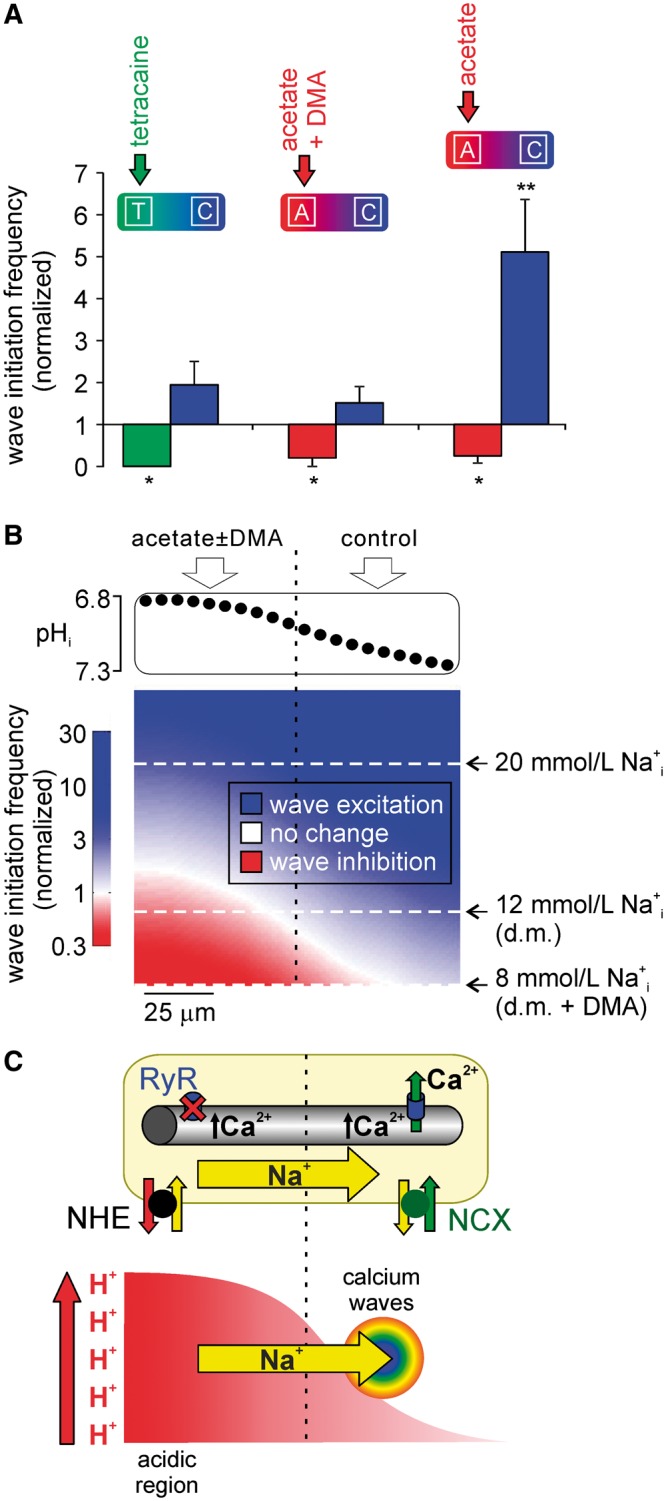
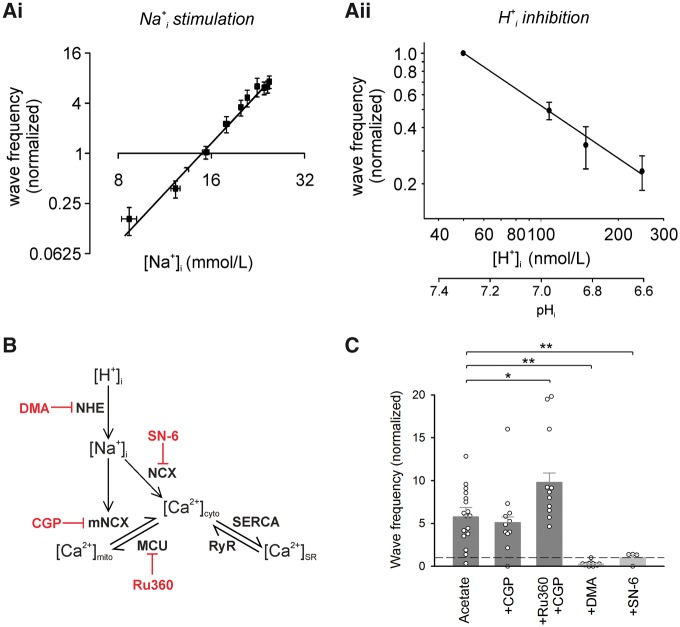
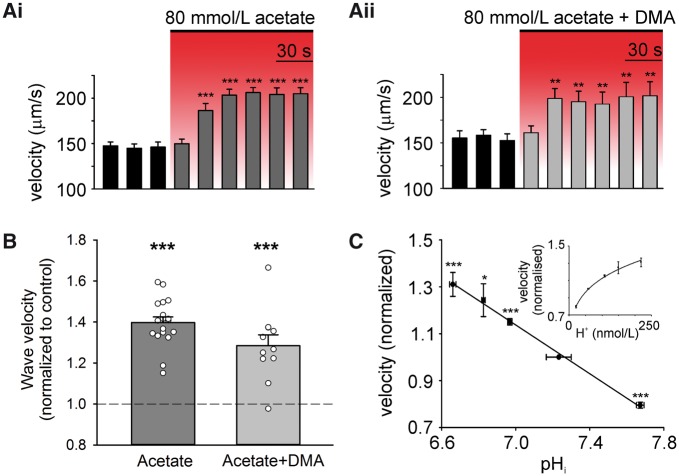
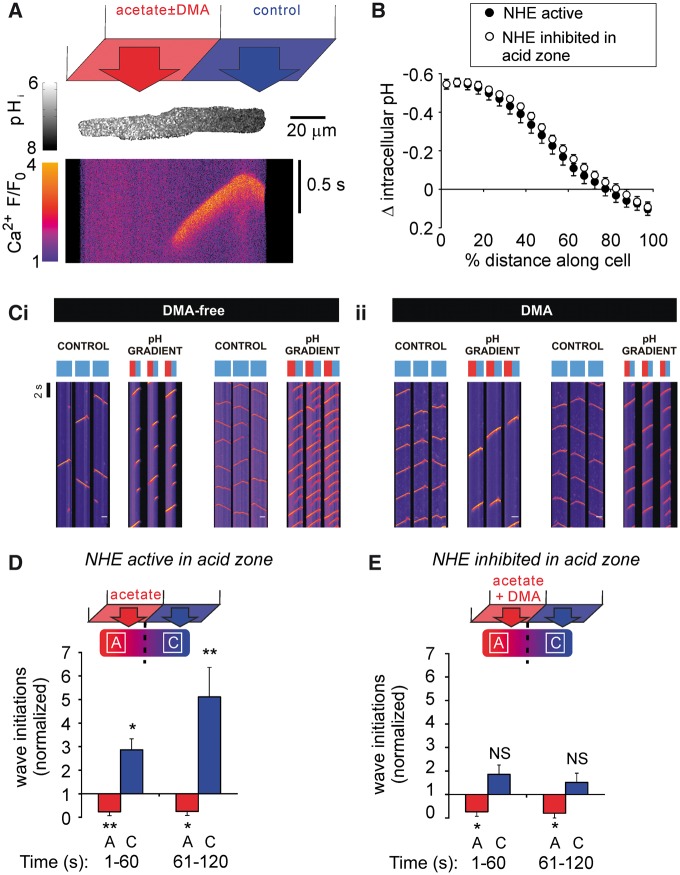
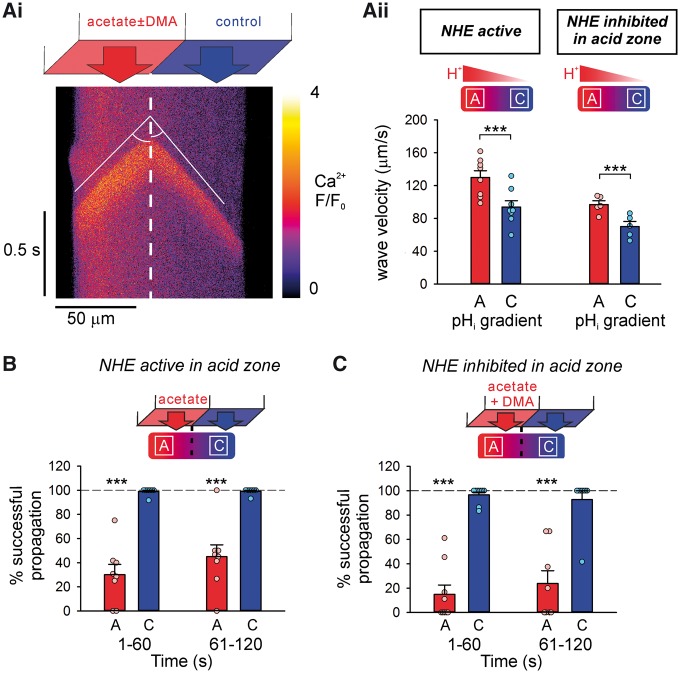
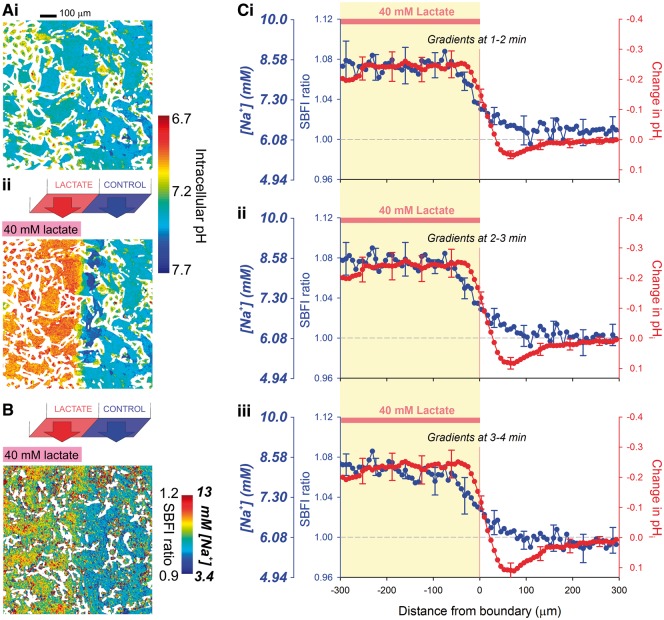
Spontaneous Ca2+ waves were imaged (fluo-3) in rat isolated ventricular myocytes, subjected to modest Ca2+-overload. Whole-cell intracellular acidosis (induced by acetate-superfusion) stimulated wave frequency. Pharmacologically blocking sarcolemmal Na+/H+ exchange (NHE1) prevented this stimulation, unveiling inhibition by H+. Acidosis also increased Ca2+ wave velocity. Restricting acidosis to one end of a myocyte, using a microfluidic device, inhibited Ca2+ waves in the acidic zone (consistent with ryanodine receptor inhibition), but stimulated wave emergence elsewhere in the cell. This remote stimulation was absent when NHE1 was selectively inhibited in the acidic zone. Remote stimulation depended on a locally evoked, NHE1-driven rise of [Na+]i that spread rapidly downstream.
Acidosis influences Ca2+ waves via inhibitory Hi+ and stimulatory Nai+ signals (the latter facilitating intracellular Ca2+-loading through modulation of sarcolemmal Na+/Ca2+ exchange activity). During spatial [H+]i-heterogeneity, Hi+-inhibition dominates in acidic regions, while rapid Nai+ diffusion stimulates waves in downstream, non-acidic regions. Local acidosis thus simultaneously inhibits and stimulates arrhythmogenic Ca2+-signalling in the same myocyte. If the principle of remote H+-stimulation of Ca2+ waves also applies in multicellular myocardium, it raises the possibility of electrical disturbances being driven remotely by adjacent ischaemic areas, which are known to be intensely acidic.
心肌细胞中的自发性 Ca2+波具有潜在的心律失常性。细胞质 H+浓度 ([H+]i) 是 Ca2+波的强大控制器,在心肌缺血/再灌注等条件下,[H+]i 会在空间和时间上波动。目前人们对 H+如何控制 Ca2+波知之甚少。因此,我们研究了 [H+]i 如何协调 Ca2+波的起始和频率。
在经历适度 Ca2+超负荷的大鼠分离心室肌细胞中,通过荧光-3(fluo-3)成像检测自发性 Ca2+波。细胞内酸中毒(通过超灌注醋酸盐诱导)刺激了波的频率。用药物阻断肌浆网 Na+/H+交换(NHE1)可防止这种刺激,揭示了 H+的抑制作用。酸中毒还增加了 Ca2+波的速度。使用微流控装置将酸中毒限制在一个心肌细胞的一端,抑制了酸性区的 Ca2+波(与ryanodine 受体抑制一致),但刺激了细胞内其他区域的波出现。当在酸性区选择性抑制 NHE1 时,这种远程刺激不存在。远程刺激依赖于局部诱导的、由 NHE1 驱动的 [Na+]i 升高,该升高迅速向下游扩散。
酸中毒通过抑制性 Hi+和刺激性 Nai+信号(后者通过调节肌浆网 Na+/Ca2+交换活性促进细胞内 Ca2+加载)影响 Ca2+波。在空间 [H+]i 异质性期间,Hi+抑制在酸性区域占主导地位,而快速的 Nai+扩散则刺激下游非酸性区域的波。因此,局部酸中毒可同时抑制和刺激同一心肌细胞中的心律失常性 Ca2+信号传导。如果远程刺激 Ca2+波的原理也适用于多细胞心肌,则有可能通过已知强烈酸性的相邻缺血区域远程驱动电干扰。