Swietach Pawel, Spitzer Kenneth W, Vaughan-Jones Richard D
Burdon Sanderson Cardiac Science Centre, Department of Physiology, Anatomy and Genetics, Oxford, UK.
Nora Eccles Harrison Cardiovascular Research and Training Institute, Salt Lake City, UT, USA.
Cardiovasc Res. 2015 Feb 1;105(2):171-81. doi: 10.1093/cvr/cvu251. Epub 2014 Dec 16.
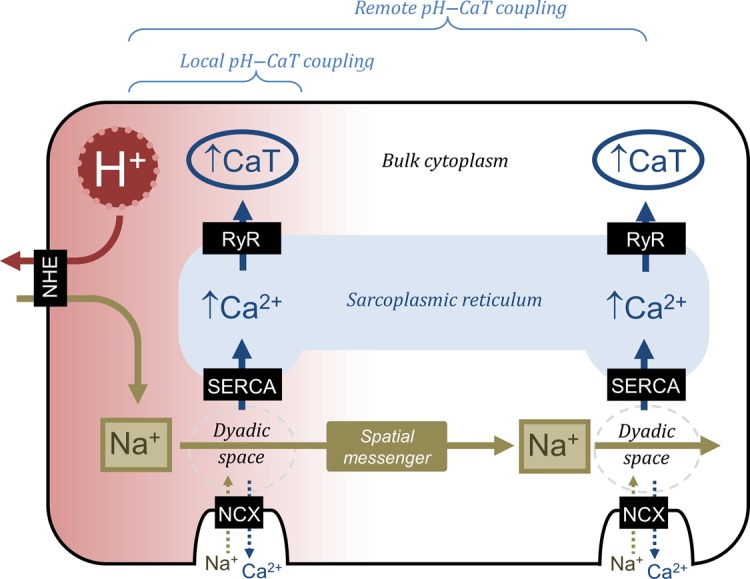
Contraction of the heart is regulated by electrically evoked Ca(2+) transients (CaTs). H(+) ions, the end products of metabolism, modulate CaTs through direct interactions with Ca(2+)-handling proteins and via Na(+)-mediated coupling between acid-extruding proteins (e.g. Na(+)/H(+) exchange, NHE1) and Na(+)/Ca(2+) exchange. Restricted H(+) diffusivity in cytoplasm predisposes pH-sensitive Ca(2+) signalling to becoming non-uniform, but the involvement of readily diffusible intracellular Na(+) ions may provide a means for combatting this.
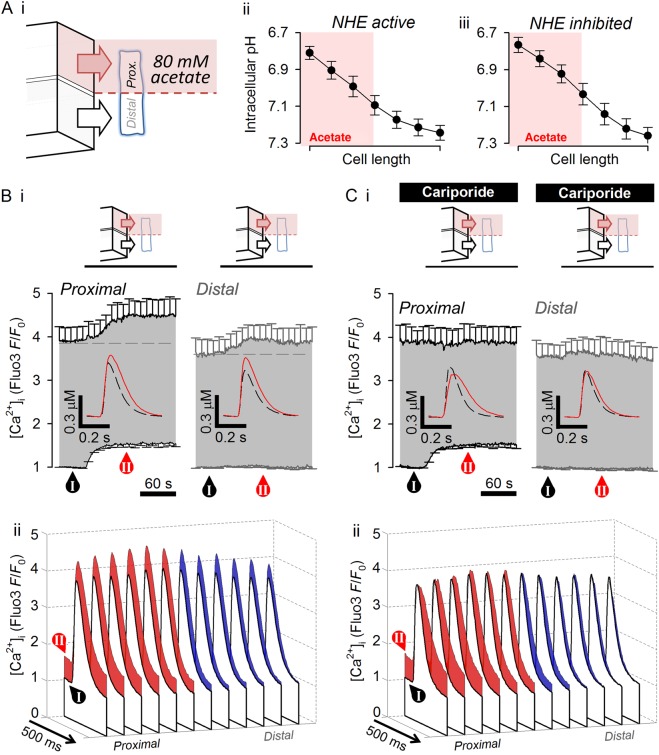
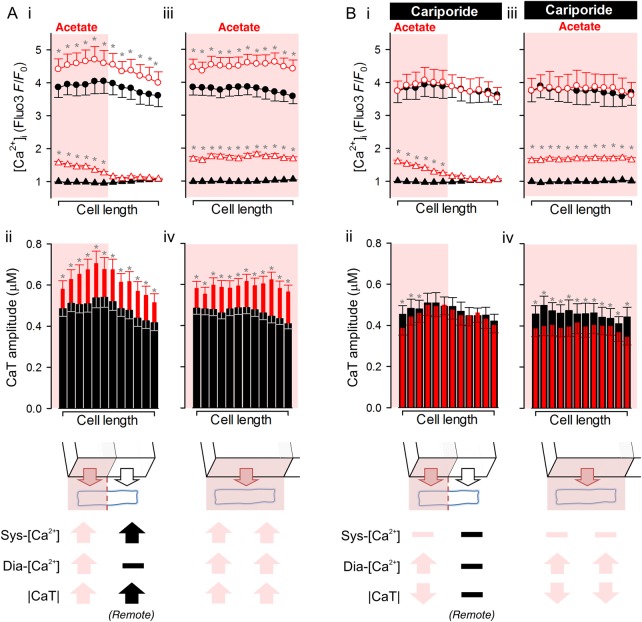
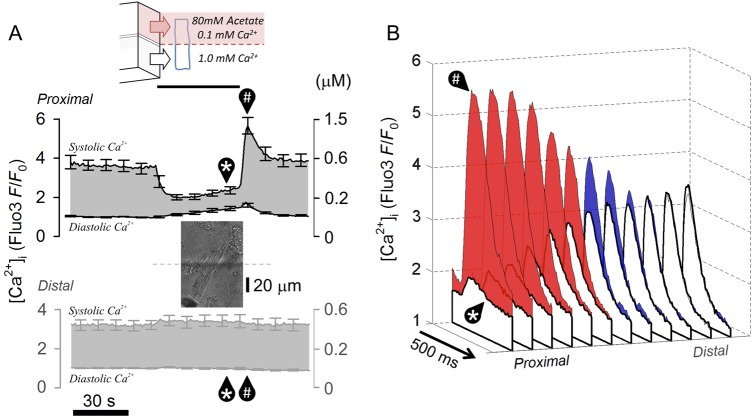
CaTs were imaged in fluo3-loaded rat ventricular myocytes paced at 2 Hz. Cytoplasmic [Na(+)] ([Na(+)]i) was imaged using SBFI. Intracellular acidification by acetate exposure raised diastolic and systolic [Ca(2+)] (also observed with acid-loading by ammonium prepulse or CO₂ exposure). The systolic [Ca(2+)] response correlated with a rise in [Na(+)]i and sarcoplasmic reticulum Ca(2+) load, and was blocked by the NHE1 inhibitor cariporide (CO₂/HCO₃(-)-free media). Exposure of one half of a myocyte to acetate using dual microperfusion (CO₂/HCO₃(-)-free media) raised diastolic [Ca(2+)] locally in the acidified region. Systolic [Ca(2+)] and CaT amplitude increased more uniformly along the length of the cell, but only when NHE1 was functional. Cytoplasmic Na(+) diffusivity (DNa) was measured in quiescent cells, with strophanthidin present to inhibit the Na(+)/K(+) pump. With regional acetate exposure to activate a local NHE-driven Na(+)-influx, DNa was found to be sufficiently fast (680 µm(2)/s) for transmitting the pH-systolic Ca(2+) interaction over long distances.
Na(+) ions are rapidly diffusible messengers that expand the spatial scale of cytoplasmic pH-CaT interactions, helping to co-ordinate global Ca(2+) signalling during conditions of intracellular pH non-uniformity.
心脏收缩受电诱发的Ca(2+)瞬变(CaTs)调节。H(+)离子作为代谢终产物,通过与Ca(2+)处理蛋白直接相互作用以及经由酸排出蛋白(如Na(+)/H(+)交换体NHE1)和Na(+)/Ca(2+)交换之间的Na(+)介导偶联来调节CaTs。细胞质中H(+)扩散受限使pH敏感的Ca(2+)信号传导易于变得不均匀,但易于扩散的细胞内Na(+)离子的参与可能提供一种对抗此情况的手段。
在以2Hz起搏的fluo3负载的大鼠心室肌细胞中对CaTs进行成像。使用SBFI对细胞质[Na(+)]([Na(+)]i)进行成像。通过乙酸盐暴露使细胞内酸化会升高舒张期和收缩期[Ca(2+)](用铵预脉冲或CO₂暴露进行酸负载时也观察到)。收缩期[Ca(2+)]反应与[Na(+)]i升高和肌浆网Ca(2+)负载相关,并且被NHE1抑制剂卡立泊来德(无CO₂/HCO₃(-)培养基)阻断。使用双微灌注(无CO₂/HCO₃(-)培养基)将心肌细胞的一半暴露于乙酸盐会使酸化区域局部舒张期[Ca(2+)]升高。收缩期[Ca(2+)]和CaT幅度沿细胞长度更均匀地增加,但仅在NHE1有功能时如此。在静态细胞中测量细胞质Na(+)扩散率(DNa),存在毒毛花苷以抑制Na(+)/K(+)泵。通过局部乙酸盐暴露激活局部NHE驱动的Na(+)内流,发现DNa足够快(680μm(2)/s),可在长距离上传递pH - 收缩期Ca(2+)相互作用。
Na(+)离子是快速扩散的信使,可扩大细胞质pH - CaT相互作用的空间尺度,有助于在细胞内pH不均匀的情况下协调全局Ca(2+)信号传导。