Shivappa Nitin, Hébert James R, Rosato Valentina, Garavello Werner, Serraino Diego, La Vecchia Carlo
Cancer Prevention and Control Program, University of South Carolina, Columbia, SC.
Department of Epidemiology and Biostatistics, Arnold School of Public Health, University of South Carolina, Columbia, SC.
Int J Cancer. 2017 Aug 1;141(3):471-479. doi: 10.1002/ijc.30711. Epub 2017 May 9.
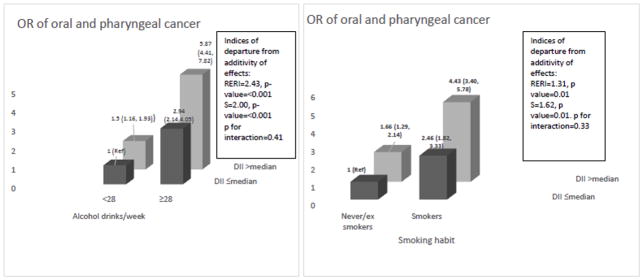
Diet and inflammation have been suggested to be important risk factors for oral and pharyngeal cancer. We examined the association between dietary inflammatory index (DII™) and oral and pharyngeal cancer in a large case-control study conducted between 1992 and 2009 in Italy. This study included 946 cases with incident, histologically confirmed oral and pharyngeal cancer, and 2,492 controls hospitalized for acute non-neoplastic diseases. The DII was computed based on dietary intake assessed by a valid 78-item food frequency questionnaire and was adjusted for nonalcohol energy intake using the residual approach (E-DII™). Logistic regression models were used to estimate odds ratios (ORs), and 95% confidence intervals (CIs), adjusted for age, sex, non-alcohol energy intake, study center, year of interview, education, body mass index, tobacco smoking, and alcohol drinking. Subjects with higher DII scores (i.e., with a more pro-inflammatory diet) had a higher risk of oral and pharyngeal cancer, the OR being 1.80 (95% CI 1.36-2.38) for the highest versus the lowest DII quartile and 1.17 (95% CI 1.10-1.25) for a one-unit increase (8% of the DII range). When stratified by selected covariates, a stronger association was observed among women (OR 3.30, 95% CI 1.95-5.57). We also observed a stronger association for oral cancers and a strong combined effect of higher DII score and tobacco smoking or alcohol consumption on oral and pharyngeal cancer. These results indicate that the pro-inflammatory potential of the diet, as shown by higher DII scores, is associated with higher odds of oral and pharyngeal cancer.
饮食与炎症被认为是口腔和咽癌的重要危险因素。我们在1992年至2009年于意大利开展的一项大型病例对照研究中,考察了饮食炎症指数(DII™)与口腔和咽癌之间的关联。该研究纳入了946例经组织学确诊的新发口腔和咽癌病例,以及2492例因急性非肿瘤性疾病住院的对照。DII基于一份有效的包含78个条目的食物频率问卷评估的饮食摄入量进行计算,并采用残差法针对非酒精能量摄入进行了调整(E-DII™)。使用逻辑回归模型来估计比值比(OR)和95%置信区间(CI),并针对年龄、性别、非酒精能量摄入、研究中心、访谈年份、教育程度、体重指数、吸烟和饮酒情况进行了调整。DII得分较高(即饮食具有更强促炎作用)的受试者患口腔和咽癌的风险更高,最高DII四分位数与最低DII四分位数相比,OR为1.80(95%CI 1.36 - 2.38),DII每增加一个单位(DII范围的8%),OR为1.17(95%CI 1.10 - 1.25)。按选定协变量分层时,在女性中观察到更强的关联(OR 3.30,95%CI 1.95 - 5.57)。我们还观察到口腔癌的关联更强,以及较高的DII得分与吸烟或饮酒对口腔和咽癌具有很强的联合作用。这些结果表明,较高的DII得分所显示的饮食促炎潜力与口腔和咽癌的较高发病几率相关。